

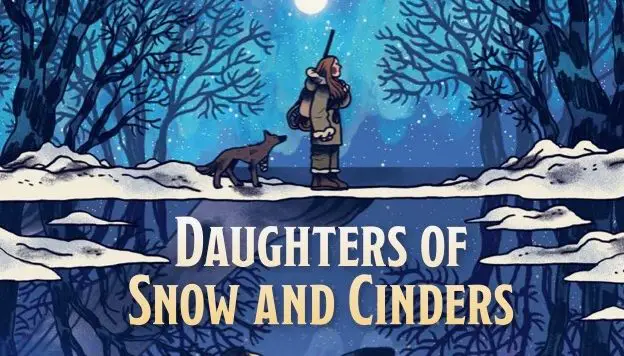

Spanish illustrator and cartoonist Núria Tamarit, who earned a master’s degree in design and illustration at the Polytechnic University of Valencia, has long been known in her native Spain as an independent creator and publisher of award-winning fanzines and comics. Described by Fantagraphics as “Princess Mononoke meets Jack London,” Daughters of Snow and Cinders is her first graphic novel by to be translated and published in English.
The story follows Joana, a young, independent woman who is determined to flee her post-colonial, war-torn homeland. Traveling beyond her own realm for the first time, she has come in search of gold, with which she hopes to rebuild her life. Along the way she meets a dog she names Peg, two indigenous women in Tala and Opa who become her allies, and a cruel, ruthless treasure hunter named Matwei.

Fantagraphics
As the title suggests, the primary setting is a barren, frozen world of ice and snow. Intriguingly, Tamarit forgoes the predictable color palette of dreary grays and stark whites in favor of wooden browns, a stunning array of haunting blues and purples, and the fiery deep oranges and reds of the majestic northern sunset. Tamarit’s intricate line work, rich textures, and lush color palette create an immersive, dreamlike world that feels equal parts creation myth and post-apocalyptic future.

Fantagraphics
This harsh duality is further accentuated by flashbacks to a green, sun-drenched world of plenty. “Back home ‘wealth’ wasn’t the worth of a golden metal,” thinks Joana, as she remembers walking through a cornfield with her grandmother. “It was something else. It was the golden color of the sun…or maize. Lemon, quince…. But here, all dreams of wealth depended on a tiny yellow rock.”
Similarly, in another flashback, Joana’s grandmother tells her that the land is hers, but not her property. “The land belongs to you, because it is part of you,” the grandmother explains. “Because it is you.”
Whereas the grandmother figure embodies notions of stewardship, protection, and living in harmony with nature, Matwei—the colonizer—sees the natural world as something to be exploited. After enlisting Tala for her tracking skills in his quest to find gold, Matwei cautions her, “And I warn you not to try anything funny. Cos if I don’t get any gold, you won’t get enough air to breathe.” Head bowed, Tala responds, “I know Matwei. And I know where I’m going. This land is my home.” Standing over her menacingly, Matwei says, “Your wrong, Tala. This land belongs to me. It is my realm.”
Whereas the female characters are generally well-developed and relatable, Tamarit relies too heavily on cartoonish, well-established tropes to define the male characters, whose roles are purely that of the villain. Matwei, the primary antagonist, comes across as little more than a two-dimensional misogynist with no redeeming qualities and a megalomaniacal case of gold fever.
In much the same way, Tala’s father Hunter—who appears in the story just once—is wholly defined by being an abusive patriarch who beats his dogs to death for barking too much. Semiov, the only other male character of note, is the classic Noble Savage. He remains mostly silent, speaking only when spoken to, as he helps Matwei achieve his violent, rapacious goals. All without a murmur of resistance. I am not asking to see some kind of avaricious-yet-kind “colonizer with heart,” but the heavy-handed messaging makes the story more didactic and less engaging.

Fantagraphics
Notably, the three indigenous characters—Tala, Opa, and Matwei—are physically scarred and bruised, whereas “Old World” white characters are not. Certainly, this detail is meant to be read as a metaphor for indigenous perseverance—and survival—in the face of wanton death and destruction perpetrated by European aggressors, but it’s also highly reductionist. It pushes Joana toward the role of White Savior, here in part to liberate her native allies who were merely surviving until she came along.
Ultimately, assuming you can get past moments of slow pacing and some pretty overt moralizing, Daughters of Snow and Cinders is a gorgeously illustrated ecofeminist epic that explores philosophical themes of greed, betrayal, companionship, and the fight for survival. Visually, Tamarit knocks it out of the park. The script, however, could stand some nuance and complexity.




You must be logged in to post a comment Login