

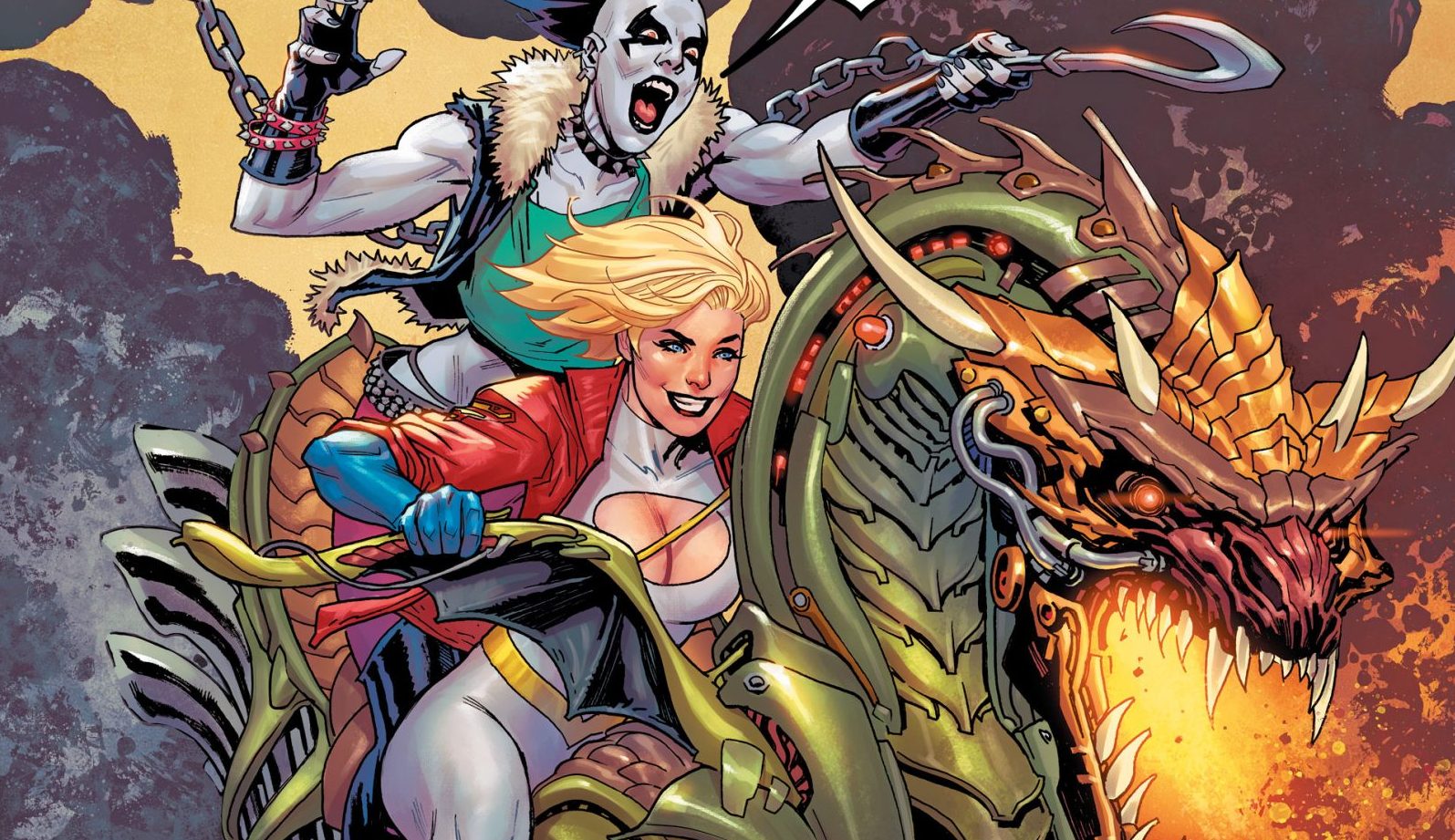

“Girly-pop, my self-confidence is fine. I had you on my back within two seconds of us meeting!”
Queueing up a two-part tie-in to “House of Brainiac”, this concluding issue is one of the strongest entries in regard to the event’s side stories. Paralleling the style of Joshua Williamson’s Superman, Leah Williams and Eduardo Pansica continue to channel the 1990s in how the Superfamily operates in Metropolis as Power Girl defends it solo. Focusing more on being a loose companion tale about Lobo’s daughter Crush amidst the Czarnian chaos gives the story an upper hand over the event’s other tie-ins.
Creating an atmosphere focused less on expanding the lore of the current onslaught, Williams hones in on the absurd and wild with Crush and the Holiday Girls; tangentially, Paige is forced to push aside her emotions to protect the city from the inside while her doppelgänger, Supergirl, is stuck in Brainiac’s ship trying to find a way to protect the city from the outside.

DC Comics
The story never needed to allude to how Supergirl was feeling or how Omen was feeling while they were both trapped in the ship because at the end of the day, it’s Power Girl’s story, which is a good way to keep focus in modern event tie-ins. While there is nothing particularly wrong with choosing to add more to the event, sometimes what you need is a good beat-em up story with a lesbian and her crew of former Wonder Woman side characters with a dash of self-hatred on the side.
Despite the fun action and wacky script, Williams hasn’t had the cleanest streak in regards to this storyline’s connection to the book’s main focus: Symbio, the physical manifestation of Power Girl’s Kryptonian rocket. Particularly with their connection to our story’s heroine, Williams scatters Symbio fairly randomly across the arc, and while their scenes are entertaining and compelling, they serve little purpose to the plot in any real capacity. This setup for Symbio makes for slightly awkward pacing during cuts from scenes with Power Girl and Crush.
Symbio’s only beneficial scene happens on the final page as we are shown the fate of Power Girl’s enemies, which is a very effective story sequence that teases a higher stakes future for the series. With that, Symbio’s purpose in the arc is fulfilled in just that one scene. As a concept and character they are striking, but the more they’re put into random scenes, the more their strong horror overtone suffers. Symbio stalking Paige is a strong story beat that needs to be tackled more subtly.

DC Comics
Regardless, what keeps these scenes strong is Pansica’s art. Though he had a slightly awkward beginning on this series, Pansica has managed to surpass his work on both Power Girl and Supergirl; every page during this arc balances horror, action, and comedy in each spanning scene. The new coloring also makes a significant difference in Pansica’s work, with the flatter colors better accentuating the line work and thus presenting a colorful display that makes the book really pop. Another highlight of Pansica’s work is how he draws Crush and the Holiday Girls, with every scene with them feeling ridiculous and stupid in the best ways. Especially with additions such as Dawg, Lobo’s old canine companion, and the various motorcycles that Pansica clearly had a blast drawing.
Overall, Power Girl #10 is a fun conclusion to the book’s first event tie-in with some of Williams’ most engaging action and Pansica’s best work. Despite the overexposure with Symbio, we are curious to see where Williams and Pansica take the book next.



You must be logged in to post a comment Login