

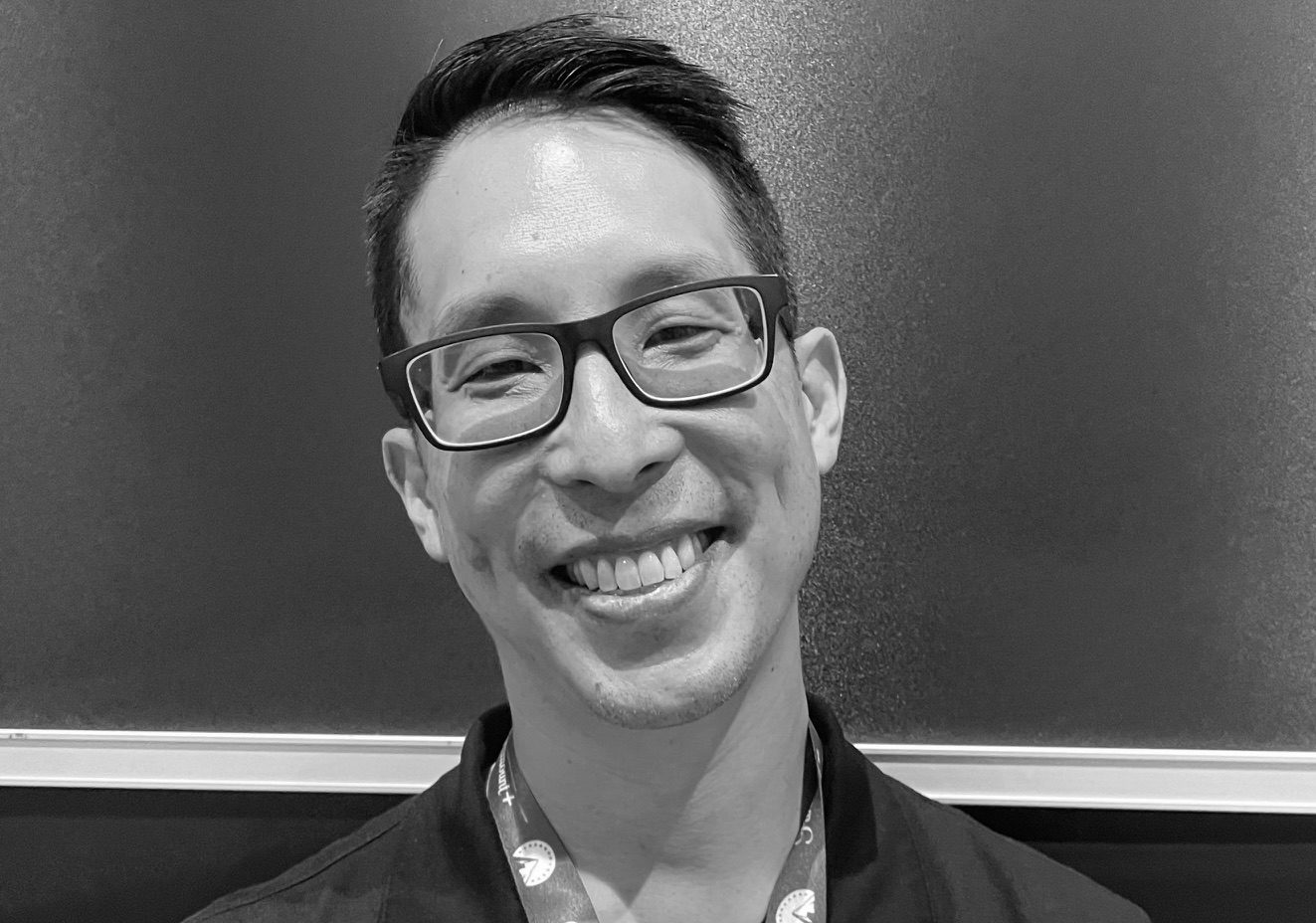

Gene Luen Yang is one of the most impactful cartoonists currently working in the industry, becoming a household name thanks to his acclaimed works American Born Chinese, Dragon Hoops, and Superman Smashes the Klan. In addition to writing and drawing comics, he is an educator and a National Ambassador for Young People’s Literature. This interview was conducted at the 2024 San Diego Comic-Con.
AIPT: Let’s start with Lunar New Year Love Story, a book you did with LeUyen Pham. It’s a great work, it received awesome press. And seems to be part of a recent wave of graphic novels from Asian American creators about their experiences being children of immigrants while growing up American. How do you think this new book builds on the biographical material you’ve already created?
Gene Luen Yang: When LeUyen Pham, my collaborator and I first started talking about it, we did talk about wanting to do an Asian-American rom-com. That was what we set out to do. But as the project went on, we realized that we wanted the Asian-American-ness to be infused in the story, as opposed to being highlighted by the story. What that meant was the characters would be Asian-American, they would be in an Asian-American environment, specifically in the Asian-American community of Oakland, but we didn’t really want to necessarily have the story itself call out the experience itself. Like American Born Chinese, right? American Born Chinese is very much about the struggle that comes with being Asian American sometimes, which comes with being caught in between two cultures.

But Lunar New Year Love Story, we wanted it to be about two people falling in love. And the Asian American-ness is just part of the environment in which they fall in love. It’s not necessarily about them wrestling with their identities or anything like that. It’s kind of part of the tapestry of that.
AIPT: You also have done some awesome superhero fare as well, but as a teen librarian, I see the autobiographical comics checked out with more vigor and enthusiasm. What do you think has changed with young comic readers? Do you feel like there’s been a difference in the way it’s marketed, or do you feel like the stories themselves are connecting better?
GLY: I think there are lots of things that have changed in the comic book market between when we were kids and now. The big thing is I think there’s genre diversity now. When we were kids, it was just superhero stuff, right? But now there’s genre diversity. I would talk that genre diversity to these changes that happened in the early 2000s. First there was this big influx of manga.
When I was in high school in the ’80s and early ’90s, manga was very niche. There would be just a handful of kids on every campus that would read manga. And then for whatever reason it exploded in the early 2000s. And manga is genre-diverse. There are manga stories set in every genre that are targeted at every age demographic. Some of that bled over into the American graphic novel market. So I think that’s what kids are responding to. They’re sort of responding to the fact that there are graphic novels for every age demographic and there’s genre diversity within graphic novels. And the second change during the 2000s was people figured out what a graphic novel was. Before that, that was not a term that was popular.
AIPT: For sure. I feel like in the library industry, we probably helped make that term a thing, if only because parents would say no to their kids getting comics, but we told the parents it’s a graphic novel they’re like “oh, okay!” Seeing that you publish both superhero and biographical books, how do you define yourself as a comic creator?
GLY: I grew up reading superhero comics, mostly because those were like really the only comics that were around. I do have a special place in my heart for superhero comics, but at the same time, I’m really glad that those are not the only kind of stories that are being told in American comics. I would say, I just like comics, period. And I’m happy to do any sort of comics, and that includes superhero comics.
AIPT: You’ve now done a lot of different books with a lot of different collaborators. You’ve not just touched on different styles, but different approaches to storytelling. Do you feel like your process for creating Books of Clans, as well as Lunar Love Story, were different than your creative process that came before it?
GLY: The way I worked on those books is very similar to the way I do books for Marvel and DC. For Marvel and DC, I write a script, there’s not really any pictures in it. It looks a little bit like a screenplay, so I turn in a bunch of words. For my books for First Second, I write in thumbnails. So I do sketches of what every page looks like. And that’s true even if I’m not drawing the final product.
AIPT: I picked up the Books of Clans book with my daughter at your event at the Schultz Center. She really likes it. Why did you decide to do the Clash of Clans comic series? What made you interested in the property?
Gene: That was something that Mark Siegel, my editor, and I had been chasing for a very long time. We both have sons. My son is about 20, his son I think is 19. And when they were like 10 years ago, we started playing the Clash games. He really loved them. And then Mark’s family and mine would play together. So that became kind of a way in which our two families connected. For a very long time, our kids were in a clan together. And ever since then, Mark and I have wanted to do the Clash comics, but it just took a long time to set up the meetings and to talk with them. We’re really thrilled to be able to do it.

AIPT: Other than meeting with fans and sharing your work, what do you most enjoy about coming to San Diego Comic-Con? Anything you like to do at the con or in the city?
GLY: San Diego’s a beautiful city. San Diego Comic-Con is all sunshine and comics! It’s really interesting to see how the community around Comic Con has grown. I came to my very first Comic Con in the mid-’90s. Back then, the comic book industry was not doing very well. I remember on Sunday, it was kind of a ghost town. It felt like there were more exhibitors than there were attendees. And the gender balance just wasn’t there either. To see it now, it seems like comics as a medium speaks to a much broader audience. It speaks to a much more diverse audience in every sense of the word diverse. Age diversity, gender, all the different kinds of diversities, which has been really nice to see. And I think as a result of that, you see this massive popularity of Comic-Con. Back in the ’90s, you could buy a ticket at the door on the day of. And now, it’s not like that.
AIPT: I was at Comic-Con in the mid-’90s, and you are right, the diversity you see today just wasn’t there. You also brought up manga, and I remember in 1996, I would bring back books in Japanese to my hometown in the desert, and no one had ever seen any of these things, and that was the only way we had access to Sailor Moon or Dragon Ball Z stuff; it was a difficult time to be a fan. Speaking of comic book memories, what’s your favorite Marvel or DC run/arc/storyline of all time?
GLY: My favorite Marvel arc, when I was in high school, was the Peter David’s Hulk. I think they drew on a lot of that for the Hulk movies, right?
AIPT: For sure, absolutely.
GLY: So where he went gray for a little while, and then he went back to green and then he integrated all of his personalities. That was mind-blowing to me when I read that.
On the DC side, I’ve always really liked the quirkier DC stuff. I really like Justice League International. I loved all the Justice Leagues, actually. So the Giffen and DeMatteis stuff, I really, really love.
AIPT: I can see that in some of your work.
GLY: Yeah, when I started working on superhero comics, I was given the advice by somebody who worked for one of the companies that I should try to write like Frank Miller. And I told them that I don’t really want to write like Frank Miller, I want to write like Giffen and DeMatteis.
AIPT: Lastly, what do you have in development that you want your fans to know about?
GLY: We have more Books of Clash coming out. We have book four coming out this fall with eight books total that are planned. Then I’m also a part of the new imprint, 23rd Street, which will be putting out graphic novels targeted at adults.



You must be logged in to post a comment Login