



In 2005, a team of religious studies scholars at Baylor University, in a now well-cited study, demonstrated that the belief in ghosts, UFOs, cryptids, and the lost continent of Atlantis were not restricted to the fringes of American society, but are actually mainstream. This surprised the researchers, because they assumed that mainline Protestantism had little tolerance for such Fortean speculations. What the Baylor Religion Survey and a subsequent study published in the 2008 Review of Religious Research showed, however, was that not only are such beliefs readily entertained by many Christians, but often considered proof of their faith.

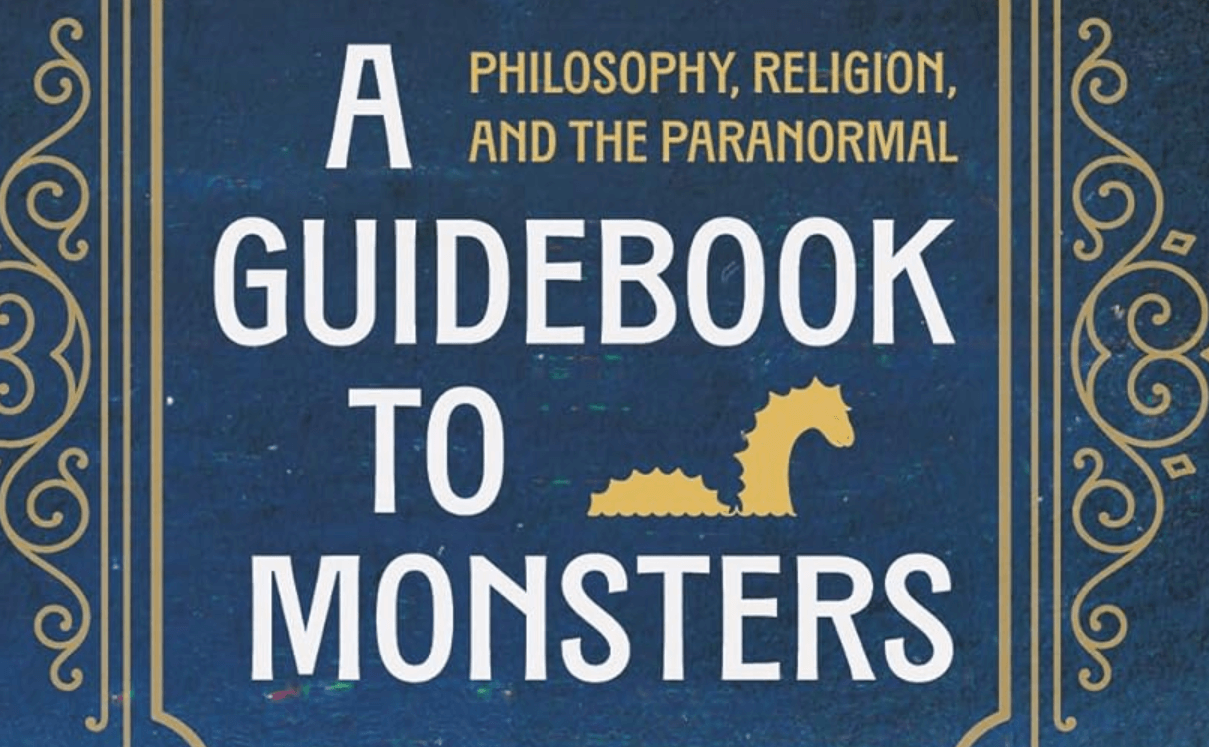
Further evidence of the smooth blending of American Christianity and the paranormal can be found in Ryan J. Stark’s new A Guidebook to Monsters: Philosophy, Religion, and the Paranormal (Cascade Books, 2024). Stark is a professor of humanities at Corban University, a small, private, Christian college in Oregon. Despite the silhouette of a Nessie-type lake monster on the cover, A Guidebook to Monsters has nothing to do with cryptozoology and everything to do with supernatural evil. At only 88 pages, including bibliography and index, it’s also not much of a guidebook, but more of a long essay.
In A Guidebook to Monsters‘ introduction, Stark notes the uptick in academic interest in monsters since the late 1990s. He also echoes Jeffery Kripal’s critique that much of this scholarship has failed to consider monsters as anything other than complicated metaphors. Stark writes that in response, some scholars have made the concession that monsters may be “phenomenologically actual” – real to those who believe in them. But Stark wants to argue that monsters are simply “actual,” regardless of if one believes in them or not, though he acknowledges his evidence is more metaphysical than empirical.
A Guidebook to Monsters is then divided into eight chapters, each of which highlights a different type of “monster” — vampires, werewolves, zombies, ghosts, robots, Leviathans, Devils, and aliens.

Stark begins with vampires, because he’s concerned by how these once feral revenants have been reimagined as ideal boyfriends in books like Twilight. Such humanizing of the demonic speaks to a fundamental misunderstanding of “evil’s ontology and our relationship to it.” It’s not for us “to redeem the irredeemable,” as “only Christ can enter the gates of Hell unaffected.” In short, “the vampires are not ours to save.”
Fair enough. But does any of this mean vampires are real, as implied in A Guidebook to Monsters‘ introduction? Stark’s ambiguous on this point. He may or may not believe in the literal reality of vampires, werewolves, and zombies, but he does maintain that these fictional monsters point to an underlying spiritual reality, a world of angels and demons locked in combat for the souls of mankind. Stark does make it abundantly clear that he does believe in the reality of ghosts, for which he argues a biblical basis exists. He even writes that AI and social media algorithms could become possessed by demons, as seen in season 1, episode 8 of Buffy the Vampire Slayer.
Rounding out A Guidebook to Monsters, chapters 6-8 represent a mostly unbroken train of thought concerning ufology and ancient aliens. Naturally Stark casts aspersions of those – ranging from H.P. Lovecraft to Giorgio Tsoukalos – who insist that religion’s many gods and demons are simply misidentified extraterrestrials, rather than real, spiritual entities, as proclaimed in the Bible.
Nevertheless, Stark also seems willing to grant some credence to certain ancient alien-type musings, including the suggestion “that the Ark [of the Covanant] was a radioactive pulse canon,” and Jonah’s whale “an ancient submarine.” Not willing to dismiss UFOs as a legitimate phenomenon either, Stark further speculates that the reality behind that phenomenon is – no surprise – likely that of angels and demons. But mostly demons, which would explain both the Nazis and Marxists’ interest in them.
A Guidebook to Monsters concludes its chapter on aliens by encouraging readers to continue freely engaging in this sort of conspiratorial thinking:
“Why the elaborate deception at Roswell? Why the staged photographs? Why the cover-up at Cape Girardeau, Missouri, in 1941, where a Baptist pastor allegedly prayed over a dying alien? When did JFK tell Marilyn Monroe about flying saucers, and to what end? Do UFO stories impress women? How did Bob Lazar hear about element 115? How much helium-3 is on the moon, and, while we are on the subject of the moon, who built it?”
Stark thinks these questions eventually lead to the truth of Christianity, the same way Agent Scully of The X-Files eventually returned to her lapsed Catholicism.
Readers of my usual reviews are decidedly not the target audience of A Guidebook to Monsters, which often feels like a devotional designed to be read by Christians during the week of Halloween. Sill, I’d encourage those interested in the intersection of the paranormal and religion to give it a look anyway. Not only is it a quick read, but Stark is a good writer who displays a genuine sense of humor and a breezy, inviting prose style. The reader never feels like they’re being preached to here – though they certainly are.
It’s worth noting A Guidebook to Monsters‘ approach to secular popular culture. Rather than warning readers away from horror novels, monster movies, and comic books, Stark readily cites them, and encourages the consumption of such media, in the spirit of C.S. Lewis’ dictum that “a young man who wishes to remain a sound atheist cannot be too careful of his reading.” In other words, those who regularly consume supernatural fiction are more likely to come to believe in a supernatural reality. In saying this, Stark demonstrates his own awareness of the feedback loop between religion and pop-horror so deftly described by Jospeh Laycock and Eric Harrelson in The Exorcist Effect (OUP, 2023).
AIPT Science is co-presented by AIPT and the New York City Skeptics.


You must be logged in to post a comment Login