

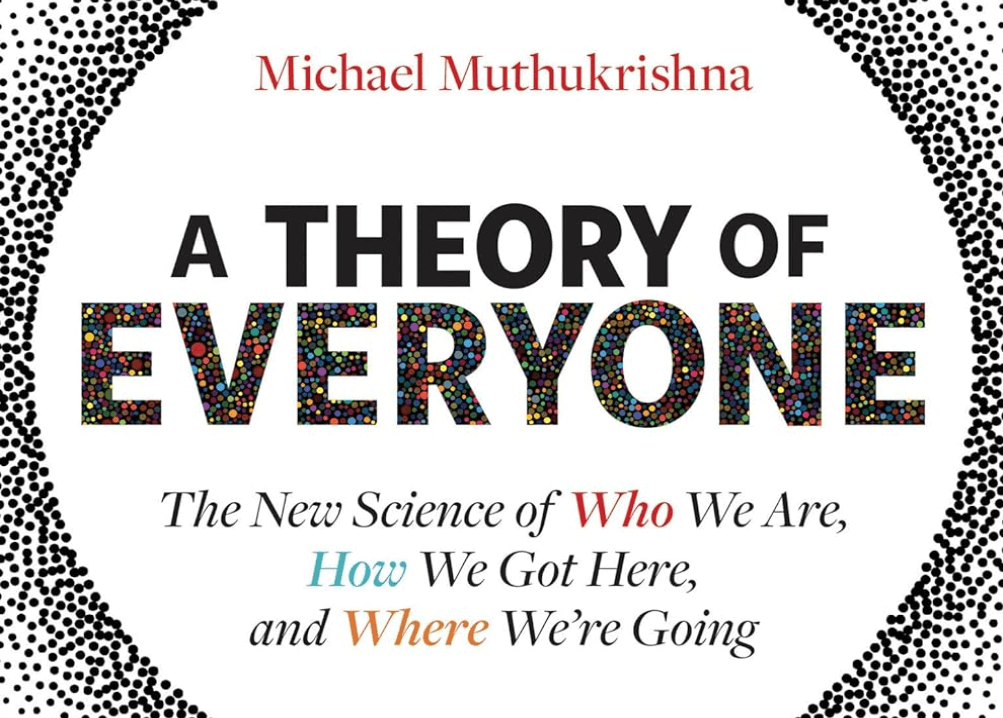

The marketing blurb for the 2023 book Michael Muthukrishna, promises “a science-based introduction to cultural and human evolution,” and “a blueprint for a better future.” A version of the following review of that book was first published here.
Part I of Theory of Everyone attempts to differentiate genetic, cultural, and individual intelligence. Muthukrishna makes a strong case that humans rely on cultural sources of information as well as social mimicry. One thing that sticks out is an anecdote about ravens being smarter than human children, which refers to a study in which ravens were able to solve a puzzle without help, but human children given the same puzzle couldn’t. Muthukrishna’s point is that there are different kinds of intelligence and even among life on Earth, some animals may outperform humans, but ultimately cultural intelligence allows us to learn much more over time than any other species.
Energy Return on Investment (EROI) and levels of cooperation are two more big concepts in Part I, which Muthukrishna weaves into his Theory of Everyone. According to him, “[…] history has shown us that every major civilization has been crushed by a falling energy ceiling — as their space of the possible shrank, they were defeated by forces both outside and within.” EROI refers to an economic measure that’s meant to be a proxy for energy budget: how expensive or difficult it is to power work. The term was originally coined in the 1970s by systems ecology professor Charles Hall.
Muthukrishna estimates Western countries had plentiful and cheap energy sources from the 1940s through the 1960s, but now we’re in a Great Stagnation due to the continued increase in the cost of energy. He thinks we need big advances in energy production and, in particular, thinks that we need to unlock nuclear fusion to truly achieve a new era of plentiful and cheap energy. In turn, this new era will increase wealth creation. Theory of Everyone also points out challenges humanity could face if that new era comes about. “It may be counterintuitive, but a more equal society is one in which genes play a greater role in success,” Muthukrishna says.

In Part II of the book, “Where We’re Going,” we come face-to-face with the limitations of the Theory of Everyone. For example, Muthukrishna suggests that some of our social troubles could be ameliorated by adjusting national immigration policies so that those with demographic profiles associated with success (economic success specifically) are given preferential admittance. Additionally, national immigration agencies could provide compulsory acculturation education to all immigrants.
Neither of those ideas is new. Muthukrishna also doesn’t have a solution for things like mass migrations caused by global warming. Even more damning, acculturating millions of climate migrants would seem to be an impossible task under current EROI.
In chapter 8 of Theory of Everyone, “Governance in the Twenty-First Century,” Muthukrishna becomes dreamily techno-utopian. He even writes, “[we have] three main lines of information — genetic, cultural, and individual learning […] Machine learning is the missing line of information […] It is the combination of cultural and individual learning.” He suggests decentralized autonomous organizations (DAOs) as models for future governance. Members of DAOs vote on changes to regulations and policies which are encoded in the blockchain structure of the organization itself. Programmable politics. The code is law.
However, Bloomberg’s Matt Levine points out the inherent difficulty of assigning responsibility and ownership in DAOs, not to mention that blockchain technology is a notoriously resource-intensive activity. As things stand now, it’s hard to see a reasonable EROI here. Even if we scale this down to a smart city project, Alphabet’s abandoned attempt to implement the Sidewalk Toronto smart city project is a glaring testament of how and why such projects tend to raise serious questions of surveillance and governance.
We can be charitable and look at Theory of Everyone‘s solutions through a more limited lens: a single startup city and stricter immigration policies in a small region could drive pockets of innovation without requiring entire nations to directly participate. But in chapter 9, “Shattering the Glass Ceiling,” Muthukrishna goes back to suggesting well-known, national-scale policies. He suggests we tax generational wealth at extremely high rates and convert tax structures to one predominated by a land tax.
Muthukrishna believes those will level the playing field and help refocus a meritocracy that’s been marred by nepotism. “Are [billionaires’] children really best placed to have that much control over the vast portion of our energy budgets that their parents’ wealth represents?” Muthukrishna asks. “The answer is that if they were, they would similarly and independently achieve levels of wealth as their parents did without that inheritance.” Whether or not you agree, it’s hard to see how the Theory of Everyone helps us overcome the political and ethical questions here.
Chapter 12 of Theory of Everyone achieves a new level of navel-gazing. Muthukrishna begins by writing that the “format of the school day […] need not be 9 a.m. to 3 p.m.” He explains, “An alternative arrangement would be one that matched a typical adult working day.” He doesn’t clarify what that means for parents who work long hours or irregular shifts.
Muthukrishna is writing from a very narrow perspective: his own. This leads him to over-promise his Theory of Everyone and vastly under-deliver on solutions. In particular, the broad problems we face as a civilization aren’t clarified much by his theory. Worse, his solutions only work if we fully buy into his ideas of wealth creation and career success.
AIPT Science is co-presented by AIPT and the New York City Skeptics.



You must be logged in to post a comment.