

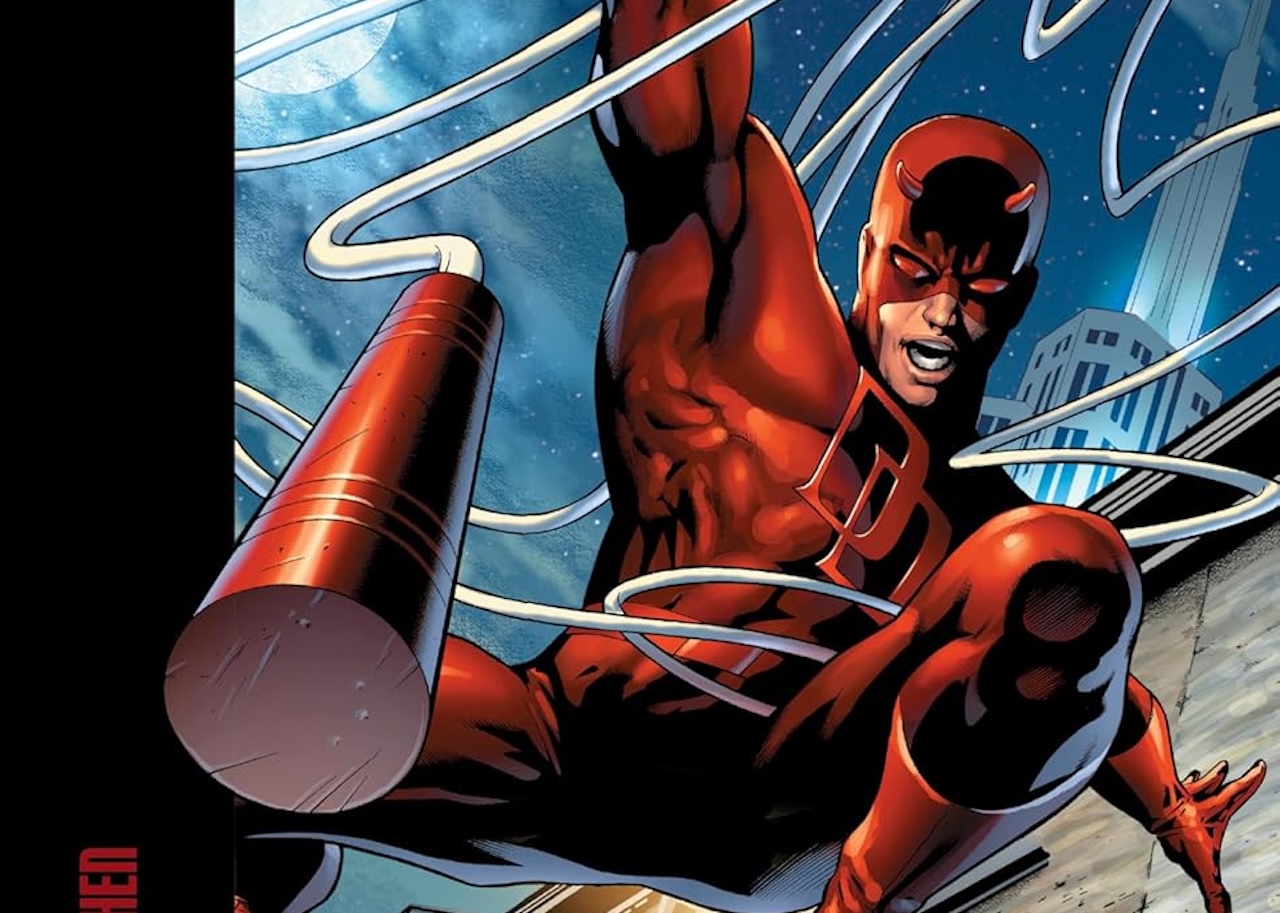

Daredevil Modern Era Epic Collection: King of Hell’s Kitchen begins without Daredevil; it also begins without the best-selling creative team that had redefined the series, Brian Michael Bendis and Alex Maleev.
Instead, the first five issues of the collection are left in the very capable hands of an artist who had already made a mark on the series a few years previous: David Mack, who takes on not just the art but the writing as he expands on his major contribution to the Marvel Universe, Echo.
It should be noted how bold of a choice this is, to give almost half a year of publishing of a character’s solo book to another character altogether. To do so having left readers on a massive cliffhanger – Daredevil has just bested Wilson Fisk and declared himself Kingpin of Hell’s Kitchen – feels rather unthinkable now. Imagine any other solo comic title undergoing such a dramatic shift before veering focus to a mostly minor supporting character; it’s like if Superman died in 1992, and then his title was handed over to Silver Banshee for six months.

Marvel
What’s remarkable is that it works. David Mack’s deep dive into Echo’s character might have felt like a diversion, but it felt worthy. Mack and Echo had won readers over during her Parts of a Hole storyline three years earlier. The character had become a sleeper fan favorite, and Mack’s over-the-top art experiments, no matter how extreme, were thrilling to see in a superhero trapping.
And Mack is experimental here: Echo begins her narrative explaining that her story ‘doesn’t happen in words’. “I’m deaf,” she says (spelling this out in Scrabble tiles), “so if something does happen in words, it doesn’t happen in the sound of words, but in the color of them. The mood and texture and mystery of their crossword puzzle meanings.”

Marvel
To reexamine the comic book narrative in the spirit of this sentiment, Mack employs all manner of artwork styles, from Echo’s thoughts scrawled into corners to real-world objects laid out in stunning collage. The only “normal” comic panels – grids with standard dialogue flow – are those she shares with Daredevil himself; even a later interaction with Wolverine (of course), which happens in the dreamlike haze of a vision quest, is relayed abstractly rather than directly.

Marvel
It’s only five of the volume’s 16 issues, but it feels like the highlight not just of the book but of Daredevil in 2003 and 2004; when the story returns to Matt (and Bendis and Maleev), the story collapses into the turbulent normalcy of Matt’s life a year after his startling declaration. It’s the story, once again, of Matt Murdock’s life crumbling around him.

Marvel
It isn’t a low point in this era of Daredevil – it’s packed with great character beats, dynamic action, and super-powered friends reaching out to try and understand Matt’s headspace – but after Echo it feels middling. It moves too quickly in that we don’t see Matt’s year as Kingpin, only his seeing-the-light moment. If you blink the story is wrapped and we’re onto a Black Widow team-up story: action-packed but somehow disconnected from the main narrative.

Marvel
Daredevil Modern Era Epic Collection: King of Hell’s Kitchen is three disparate arcs of one of Daredevil’s greatest runs, and they vary so widely in subject and quality that the volume feels scattered, together for the important project of cataloging a chronology rather than containing a single artistic sentiment. It’s a turbulent two years of the book, but those years are wonderfully experimental, emotional, and full of action.
Most importantly, they continue the trend of deepening these characters, realizing relationships in ways they had never been explored before. Daredevil continued to make these characters human and charged with delightful flaws.




You must be logged in to post a comment.