

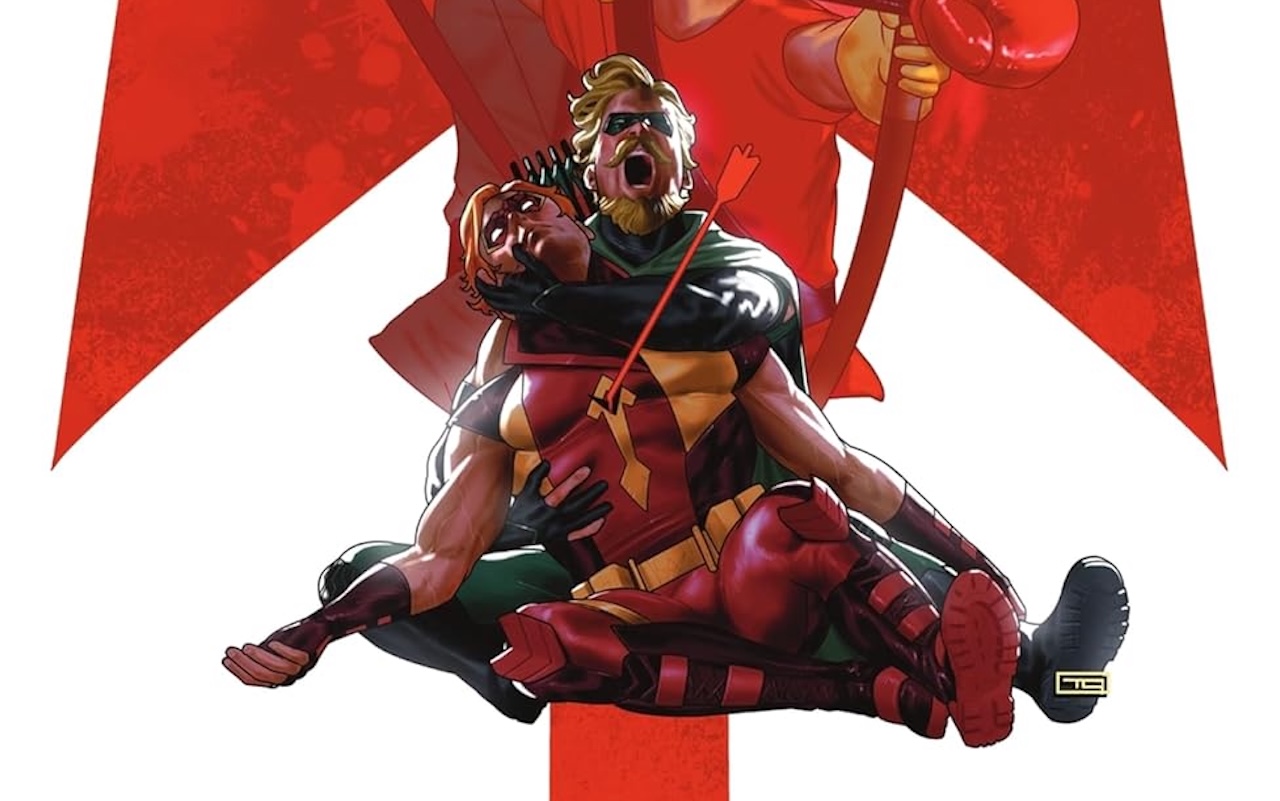

With Chris Condon and Montos’ first arc under their belt, the pair doesn’t hold back whatsoever as their second arc, “Crimson Sand”, appears to be equally as heavy of a topic as their first. While their first arc was a reflection on how corrupt corporations disenfranchise people by offering false promises of a better tomorrow that will never come, this arc is an analysis of the pharmaceutical industry and its connection to addiction. I recently spoke to Chris Condon about this arc – be sure not to miss it!
With that, everyone’s seen the cover, they’ve read the solicitations, so the burning question is: what happened to Roy Harper?! Well, I guess you’ll have to read and find out. But as a whole, how well does this issue do at setting up Condon and Montos’ second arc on the title?

DC
When Chris Condon said this arc was meant to reflect on “Snowbirds Don’t Fly”, I didn’t realize how in-depth of an analysis that could entail. So, instead, I think it’s safe to say that the story as a whole works to honor one of the most renowned comic stories of all time, from small, nuanced moments to ones that are far more poignant. In “Snowbirds Don’t Fly”, we learned that Roy Harper, who was once Oliver Queen’s ward, had become addicted to heroin after feeling lost and abandoned by his father figure. This was a huge moment in comics, and Roy’s path to recovery was far from easy. But for quite a while now, Roy’s been sober. He’s even previously worked for the US Drug Enforcement Administration. All that to say, Roy’s past is paramount to understanding his relationship with Oliver, with himself, and his family.

DC
Here, Condon opens the issue with something fans have been yearning for: Green Arrow and Arsenal teaming up! The pair takes down Count Vertigo pretty quickly, and he isn’t even the focus of the story. No, the focal point is actually the pharmaceutical CEO in a suit. But more about that later. Like, next month later. Rather than getting right to it, Condon slowly drags out the inevitable and does so masterfully.
Roy and Oliver have been through a lot by this point, and the two have a true, open, and honest dialogue about social issues after years of relatively surface-level interactions. Sure, there’s a lot that’s happened to them; they both died at one point or another, some people wore despicable trucker hats, some people wore disgusting sunglasses, the whole nine yards. Ask me what my least favorite character designs for them are, I’m sure you’ll never guess. With all the drama of redefining their relationship given the changes the New 52 and DC Rebirth gave us seemingly in the past, it’s nice to see the pair interact as their true, authentic, accurate selves.
Here, the story feels wistful, well-paced, and utterly gut-wrenching because of the inevitable. While we don’t know a whole lot about the antagonist yet, except that they’re an older character getting a new look. Rather, the focus in this issue begins to ramp up Oliver Queen’s impending battle with Big Pharma. By shifting the focus away from who the antagonist is and onto what they do, the story’s ending feels much more devastating because of how it’s drawn out over the course of the issue.

DC
Montos and Adriano Lucas are truly the best duo in comics right now. Montos uses incredibly detailed line work to help add detail to every panel in the story. This helps to add to the emotional weight the issue aims to carry by crafting a comic full of nuanced intricacies that make a heartbreaking story as vividly realistic as possible. Adriano Lucas does an incredible job adding sharp colors to the more classic superhero pages while slowly darkening the tone of the story as it transitions. As a side note, I’d like to thank them for not giving Roy the trucker hat. On behalf of many, thank you. In all seriousness, the issue is perfectly illustrated in what may be the pair’s best issue yet in a story full of vibrant colors, detailed line work, and quintessential super-heroics.

DC
Green Arrow #25 is an absolutely perfect issue from start to finish. Everything about this issue feels like a love letter to the fans, to Denny O’Neil and Neal Adams, and to what comics can still mean when writers use the medium to speak about critical social issues and take those dialogues beyond the surface level. While the cliffhanger is truly heartbreaking, it doesn’t feel needless; it has purpose, and one that’s sure to be explored over the course of this arc. So, buckle up, Green Arrow fans, it seems like we’re in for the ride of our lives.




You must be logged in to post a comment.