


On March 8, 2009, the History Channel broadcast the two-hour special Ancient Aliens, which served as a backdoor pilot for the TV series of the same name. Not only did Ancient Aliens revive interest in the previously moribund “ancient astronauts” conjectures of Swiss hotelier Erich von Däniken, but it also went on to become one of History’s flagship programs having, to date, run for 21 seasons and more than 250 episodes.
How did we get to a place where one of the History Channel’s longest running documentary series (only Pawn Stars and Modern Marvels have more episodes) deals with the credulous presentation of baseless pseudo-archeological speculation that extraterrestrials visited the earth in the distant past to swap both megalithic blueprints and DNA with humanity?
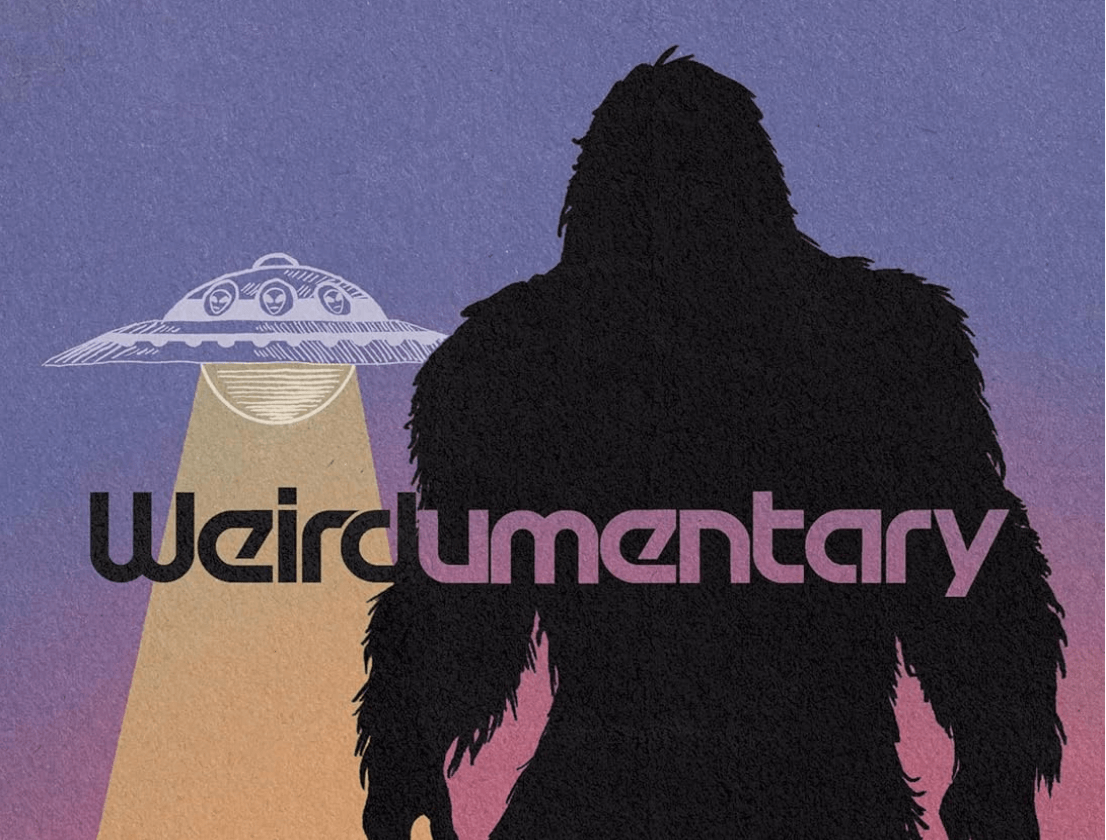
Part of the answer can be found in film historian Gary D. Rhodes’ new book Weirdumentary: Ancient Aliens, Fallacious Prophecies, and Mysterious Monsters from 1970s Documentaries (Feral House, 2025). Here Rhodes has assembled a survey of what he argues was a new genre – the “weirdumentary” – that emerged in the seventies with the release of a 1970 German documentary based on von Däniken’s book Chariots of the Gods? (1968). Picked up for American distribution by Sunn Classic Pictures, the film was released to big box office, and even earned an Academy Award nomination for Best Documentary.
The success of Chariots (1970) led to a string of similar weirdumentaries including “In Search of Ancient Astronauts” (1973), “In Search of Ancient Mysteries” (1974), “In Search of Dracula” (1974), “In Search of Bigfoot” (1976), “In Search of Noah’s Ark” (1976), and eventually TV series like, you guessed it — “In Search Of…” (1976 – 1982).

Rhodes notes that documentaries about Fortean phenomenon didn’t begin in the 1970s, though. Following his introduction, the entire first section of Weirdumentary is dedicated to cataloguing the proto-weird documentaries of the preceding five decades starting with the 1923 spiritualist doc Is Conan Doyle Right? and up through the exploitative Italian Mondo documentaries of the 1960s.
However, in contrast to a traditional documentary which is meant to convey information, the distinguishing feature of the weirdumentary of the ’70s is that it asks questions: “What if UFOs are extraterrestrial visitors?” “What if the stories from the Bible were literally true?” “What if a plesiosaur was living in Loch Ness?” “What if there was a way to predict the future?” et cetera.
None of these questions are ever answered, and Rhodes suggests that’s the whole point. Much of the entertainment inherent in weirdumentaries lies in their invitation to viewers to pull up their barstools and endlessly speculate along with them. Rhodes compares this deliberate ambiguity to the approach taken by Stanley Kubrick in 2001: A Space Odyssey (1968), which also addressed the idea of ancient aliens.
These observations are echoed and amplified by artist and genre film historian Stephen Bissette in his foreword, where he astutely observes that the weirdumentaries of the 1970s owe less to the Mondo docs of the 60s – the aim of which was to shock viewers – than they do to the science fiction films of the 1950s. After all, von Däniken’s Chariots of the Gods? was preceded not only by Kubrick but also Hammer’s Quatermass and the Pit (1967). In this way, the weirdumentary parallels a trend observed by Joshua Blu Buhs in his recent exploration of Forteana in American culture, namely that as science fiction writers sought to make fantasy more realistic, Forteans sought to make reality more fantastic.
The weirdumentary accomplishes this by appropriating the stylistic trappings of the documentary and using them to present material previous found predominantly in science fiction movies. In a few cases, films like The Hellstrom Chronicle (1971) and The Legend of Boggy Creek (1972) have so thoroughly mixed scant fact with overt fiction that Rhodes confesses not even being sure they deserve the documentary label, but opts for comprehensiveness by including them anyway.

Outside of Rhodes’ introduction and Bissette’s foreword, Weirdumentary contains little in the way of critical commentary of the films and TV shows under consideration. Rhodes’ tone is consistently one of nostalgic jubilation. Rhodes makes no bones about the fact that he finds pseudoscience incredibly entertaining, and the wilder the conjectures, the better. Each of his reviews are less than three pages, with some for individual episodes of In Search Of… and Arthur C. Clark’s Mysterious World (1980) coming in at only a few sentences. Weirdumentary contains no citations or bibliography, which is disappointing, since the few sources Rhodes does cite are intriguing.
More frustrating, the book also lacks a table of contents, making its organization as mysterious as the content of the documentaries surveyed within. The films aren’t listed in chronological or alphabetical order, but are instead divided into seven subsections. How exactly Rhodes came to his conclusions about which films belong in which sections isn’t always clear, and at times it seems somewhat arbitrary. For example, little seems to separate the documentaries on “Ancient Aliens” from those on “UFOs.” The book does include an index with all the films listed, but unless you already know which specific film you’re looking for, this doesn’t help much.
Also, while not something I usually bring up in reviews, Weirdumentary is an awkwardly proportioned book. An 8 x 11 paperback coming in at 336 pages, its magazine-like dimensions combined with its length and girth make it awkward to hold and read, as the book’s center of mass tends to “flop” around.
In his conclusion, Rhodes notes it was the weirdumentaries of the ’70s which paved the way for History’s Ancient Aliens, but says little beyond this. Ultimately Weirdumentary: Ancient Aliens, Fallacious Prophecies, and Mysterious Monsters from 1970s Documentaries stands as an important resource for future scholars looking for a comprehensive listing of paranormal documentaries, but its lack of critical insight and poor organization makes it far from the final word on the topic.
AIPT Science is co-presented by AIPT and the New York City Skeptics.



You must be logged in to post a comment.