


Since Supergirl’s All-In relaunch, writer and artist Sophie Campbell has been revisiting forgotten characters and concepts from Kara Zor-El’s Silver Age and Bronze Age stories. She’s also been expanding her supporting cast to include her own group of friends and family members outside of Superman’s immediate family. This has not only revitalized the Girl of Steel in exciting new ways, but has led to some truly fun stories that honor the heroine’s rich legacy.
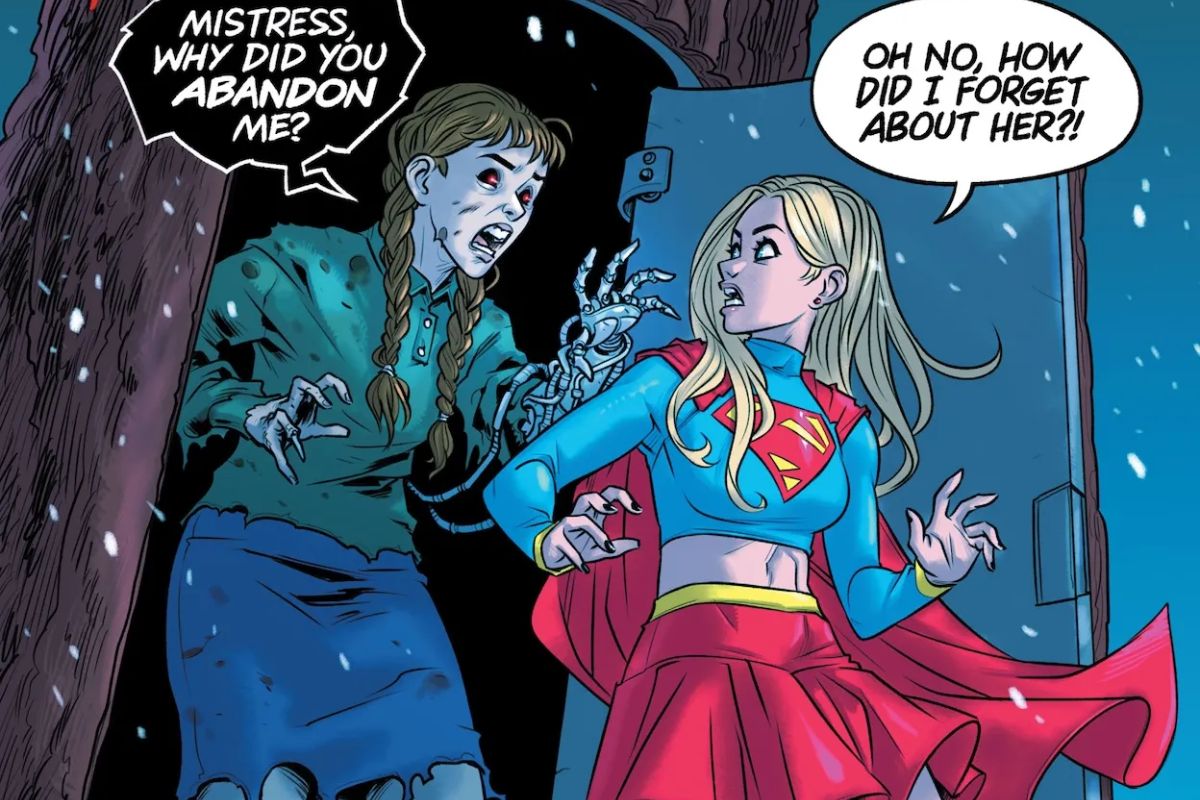
Since October, Campbell has been exploring what Earth-based holidays mean to Kara. Supergirl #6 got inside Kara’s head to revisit her complex traumas and greatest fears on Halloween. For Thanksgiving, Supergirl #7 did a redemption story that called back to Disney’s The Little Mermaid. For Christmas, Supergirl #8 continues the trend of depicting how Kara experiences the most celebrated holiday around the world, but with a “ghost” from her Silver Age past: the Linda Lee robot.

DC Comics
As silly as it was for Kara to have a robot doppelgänger to cover for her at the Midvale orphanage while she saved the world as Supergirl, Campbell still manages to tell a heartbreaking story with this idea. Campbell achieves this by first reorienting the reader to the Linda Lee robot. Fans of the Girl of Steel are already familiar with the robot, so revisiting this forgotten detail of her past is a special treat down memory lane. For fans who have not read Supergirl’s earlier adventures in the 1950s and 1960s, Campbell does a quick recap of her history before telling her actual story.
Though the recap depicts Kara’s last day at the orphanage before being adopted by the Danvers, it still does its job at conveying to the reader the robot’s purpose, which makes her story in the present all the more tragic. With a solid script, Campbell perfectly captures the robot’s voice and child-like need to always be of use to Kara. When the latter leaves the orphanage in the flashback sequence, the robot remains hidden inside the hollowed out tree, ready to be of use again. When Kara never returns for her, the robot experiences some sense of abandonment.

DC Comics
What’s brilliant about the execution here is how Campbell draws parallels between Kara in the present and her cousin in the past. As shown in the Halloween issue, some part of Kara also felt abandoned by Kal-El when he left her at the Midvale orphanage, instead of integrating her into his family. The Linda Lee robot feels the same way, which causes Kara to understand her own cousin on some level. By the time she arrived on Earth from Argo City, Kal-El was already a superhero, and likely didn’t know what to do with her when she arrived. He also likely forgot about her the same way Kara forgot about the robot.
This juxtaposition makes Kara’s reunion with the robot all the more heartbreaking, especially since she expected the robot to shut down on its own. When she realizes she remained activated in the years since leaving the orphanage, this makes Kara feel terrible the way her cousin most likely did. But forgetting about the Linda Lee robot is not the only thing that has Kara feeling melancholy during the holidays – she’s also missing her Kryptonian family and friends who have long died.

DC Comics
Though Supergirl #8 tells a melancholy tale about loss and abandonment, the tone is not entirely blue. To help lighten up the mood, Campbell continues to showcase Lesla-Lar’s child-like wonder about Earth-based holidays and traditions. She still doesn’t understand much of it, but understands the purpose of Christmas being about cheer and gift giving. This prompts Lesla to learn how to make cookies as a means of cheering up Kara, but that’s not all she does for her: she also reminds Kara that it’s okay to focus on the people who are here now, which reminds Kara that she can’t be there for everyone.
In addition to Campbell’s excellent writing, the other storyteller that does her share of heavy lifting to give the story its strong emotional hook is artist Haining. Though Haining has an art style that’s more associated with manga, it still works to capture the Silver Age feel of the flashback sequence, especially with Guimarães using pastel colors for these pages. Even in the present, the bright colors and art even perfectly capture the emotions each character is feeling – from Kara’s brooding, to Lesla being easily excited to experience snow, to the Linda Lee robot experiencing a child-like sadness associated with abandonment.
Though Supergirl #8 may not be the most upbeat Christmas tale compared to many others, like the holiday specials people watch on TV every year, it still touches upon a relatable human experience, and centers its story on reminding the protagonist what truly matters to them. In this regard, Supergirl #8 succeeds as both a holiday special and a standalone tale.




You must be logged in to post a comment.