

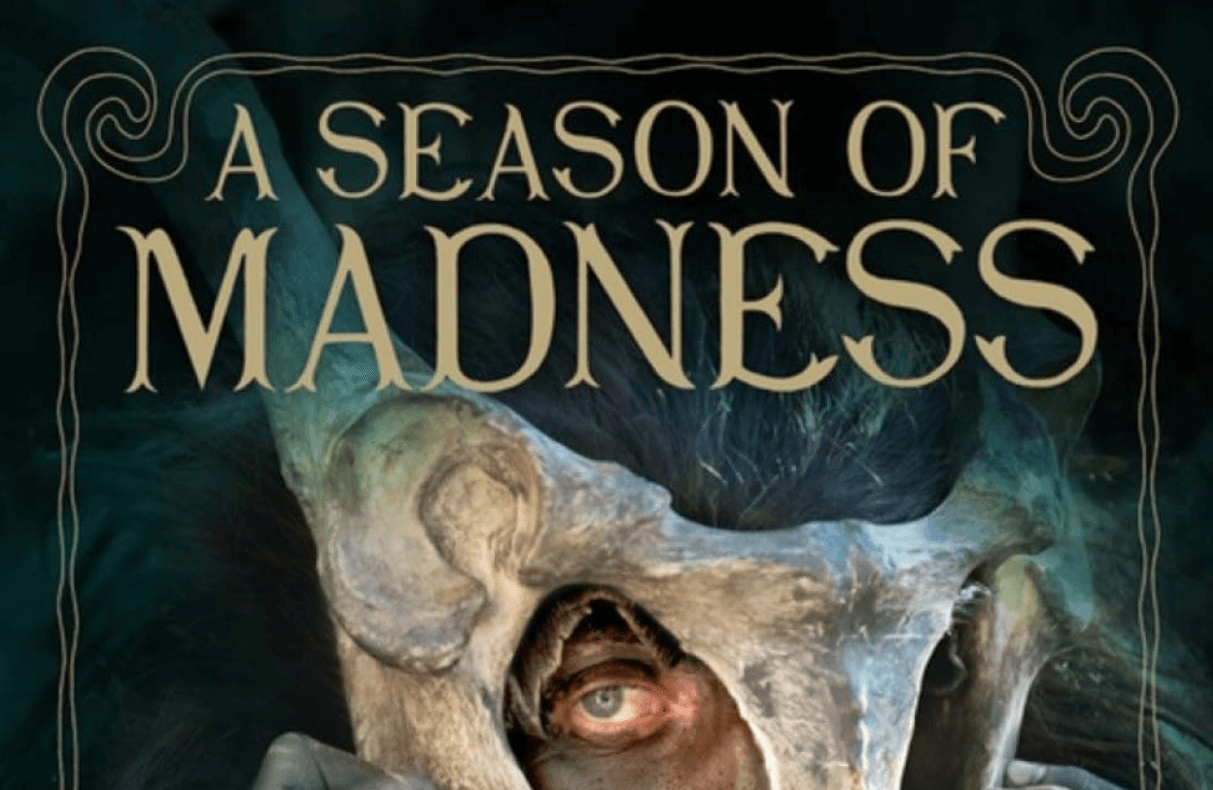

It takes a certain amount of chutzpah to begin a book by acknowledging that you, the author, don’t find its subject matter particularly interesting. Yet this is exactly the counterintuitive approach which self-described “rogue folklorist” Al Ridenour has chosen in the introduction to A Season of Madness: Fools, Monsters, and Marvels of the Old-World Carnival (Feral House, 2025). This is the follow-up to Ridenour’s marvelous The Krampus and the Old, Dark Christmas (Feral House, 2016), which still stands as the definitive English language work on that yuletide monster.
Being an American, Ridenour confesses that his understanding of Carnival, as a holiday, was largely informed by the New Orleans-specific celebration of Mardi Gras, with its plastic beads, copious consumption of alcohol, and frequent flashing of women’s breasts. All of which is about as far away from the subdued, rural, folksy traditions which the author displays such fondness for in his historical and ethnographic exploration of the Krampus, and which are regularly the subject of his podcast Bone and Sickle, which explores the intersection of horror and folklore in a historic context.
As a result, an exploration and examination of Carnival did not immediately strike Ridenour as a logical follow-up to his work on our “Old, Dark Christmas,” until he realized that many of the most striking aspects of Austrian, German, and Tyrolean Christmas celebrations are actually derived from much older Carnival traditions.

If The Krampus examined the folkloric origins of Christmas by zeroing in on the traditions in backwoods alpine communities, then A Season of Madness takes the opposite approach, offering a 40,000-foot-view by examining a wide range of customs across eastern Europe, and spanning a greater period of time. Exactly how much time varies, since Carnival can begin as early as November 11 (Saint Martin’s Day or Martinmas), and end as late as February 17 (Stove Tuesday or Mardi Gras). What matters is that the last day falls before the beginning of Lent, which in turn must arrive exactly forty days before Easter, which is itself a mobile holiday, being based on a lunar, rather than solar, calendar. Such a vast swath of the calendar encompasses not only the twelve days of Christmas (December 25 – January 6), but also New Year’s, Groundhog Day, and Valentine’s Day, all of which are discussed by Ridenour in turn.
Because Ridenour’s exploration of Christmas folklore began with the Krampus, it’s not surprising to find this preoccupation with monsters continue in A Season of Madness, as Carnival boasts its own menagerie of fantastic beasts, including the Germanic Wild-Man, the Slovenian Kurent, the Hungarian Buso, and the Bulgarian Kuker. All these creatures have an unmistakable resemblance to the Krampus in both appearance and behavior. In Chapter 12, Ridenour makes the fascinating case that all these hirsute holiday horrors may in fact be derived from older customs involving “carnival bears.”
Throughout A Season of Madness, Ridenour displays an admirable sense of skepticism – also found in some of the best episodes of Bone & Sickle – often opting for the pragmatic over the poetic. For instance, the ubiquitous use of bells, bullhorns, and cracking whips by the performers who dress as the carnival monsters is often interpreted as an apotropaic, designed to frighten away evil spirits. Ridenour, however, offers a far more prosaic interpretation, that such noisemaking devices are primarily intended to alert the public to the performer’s imminent arrival, and to help draw attention to them.
Another example can be seen in Ridenour’s response to the oft-repeated claim that the more folkloric aspects of the Carnival holiday – especially those perceived as “weird” and/or “dark” – are evidence of an older. underlying pagan celebration antedating the advent of Christianity. This includes the claim that the Kurent is a pre-Christian Slavic trickster god, despite the fact that records of the Kurent don’t go back any further than 1890, and even the assertion that the Roman ethnographer Tacitus’ description of the Teutonic earth goddess Nerthus being transported via a wheeled cart is the origin of modern Carnival floats!

A Season of Madness notes early on that such “flamboyantly exaggerated notions” derive not from sound research, but rather with 19th century anthropologists of religion who, obsessed with the notion of pagan survivals, “saw in festive customs of the countryside traces of the ritual sacrifice of an ancient god-king.” Historian Janez Trdina, who first claimed that the Kurent was a pre-Christian deity, was just such a mid-19th century scholar.
Despite being “unsupported by archaeological and historical evidence,” such conjectures have nevertheless survived, first in the work of “Victorian and Edwardian writers and artists eager to project upon the pagan world all manner of forbidden pleasures,” and more recently in the increasingly popular “folk-horror” subgenre in which “the drama and righteous thrill” of the uncovering of secret rites and rituals masked by mundane (and highly commercialized) celebrations takes precedent over sober reason and empirical evidence.
As Ridenour notes, the only authentic “paganism presented in this book consists of rural superstitions and beliefs that largely have coexisted with Christian practice, undifferentiated in the common person’s world, but condemned by the more exacting Catholic or Orthodox clerics.” To this end Ridenour produces numerous excerpts from early church fathers, incensed over their congregant’s participation in completely secular new year’s festivities which nevertheless frequently involved both crossdressing and celebrants “[changing] their appearance for that of wild animals.” Which just goes to show that Christians complaining about drag shows and furries is really nothing new!
A Season of Madness is a beautifully designed book, divided into fourteen chapters and boasting over 250 full-color photographs. It contains a bibliography and index, making it a worthwhile edition to any folklorist’s library. Researching it changed Ridenour’s view of Carnival and it might change yours, too.



You must be logged in to post a comment.