


Here’s a story about my dad, Bill Coplan.
When I was an ornery, bigger-than-my-britches 15-year-old, I told pops that one day we’d fight. It seemed like the sort of thing that happened between all fathers and sons as an expression of burgeoning male authority, and so we even signed on a piece of yellow legal paper. For years after, whenever we’d butt heads about this or that, my dad would remind me of our “contract.”
I never did fight him, and I’ll let that stand as a testament to whatever.
People’s reactions to this story often fall in line directly with their respective genders. Women (quite rightly) highlight it as a sign of men’s wholly regressive outlook on the world and themselves as individuals. Men, meanwhile, have talked about their own “run-ins” with daddy dearest like sharing rousing war stories.
If anyone could truly relate to my tale, though, it’s Igor Kordey.
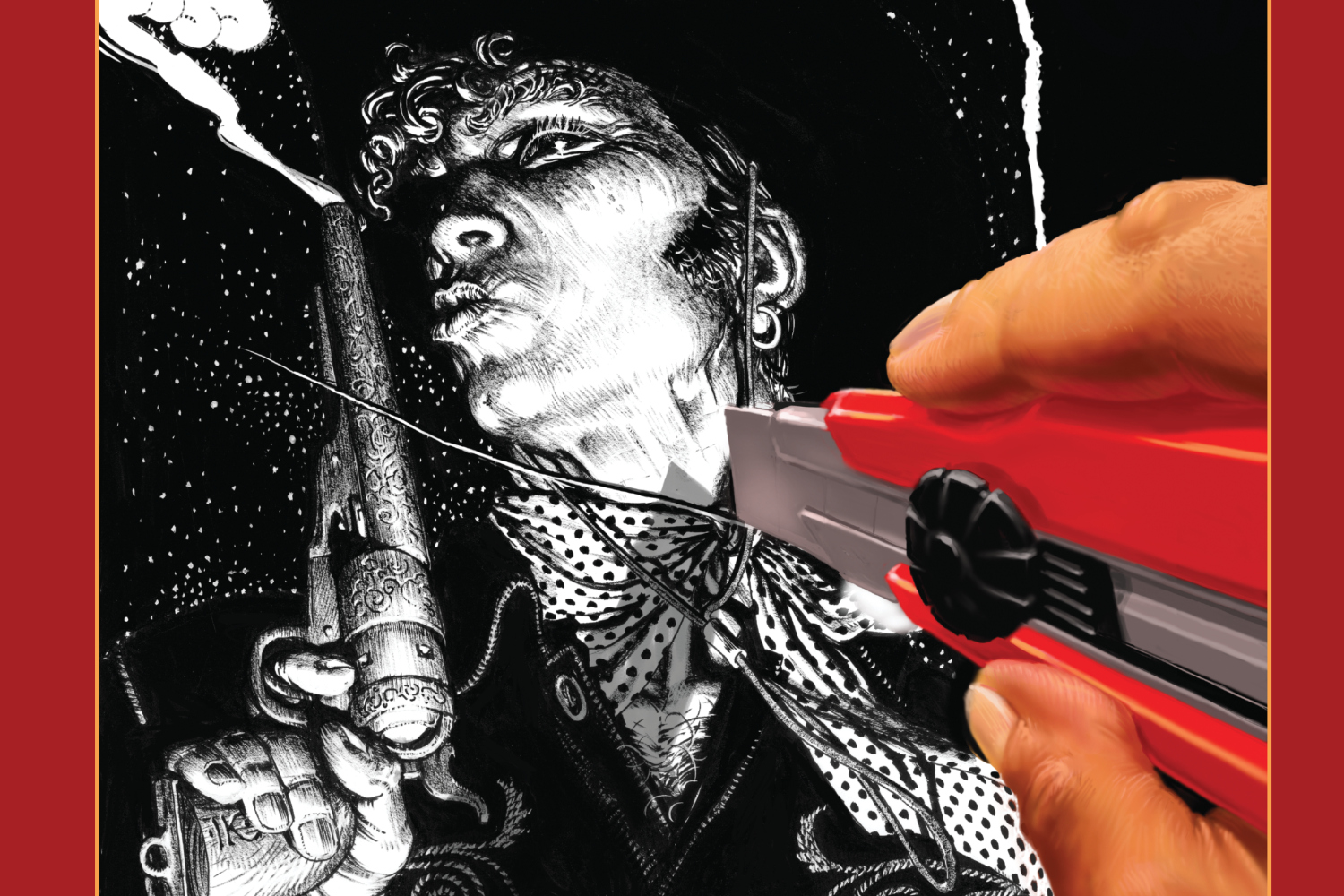
In his new OGN Texas Kid, My Brother (from Goats Flying Press), the iconic cartoonist explores this potential cocktail of familial violence, male peacocking, and how that connects/intersects with the stories we tell ourselves. We follow cartoonist Radovan Brandt, who has spent his life under the thumb of his father, Tomislav Brandt, an infinitely more famous cartoonist. But just as Radovan is finally stepping into his own, there’s a knock at the door: It’s the Texas Kid, his father’s most beloved comics creation, ready to wreak all kinds of havoc.

Courtesy of Goats Flying Press.
The sheer number of meta layers here (between Kordey and the story but also myself/the audience and the story) are enough to make a 100-layer lasagna of stunted male emotionality. It’s basically the comics version of Adaptation. as Radovan and Texas Kid fight for their father’s attention like stupid, angry school boys. But where the general framework feels familiar to the point of being somewhat predictable, Kordey makes key decisions that position Texas Kid as this complicated, compelling journey into art, masculinity, and the way these things interplay with one another (for better and worse).
Tomislav’s portrayal, for instance, is especially interesting. He is primarily a man of great anger and emotional violence, going so far as to edit his young son’s early comics with a ruthlessness that’d make Jim Shooter blush. When he all but abandons the last shred of his relationship with Radovan upon Texas Kid’s arrival, the ease of his cruelty casts Tomislav as a Doctor Doom-level supervillain. Yet Kordey complicates our relationship (and obviously the Radovan-Tomislav dynamic) by also casting the elder cartoonist as his own adventurous hero. Tales of his harrowing life pre-WWII are just as bloody and brilliant as anything from an issue of Texas Kid, and in that way, Tomislav is just as much a hero in the vein of Doc Savage or Conan. He’s rugged and handsome and capable of killing a wolf with his bare hands, and you see that greatness before anything else.

Courtesy of Goats Flying Press.
It’s not about excusing Tomislav’s behavior (which eventually extends to more heinous acts as the Texas Kid’s influence grows deeper/more insidious). It’s about contextualizing the life of a man, and recognizing he is often both the hero and villain of his story (and that of his sons). Is enough of Radovan’s suffering self-perpetuated, and born out of some asinine obsession with his father’s artistry over meaningful emotional functionality/delineation? Yes, and that’s the point. As much as Tomislav was capable of being a great artist and a good father (but chose to be just one), so too has Radovan chosen to worship his father as both shimmery paladin and fiendish warlord. (And not making the choice that would have him seen him be far happier.) It speaks to a sense of responsibility we share in “crafting” the stories of our lives, and how we decide the shape of these narratives based on our own wants and needs.
As an extension of that, it feels not just like a great commentary on the dynamic between fathers and sons, but also the idea of separating the art from the artist. So often people think the good can outweigh the bad, but as I think Texas Kid makes clear, we spin these complicated stories because they somehow make our lives easier/better. That to believe men are dense oceans of light and dark is a choice over saying that Tomislav knew how to draw the heck out of cowboys but was mostly just a huge dick. The choice tells us everything we need to know about the one making said choice, and in that way, Texas Kid cuts to the heart of not only male identity, but how so much of it is this complex processing of spinning yarns and hoping no one dares to look at the person holding the pen.

Courtesy of Goats Flying Press.
There’s even a “manifestation” of this in an other, equally vital component of Texas Kid. I’d mentioned before about the meta aspect not being particularly novel, and that’s generally not a downside for this book. Mostly because Kordey commits to the comics aspect of this fully and completely, and that resulting framework is really important. For one, it creates a certain baseline of expectations for readers: We almost demand a certain tone and a narrative ebb and flow, and we want the trademarks of a great comic (i.e., action sequences, great flashbacks, a certain tonal consistency, an engagement with the medium’s narrative pillars, etc.)
That corresponding commitment, then, is another layer of the meta — a comic book about comics creators dealing with a “living” comic book, clinging fiercely to comics storytelling as a form of gravity. Sure, comics are for everyone, but comics by emotionally-stunted dudes engaging in heavy wish fulfillment becomes this extra rich commentary on male immaturity and our unwillingness to change despite being the authors of our own story. It also shows just how much feckless male sentiment shapes how we engage with comics, and that once again furthers the larger point of how the power is in our hands to change these narratives and not cling to the violent, ugly past.

Courtesy of Goats Flying Press.
You get even more of this dynamic in the visual standouts across Texas Kid‘s 205 pages. There’s a tendency by Kordey to basically move the camera in and out, as it were. For instance, if we’re looking at a scene from a random issue of Texas Kid, it may seem less detailed or “distant,” exuding a sheen of hazy nostalgia and child-like wonder. Elsewhere, Kordey goes extra deep and detailed— the black ink practically hums — with especially potent moments, including an upsettingly vivid interaction with Texas Kid and Radovan’s girlfriend. On the one hand, it’s just more masterful displays by Kordey, who continues to know comics in a way that makes his commentary and dissection of the medium all the more thoughtful and valid for all that beguiling skill.
Still, this approach/technique is compelling for other reasons worth mentioning. It positions comics as this ultimate lens for life, and how if we’re really telling a meta story, it feels like the best medium to bring character and audience together around these core themes/end goals. And from there, those themes move and bounce off one another in some really interesting ways. (It’s how Kordey makes this book feel so massively personal and even assigns some version of blame without ever being so forced or heavy-handed.)

Courtesy of Goats Flying Press.
The moving in and out (again, it’s more a feeling, and a testament to Kordey’s sheer storytelling skills) is reflective of my earlier point about how we shape our own stories. More specifically, it’s a visual representation of that very functionality, and by hitting on ideas of memory and perception, Kordey is showing us (more viscerally, I’d add) how we emphasize, edit, and generally manage our lives through these stories. We remember things the way we want to remember, and play them back in a way that best serves our needs/desires.
The visuals are also where the idea of men being “stuck” in a comic, where they’re fighting over a comic character, becomes even more rich and undeniable. (For as much existential might as this tradition has, it empowers as much as it limits these characters in some important ways). You see that in the masterful ending sequence, where Radovan plots his “revenge” against Texas Kid, and how he adorns himself with comics characters as a both a safety blanket and a recognition of his own shortcomings in living life/dealing with conflict.

Courtesy of Goats Flying Press.
And there’s so much more still I haven’t even discussed: Radovan’s mother (who remains nameless), and how she’s basically the only truly sympathetic character (again, without being so needlessly simple or direct); Texas Kid and the further layers in which he serves as an avatar for Tomislav; the commentary regarding comics’ role as a commercial good, and what that notion does to extend and even counter some of the themes/discussions here; and even how Texas Kid is just a damn good comic, and what that affinity means for us as readers.
For such an involved premise, where Kordey is having to do so much in an already crowded field (of meta-centric stories), Texas Kid is sort of a breeze. Admittedly, a nerve-wracking, generally upsetting breeze, and one that will boil your blood as you think of your own interactions as a person, artist, child, spouse, etc. with varying levels of grief or guilt. But mostly a breeze in the sense that this story is easy and familiar in all the right places — as both a cautionary tale and a family story passed down to generations. You know this song, but singing it here cuts ever deeper.

Courtesy of Goats Flying Press.
From there, the story challenges us in all the right ways, thrills us when we think we don’t want to be so moved, and cuts us down when maybe we wish it wouldn’t just right then. In short, it’s a story with layers galore, a narrative about being alive, seeking more, committing to the path you’ve chosen, and grappling with what it means as a person capable of both great good and great evil. It’s a mighty tale of action and misery, heartache and ascension that truly moves you. Heck, it moved me to share a story about wanting to fist-fight my dad, and that openness and self-examination is perhaps the greatest gift Texas Kid could ever offer its audience.
Now, hop on Lucky the Horse and try not to get bucked off yourself.
For more on Texas Kid, including snagging your own copy, check out its recently-funded Kickstarter.




You must be logged in to post a comment.