

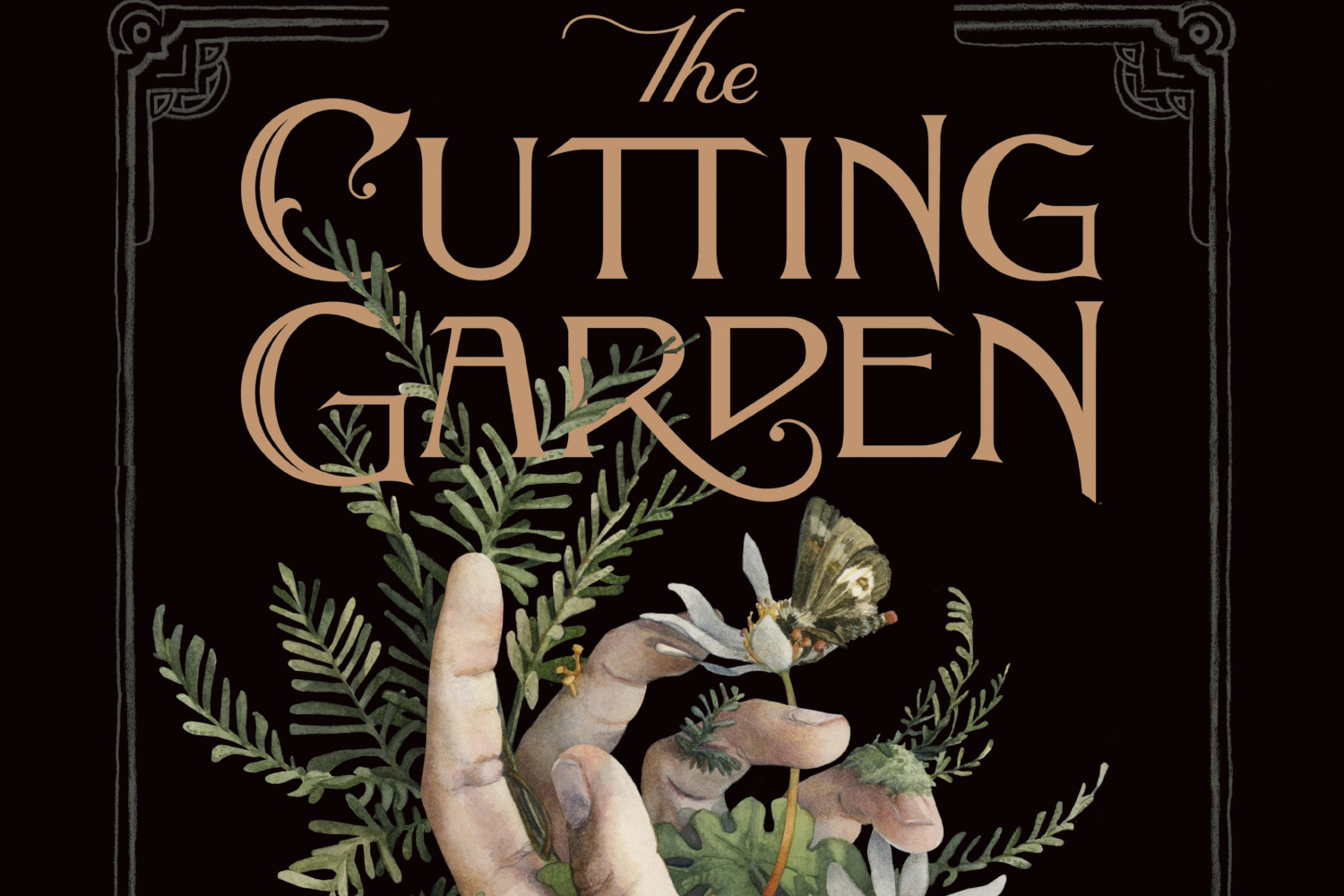

Flowers are liars.
OK, what I actually should’ve said was that they’re master manipulators, and that countless gorgeous specimens have layers and secrets that we can’t see upon first glance.
The Bee Orchid, for instance, tricks male bees by appearing like their female counterparts. The Corpse Flower, meanwhile, attracts flies with a scent that mimics decomposing flesh. And the Skunk Cabbage can manipulate the surrounding air during winter to melt snow and attract early pollinators.
Now, does all of this mean we should stop picking and enjoying flowers — maybe adopt a scorched Earth approach instead? No, just that we should temper our understanding of these beauties, and recognize that what’s on the outside is often only part of its true scope and wonder.
Sort of like with The Cutting Garden.
The Blooming Snowdrops

Courtesy of Image Comics.
A forthcoming OGN by Image Comics, The Cutting Garden is the work of writer Darcy Van Poelgeest and artist Erin Connally (who is releasing her debut comics work). Rather than try and re-arrange these cuttings into some gorgeous bouquet, I’ll let the book’s solicitation shine all on its own:
“On a quiet street in 1930s New Orleans, a florist agrees to work through the night to construct a floral arrangement for a funeral the coming morning for a peculiar customer — a precocious 11-year-old girl named Adeil who pays the florist in stories. For every new flower the florist adds to the bouquet, Adeil offers another dissonant detail in her story: a chance meeting with a disillusioned jazz singer [Josette], a dilapidated family home, an idyllic life on the fringes of an imperfect world. As dawn approaches and the arrangement takes shape, the florist is left to piece together the final details of Adeil’s mysterious life and ponder…where exactly does she fit into this story?”
To discover the true secret of The Cutting Garden, we must peel back each petal until we get to the lively, pollen-rich core. And the first such layer is that, for as much as this is a markedly different story from Van Poelgeest, it’s also very much the same in some important ways.
“But my sense is that I’d probably be lying if I didn’t think that everything I did is somehow a response to stuff I’ve done in the past,” Van Poelgeest said. “In Precious Metal and Little Bird, it’s so much about having the responsibility of the world on your shoulders while you’re trying to navigate complex personal relationships. And I think what The Cutting Garden does is that it’s still exploring those complicated personal relationships without feeling the weight of the world.”
Even some of the differences (like setting, for example) are important as context but ultimately don’t leave The Cutting Garden locked into one room or another.
“I think of all those books as tragic and beautiful kind of in the same way, to be honest,” Van Poelgeest said. “Maybe because The Cutting Garden is set, even though it’s in the past, in a more familiar world that I could approach with a level of nuance that is less accessible when you’re doing sci-fi dystopia stuff. The three characters in The Cutting Garden are equally as confused as [Precious Metal‘s] Max Weaver.”
But unlike those other works, where Van Poelgeest and artist/co-creator Ian Bertram were interested in ideas of memory and identity, The Cutting Garden is interested in a more “basic” but equally important question.
“The Cutting Garden was born out of just wanting to think about this idea of, ‘What does a girl look like who doesn’t have a mother and wants one, but will never be able to have one,’” Van Poelgeest said. “And also, ‘A mother who wants a daughter and may never be able to have it in the way that she liked.’ Then it’s about putting them together.”
But to do just that, he’d need a different kind of gardening buddy. As Connally told it, the pair had linked up when Van Poelgeest found her artwork online and decided they ought to collaborate.
“Only that didn’t work out,” Connally said. “And so I thought, ‘That’s probably going to be the last bit I hear from this kid.’”
But, clearly, it was not, and the pair’s collaboration just had to wait for its own springtime to arrive.
“So when he did come and knock on my door to be like, ‘I’m just as OCD as you are and I’ve been thinking about this constantly. Here’s this I have for you.’ I would say it blew my mind,” Connally said. “And I was like, ‘Clearly you wrote this for me because here’s the field that you’re in and it’s way over here.’”
As Van Poelgeest tells it, this story always had to involve Connally. In one edition of his newsletter, he mentioned talking about how ideas “attract other ideas and it grows into this ball. And for the most part, you have to just take those things and put them away because you just have too many ideas.” However, there comes a “breaking point where an idea grows to a point where you just it’s too big to put anywhere.” Then it’s time to get out the fertilizer and your trusty trowel.
“And just looking at Erin’s art, where it’s like, ‘Oh my god, this thing already exists now at this point. We just have to do it.’ The story is in your unconscious mind,” Van Poelgeest said. “Because I see art all day, every day and I can’t not have visceral reactions to it. Any story inside of you is like lightning where it’s just searching for the strike point.”
The Twisting Dodder
Similarly, Connally thinks the nature of their collaboration is especially novel. As such, it’s given both of them keen insights into one another, and that connection and bonding filters back into The Cutting Garden as a whole.
“There’s also a similarity in the way of telling a story that you don’t realize until you’re getting to know a person,” Connally said. “Darcy loved certain aspects of film that he hadn’t gotten to develop into comics yet at that point in time. It was something where, getting to know him, it made sense why I was the strike point.”
That instant chemistry is very much at the heart of the Adeil and Josette relationship. That is, with a twist that lends ample drama while allowing the story to dissect other interpersonal dynamics.
“Even from the very beginning, just the way they met, the way that Adeil even introduced the idea that they could live together, she knew her for five minutes,” Van Poelgeest said. “It makes me think of friends who have been in relationships in the past where it’s so fiery hot that they’re like, ‘I love this person more than the world itself,’ and they met them two days ago. And in my head, that’s not going to last.”
Van Poelgeest added, “I think we’re all guilty of stepping into relationships that we probably know aren’t going to last. And that doesn’t mean romantic or whatever. Even just in a friendship, where if you are completely honest with yourself, you’re like, ‘This isn’t really the kind of person’ or ‘This isn’t really the right setting for this to go really anywhere,’ but you just want it so bad that you’re willing to go along with it for a time.”
But it’s not just the speed of their coalescence that’s ripe with narrative gold. It’s also that, without spoiling too much, the pair’s relationship grows and undulates in some especially interesting ways.
“I think it’s one of those things that flips a few times as the story goes on,” Van Poelgeest said. “Initially you’re thinking about it one way, and then at the end it feels different again. I think that by the time you get to the end, you realize, ‘Oh, this was mutual’ in the sense that they were both using each other to get something that they didn’t have.”
Part of that is (and again without spoiling too much) there’s acts of violence that occur as the pair set about “playing home.” Sharp, bloody moments where the power dynamic once more becomes uncertain. There’s one scene in particular that utterly dazzles, and it uses little more than a shovel to absolutely take your breath away.
“That’s the one scene that I just debated over and over again in my head if I should include or not,” Van Poelgeest said. “Because at first it felt like too much too soon, but I think it was really important in establishing where Josette was coming from and the baggage that she was bringing into the relationship.”
Van Poelgeest added, “It also sets up a way for Adeil to get her claws into the relationship. Again, just thinking about things you see and experience in your own life that quite often people who are manipulative when it comes to relationships will look for that opportunity.”
The Beguiling Langsdorffia

Courtesy of Image Comics.
If you hadn’t already guessed by now, Adeil isn’t your average 11-year-old girl. I won’t say what she is so abruptly and overtly, but she represents the bubbling fountain of horror within The Cutting Garden. But again, it’s not so simple as good versus evil, creatures of darkness versus ordinary folks. There are, once again, layers a plenty.
“I was thinking about the mother-daughter relationship – I just had this idea of these two characters who need each other, but it doesn’t really work,” Van Poelgeest said. “I wanted to take, for the most part, the monster out of the story and just think about it like, ‘What does this look like?’ If you take all the tropes out of it, what does that story look like?”
And because Adeil is different, perhaps that let the creators explore spaces that they might not be able to in a more “traditional” narrative. The Adeil-Josette relationship has a sheen of romance to it — it’s hard not to see that when they’re actually playing house. But intended or not, Van Poelgeest recognizes what that aspect offers as they were crafting this complex, layered relationship.
“It’s romantic – not in obviously any kind of sexual way – but it’s romantic in the sense that just because that’s where people tend to go with that word,” Van Poelgeest said. “It is romantic in the sense that they are both fulfilling a fantasy that can only ever be a fantasy. They’re delusional, but there is a sort of willingness. It’s intentionally romantic in the sense that they’re both trying to live out an impossible fantasy in each other.”
That fantastical sheen seeps its way into other parts of The Cutting Garden. For instance, knowing that she’s not exactly human, you get a better sense of why Adeil may be manipulative of Josette and her situation. It’s not necessarily that she’s evil; it’s just that she engages with the world in ways we might not otherwise.
“And it’s not even coming from a place of malice. Adeil, she is not trying to be awful,” Van Poelgeest said. “For her, it’s a survival skill. In a sense, she’s looking for prey and it’s like, ‘Oh, here’s a wounded deer that I can take out.’ Its a genuine need for sustenance for her own self, but it’s those things can become horribly manipulative.”
And while Van Poelgeest can’t fully reconcile with that, he always understands his characters’ most essential wants and needs.
“When I’m doing this, I’m putting myself in the mind and body of Adeil,” Van Poelgeest said. “In my mind, you’re just not going to look at life in the same three dimensions that maybe you and I would. It’s like, ‘This was horrible, and I care about this character, but this is the decision. This is how she would think of it.'”
The Hiding Mimosa Pudica

From Little Bird issue #3. Courtesy of Image Comics.
That approach is especially novel given Van Poelgeest’s relationship with these kinds of spooky, bloody tales.
“I’m not actually a big horror fan,” Van Poelgeest said. “It’s just not a genre that I’ve ever been really connected to. So part of it was just an exercise of, ‘How do I tell a horror story that’s not a horror story?’ That was part of the fun little challenge I set up for myself and for us.”
And while he’s certainly helped accomplish his fair share of violent battles in books like Little Bird, violence is another thing that Van Poelgeest struggles with in his writing.
“It’s not that I don’t have it in my comics, but it is definitely the hardest thing for me to write,” Van Poelgeest said. “I’m just firing along, and then I get to those scenes and I go, ‘How in the world do I make this interesting to myself?’ So in this book, I just decided to avoid it. I just won’t write the hard part.”
Again, given moments like the aforementioned shovel scene, and Adeil’s own monstrous behaviors, there’s absolutely horror and violence depicted across The Cutting Garden. But it’s done in a way to mimic real life, and to focus less on the release and more on what these acts and corresponding feelings really mean.
“The violence is not something you remember, right? There’s the moment before it – you remember that,” Van Poelgeest said. “And then you remember after. Psychologically, we just edit that out anyway. And so that’s the interesting part to me – to be able to explore those moments of what happens leading up to it. And what are we left with afterwards? The actual violence that we spend so much time consuming in the media doesn’t really cause us anxiety, because we don’t even remember it. It’s everything leading up to it. It’s the grief that we’re left with afterwards that we constantly revisit in our own minds.”
Connally absolutely agrees with her collaborator — all that blood and carnage just doesn’t land the way it ought to.
“Once you let everything out – here’s a dead body, here’s the monster – the cat’s out the bag,” Connally said. “It’s so much more fun to build up the suspense and the fear with tiny little bits of, ‘There’s a dissonance, there’s a dissonance, there’s a dissonance.’ I think that feels much more impactful than just being like monsters.”

Courtesy of Image Comics.
In terms of building up the suspense, there’s one moment that encapsulates that to a tee. It’s about denying something in the narrative, and letting the audience force themselves to squirm.
“With her taking that grasshopper, it becomes, ‘Will she release it?’ Or, ‘What’s gonna be the story here,’” Connally said. “But that also creates a distance because you’re like, ‘What would she do next time?’ I want you to feel it – deeply uncomfortable in the absolute best way. We’re in our heads experiencing it. And so much it is, ‘What am I perceiving when it’s happening?’”
A big part of the pair’s ability to create this distance and play around with space is with our other character, The Florist. She’s not just the narrator, but she’s very much a stop-gap, as it were.
“If the florist wasn’t involved in the story, and she wasn’t telling the story, this actually would be a straight up horror,” Van Poelgeest said.
And he means that in a rather literal sense. To once more visit the shovel scene, that moment is terrifying not only for the actual moment and its implications, but what The Florist allows us to see in the continued tale between Josette and Adeil.
“That is interesting storytelling because…so much of the story is told from a third-person perspective, but [The Florist] is thinking about it very embodied – like the way she’s telling the story,” Connally said. “So much of the story is about avoidance. To look at it directly in the face means that you have to do something about it, which means the dream is over. It’s real and you don’t want it to decay.”
The Florist, though, isn’t just a stand-in for our own fears. This tendency to “edit,” as Connally mentioned, is a way to not only understand a core theme of The Cutting Garden, but the unique role that The Florist plays in the story (without knowing any of it beforehand, of course).
“The Florist is a character that comes more from a place of privilege and has had the good fortune to be able to bury her own baggage in a way that Josette and Adeil have not,” Van Poelgeest said. “And so she’s incredibly romantic about the world. Even the fact that she opened up this flower shop and all that, and that her opening monologue talking about and addressing that she’s actually not that different than Adeil and Josette…she just has the distance from all of it. The Florist is able to take Adeil’s story and retell it in a way that fits within her own fantastical, beautiful world.”
The Ever-Poking Boquila

Courtesy of Image Comics.
For all of this book’s interest in horror, female relationships, perception, etc., The Cutting Garden is, closer to its flowery center, a vehicle for both of its creators.
Van Poelgeest, for instance, didn’t just want to write about mothers and daughters. He also wanted to lean and explore his own life through this approach.
“I was thinking a lot about my own mom too – it’s not that she’s any of those characters, but just that she was adopted and never really knew her real mom or her real parents,” Van Poelgeest said. “And so that was something I was just exploring, and the role of an imperfect mother and the role of an imperfect daughter and all the baggage that they carry and put on themselves in a world that has never really given them a fair chance.”
At one point, I ask Van Poelgeest if he had any issues, as a male author, in writing women leads. Initially, he said that there’s an “internal debate of should I just pursue this the way it’s come to me, but also I need to be honest about the type of things that I should not be doing. I think that all these conversations we’re having about who should be writing what is incredibly important dialogue. So it’s complicated.”
But as we got deeper into the subject, he said something else that felt significant for The Cutting Garden.
“I’m incredibly comfortable writing women characters,” Van Poelgeest said. “I feel really, really at home. I don’t know what that is. I grew up just me and a single mom for most of my childhood. And if there’s any other men out there who grew up in that way, I think I they understand. You just find yourself at the table with women a lot, and it feels very natural to me. I don’t feel like I’m forcing anything.”
Van Poelgeest added, “I try and not let it stop me from pursuing the ideas the way they come to me because I feel like that’s anti-art to some degree or self-censorship.”
In a story about single moms (albeit in a totally different configuration, mind you), it makes sense for at least one creator to recognize the intricacies of this relationship to fully get at what Josette and Adeil are grappling with across the 128-page story.
Similarly, Van Poelgeest hoped to use The Cutting Garden to not only honor his own family, but to be a male writer who doesn’t make women characters feel trite or under-developed.
“Not to pat myself on the back, but the characters are complex,” Van Poelgeest said. “Where some writers, and male writers particularly, tend to lose the plot a little bit on writing female characters, and they’re often assigning them a kind of simplicity. Whether that’s because they’re a femme fatale or they’re the damsel in distress – all these go-to positions for women in literature and movies. But these are complex characters that have done horrible things and beautiful things in their lives. We’re all capable of that, regardless of our gender.”
So, how exactly did Van Poelgeest do in actually making earnest, three-dimensional female leads?
“Whenever I’m reading Darcy’s scripts, it never felt odd to me – it’s always felt very much like, ‘Well, of course, this is the story,'” Connally said. “It doesn’t feel off or that the motives or thought processes have been inaccurate. I’ve been very impressed with Darcy’s ability to get into the female mind and the psyche – I mean, arguably also one of our characters is a little crazy, a little bit murder-y.”
Connally added, “At the same time though, when it comes to my personality, I think that I tend to write male characters. The novel I’m writing, that’s not a graphic novel, is a male protagonist. So it’s hilarious to me that I’m like, ‘Well, we’re both very emo.’”
The Flexing Ilakuash
As we discussed already, Van Poelgeest wrote The Cutting Garden specifically for Connally. And looking at the striking, gorgeous watercolors Connally has done over the years, you can see why Van Poelgeest might have been so darn excited.
“She did a lot of floral work and stuff, which is where the whole idea came from for The Florist and the flowers to represent the chapter breaks and their individual meanings and all that,” Van Poelgeest said. “I set myself the task of, ‘What’s the perfect story for Erin?’”
Before working with Van Poelgeest, Connally said that most of her interests centered around manga and WEBTOONS. However. she’d spent years trying to break into comics in the first place, with almost no luck.
But it wasn’t just that her pieces are the perfect blend of gentle and earnest with striking depth and power. It’s that Connally is all about taking her ever loving time, and that patience is just as important to the book’s sense of magic.
“Watercolor is also an Eastern methodology that is really useful,” Connally said. “What really draws me to Eastern comic storytelling is it’s moment to moment. It’s the ratio of paneling – you’re not just jumping from action to action.”
That’s why you may find some aesthetic connections to a book like Sandman in The Cutting Garden. Slow and steady not only wins the race, but it’s how you best immerse your audience into the rich, complicated lives of your characters.
“The early Sandman comics were fine,” Connally said. “But as it went on, you started to see this beautiful story unfolding that was very slowly told and that developed into something that really coordinated to be a nuanced take on several different personalities that people want to follow along with.”
Added Connally, “I think that aspect of storytelling, really getting into the nuance and the subtlety of character, is something that I try to bring to all of my watercolor and to my storytelling. It’s about being able to capture the tiny, little moments in the slower way. So if people want to go slow reading something, they can. If they want to speed through, they totally can, too. I want my paintings to make people want to slow down a little bit. I think Darcy wanted that in his storytelling.”
Van Poelgeest not only resonated with that deliberate pacing, but he connected it back to some of his aforementioned works.
“Your art and Ian’s art couldn’t be further apart,” Van Poelgeest said. “But they have a commonality in that you do want to slow down and just look at them.”
This approach isn’t just for Connally to explore her own creative/artistic interests. It’s also very much a celebration of how she grew up and the way she connected with her surroundings as a young military brat moving across the South. (And some time in Alaska, too.)
“Where you grew up is very much a part of you,” Connally said. “For me, it’s the smell of the clay. Knowing that I will climb the live oak tree and sit in there for hours. Or, the humidity that is going to be so thick you can slice it and spread it like butter on toast. There’s just aspects of the South that are just in me that I think come out onto the page.”
And even as she finds herself living abroad, those skills/tendencies remain a vital part of Connally’s connection to the outside world and how that translates to her art.
“Earlier today, I was in the city, and I was staring at the person across the street. I was also staring at the building,” Connally said. “I was also looking at my phone trying to figure out where I was going in Maps. And I was also thinking of that enduring smell of nastiness of that particular aspect of Cork. There’s always multiple things our brain is taken to, and to convey that with your panels allows people to slow down. We’re able to get you to drawn in because of that paneling.”
But this process goes even deeper still, and it’s also about Connally honoring something larger than the trees and mud in the South. The way The Cutting Garden approaches and engages with horror, and the methodical pacing and balancing act, are vital aspects of proper Southern storytelling.
“One of those aspects, though, is the darkness of the South, historically on multiple ends,” Connally said. “In the past, you had tons of immigration happening in the South along with slavery all happening on top of each other. And so the folklore that was created out of this amalgamation of cultures. The spirituality and the mysticism that came out of it is just rife, and there’s just this gorgeous, weird vibe that happens as far as horror goes.”
But even the historical inevitably also filters down into the deeply personal.
“We based this in New Orleans, which I absolutely love, for the start of the book, but really it’s the bayou,and the swamp,” Connally said. “It’s the movement of the salt water into the freshwater – there’s this whole same amalgamation that’s happening. It makes us feel alive to be able to touch the place that we’re at. I think that’s the way we can transport people and set them into a place.”
Connally added, “I have a feeling that no matter what comic I produce next, it will probably have a lot of that place-ness in it as well just because it’s the way I see the world. It’s all very much tangible and grounded. Because how can you not?”
The Unwavering Plumbago

Courtesy of Image Comics.
For everything we’ve touched on, there’s one vital question remaining: just what kind of flower is The Cutting Garden? Well, you could ask its creators — OK, without meaning to spread another little white lie, I actually asked them what flowers/trees they’d become themselves if suddenly transformed. Luckily for everyone, their choices were packed with significance for their endlessly powerful little book.
Van Poelgeest actually offered up two picks. He initially said the Arbutus tree, because they have “this incredibly silky, smooth bark and always have low, twisting branches. And if you find a comfortable branch, you can literally stay all day.” And that speaks exactly to the easygoing flow of The Cutting Garden, and how it lures you in to exist in its rich, complicated confines. Whether that’s a comfortable position is up to your personal preferences (and thresholds, of course.)
He also had a pick that was both humorous but mostly spot on. While Van Poelgeest chose the orchid for its “flawless bloom,” Connally was quick to make an observation.
“Darcy, I’m giggling at your orchids because it’s the vagina flower,” Connally said. “And you were talking about being in touch with your feminine.
But it’s Connally’s own choice of flowers that felt especially apropos.
“The first flower that came to mind for me would be a magnolia,” Connally said. “And that would be because of my roots. It’s the first tree I climbed. The smell of it is very distinctly in my nose for the South. And just the sadness of it because it’s both so beautiful smelling and the decay is so rotten.”
And there it is: The Cutting Garden rendered as that most breath-taking of flowers. It’s relatable enough, living right outside many of our own homes/communities. It’s both visually appealing but also the right kind of depressing in its connotations. You can climb its many branches and take your time mulling over its many ins and outs. And it’s connection to the ideas of perseverance and dignity feel essential in a story that’s ultimately a “meditation on finding beauty in the darkest corners of our own humanity.”
Now come and pick The Cutting Garden, and don’t you dare mind those barbs one bit.
The Cutting Garden hits shelves on September 2. (The FOC is Monday, April 20.)



You must be logged in to post a comment.