

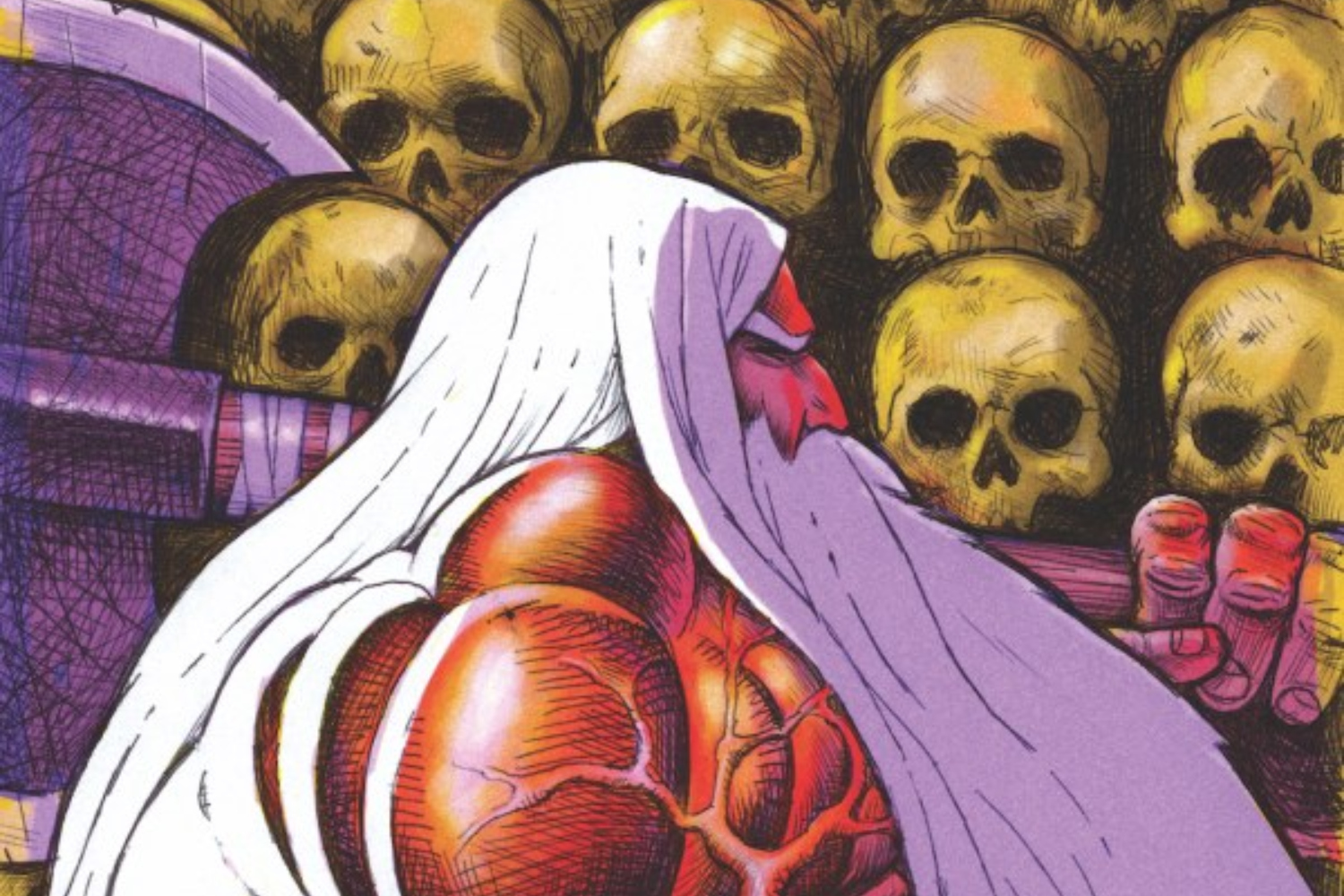

This month, Head Lopper commemorates 10 years with a brand-new #1 that kicks off volume five. And no one is perhaps more surprised at this very fact than series creator Andrew MacLean.
“I can’t believe how many years this has been,” MacLean said during a recent Zoom call. “Here I am 10 years later, still drawing a character who’s whole shtick is cutting the heads off of monsters and bad guys. I’m just kind of stunned.”
Yes, Head Lopper is just as direct and straightforward as MacLean suggested. Across the first four volumes, we follow Norgal (Narschlahn’s mightiest warrior) and Agatha the Blue Witch, whose severed head is carried around like so much complaining luggage. Together, the two fight monsters of all shapes and sizes across the Isle of Barra in what’s basically “Conan if made by a heavy metal fan” (per MacLean).
Yet Head Lopper is so much more complex than such massively bloody indulgences. While it might seem like an excuse to draw dope beasts and sword fights, understanding MacLean’s connections and overarching relationship with the book reveal some proper layers. And if you understand the layers, then you see Head Lopper as this interesting, thoughtful vehicle for how MacLean creates and disseminates art and stories for the modern age. In short, Head Lopper is a certain kind of brutal magic.
Now, grab your giant blade and lets cut into this beast.
“Is it Fun?”

Main cover by Andrew MacLean. Courtesy of Image Comics.
Like magic, Head Lopper always has to be fun.
MacLean is quick to admit that if that weren’t the case, “I would do a different book,” adding that Head Lopper is a “bit of a gift to myself. I can keep making it fun for myself.” (He also could’ve used all this time to “read a novel or watch a TV show.”)
And that’s no dig on literature, folks — it’s MacLean ensuring lasting honesty about his work and relationship to comics at large. Specifically, they’re damn hard work, and if you ain’t having a blast, then you’re wasting everybody’s time.
“I like to draw monsters. I like to draw magic. I like to draw fight scenes. I love to write and I love to put these stories together,” MacLean said. “But a vast amount of time is drawing – you can write even a long script within a week and have it pretty polished. Now I’ve got to spend three, four, five, six months drawing it.”
Yet MacLean’s dedication to fun isn’t entirely about sustaining his own interest. He thinks that far too often in comics, people ignore the power of what it means to genuinely and earnestly enjoy these stories. Similarly, MacLean also admits to not having a vision going in, adding that he was content to “built it piece by piece, until all of a sudden there’s this big world that unravels.”
MacLean added, “I think we talk ourselves out of just having fun, as opposed to just trying to do something impressive. That has its place, but it isn’t always the most important thing. But you can make things that are, on their surface, not totally original, but are still really fun.”

Variant cover by Alex Horley. Courtesy of Image Comics.
Case in point: a couple years back, MacLean got to write a Godzilla OGN, War for Humanity. That book wasn’t about breaking new ground, but doing something truly worthwhile.
“I also did my own comic called Snarlago…I’m not really trying to necessarily give you an idea or kaiju you’ve never seen before,” MacLean said. “But if you’re a lover of the same kaiju movies, you’re going to feel it. You’re going to have a real love for that thing. I’m going to bring my own thing to it just by the very nature of me being a different person than the other people who created it.”
And he very much invites other comics writers/artists to think about their efforts in the same framework.
“If you want to draw noir, you don’t necessarily have to make it a western sci-fi noir, you could just make noir,” MacLean said. “So what if it feels ‘unoriginal;’ is it fun? Like, what’s the experience you went through and what’s the idea behind the story?”
“A Fantasy Vacuum”

Variant cover by Dylan Burnett. Courtesy of Image Comics.
You can find some of those ideas at work in Head Lopper: The point is the story, and the promise of bloody beheadings is enough adventure. And you can’t deny the impact of MacLean’s “novel approach.” With Head Lopper dating back to a 2013 self-release, I asked MacLean if he thinks he was “responsible” for the proliferation of fantasy stories/titles in recent years. Short answer: kinda, yeah.
“I’m a little bit of a creator’s creator, or an artist’s artist,” MacLean said. “A lot of people who like my work also like to make things themselves. I have some friends who told me that they read Head Lopper and wanted to make a book themselves.”
Rather than taking direct credit, though, MacLean mentioned that Head Lopper achieved something that someone else was bound to have done had the book never dropped.
“I also feel like there was a little bit of a fantasy vacuum, because that was what I was craving at the time,” MacLean said. “Anytime you have something that’s missing from the market, something’s going to come in. People in my age group, they’re probably watching the same movies that I did as a kid, and then probably also sensing a little bit of a vacuum or something.”

Variant cover by Jeffrey Alan Love. Courtesy of Image Comics.
What MacLean will take more credit for, however, goes back to his comments about being unafraid to tell “simple,” massively exciting (and often genre-centric) stories. Complexity is often overstated, and there’s real power in earnestness above all else.
“I hope I just showed some people that you can have fun with fantasy because sometimes it’s taken so seriously,” MacLean said. “I just don’t think it’s necessary. Or, it’s OK to make comics that are a love letter or even straight at the genre.”
If you think fun just means short-term excitement over long-term prospects, you’re way off base. Early on in the interview, MacLean shared another anecdote about why he began Head Lopper in the first place. It’s another silly idea, generally, but it speaks to how to position that core joy and still achieve long-term ramifications.
“One of the things that made me want to really turn this book originally into a series back in, like, 2011 or something, was just this funny thought that I had that I always had about a band’s hit song,” MacLean said. “Like, they better really like their hit songs, because if they’re lucky enough to still be playing 30 years later, they’re playing a 30-year-old song every night. So I was thinking, ‘What if your character is your hit song?’ Imagine working one character for 20 years, and all he does is chop heads off.”
“Read it and Just Feel Excitement”

Variant cover by James Harren. Courtesy of Image Comics.
But while Styx have have been playing “Mr. Roboto” for literal decades, MacLean did step away from Head Lopper for a time. Volume four came out in summer 2021, and after that he set to work on other projects (including the aforementioned Godzilla tale).
“I don’t even care about trains, but there’s this great meme that’s taken from Wallace and Gromit,” MacLean said. “It’s where Gromit is riding on a toy train and he’s laying the toy tracks immediately in front of the train.”
MacLean added, “So that’s how I felt Head Lopper was for me – it was such a labor to draw the books and actually turn them in on time. I wasn’t spending enough time building the world and really having an idea of where I wanted to go.”
But rather than abandoning the project outright, MacLean used this time to “take a step back real quick, and make sure as I move forward with this universe, I know exactly what this world is and where I want to go with it.”
Some of that planning was surface level. MacLean said that in recent years, he’s been able to decide on several “rules” for the world of Head Lopper, like never calling dragons by their name, avoiding the use of electricity and technology, and even making sure magic is kept to a minimal to maintain its relevance. MacLean added, “I want the world to feel independent of the fantasy worlds. Even the idea of Agatha – a talking severed witch head – people should always be shocked at her just existence.”
During the hiatus, MacLean was also working on a cartoon adaptation of Head Lopper. While that project never came to fruition — he says there’s a chance down the line — the process let him do more of that planning and world-building.
“I had to write a few episodes, and I just wrote so, so much for development. I got a ton of practice writing while I was gone,” MacLean said. “I was planning the rest of the comic and figuring out, ‘What does this whole thing look like? Where am I going with it?’ Because at that point, I was thinking about it in the big picture, and spending more time thinking about the big picture than ever before.”
And, unlike even that whip-smart Gromit, he was going to plan smarter and harder.
Added MacLean, “I think having that clear picture and knowing – to use the Gromit train reference again – that, ‘I’m going to collect all the pieces of track that I need so then I can get them laid now up front.’”
The break also offered a chance for MacLean to further evaluate his creative habits and general attitude. He actually got to work on his drawing skills/techniques, and to open himself up to new approaches that filtered directly into Head Lopper.
“I’ve spent a lot of time looking at these ‘60s and ‘70s horror manga that I love,” MacLean said. “I’ve just learned a lot from those older mangaka of when to draw flashy and then when to draw legible. I obviously enjoy drawing, but clarity for me is king – I don’t really want to lose the reader, because I wanted to draw messier or something.”
As an extension of the creative “excursion,” MacLean made ample time for personal introspection. Because as certain as he’s always been about this project, even MacLean had manage his ego as the book first took off.
“Before Head Lopper, there was a time, as much as it was worth the effort, I was just pretty sure I was never going to be a published, successful creator. I just thought the stuff I wanted to make was maybe too weird or something,” MacLean said. “I felt my sense of humor creeping into my work — I think this is funny, but it doesn’t mean they’re going to think it’s funny.”

From Head Lopper #1 (2026). Courtesy of Image Comics.
Now, thanks to a little distance and perspective, MacLean has a rather solid idea about the book’s impact and longevity.
MacLean mentioned that people were possibly “surprised to see fantasy look a little different,” with Head Lopper leaning into a “simpler,” decidedly more colorful palette. As an extension of that, he tried to give people something that energized and engaged them.
“I want you to read it and just feel excitement,” MacLean said. “I’m not trying to hit you with crazy cliffhangers or anything. I’m just trying to make you feel that, when you sat down with it, you’re like, ‘I just enjoyed my time.’”
And that last idea seems especially significant. People come to comics for many reasons, and it’s not always so easy to suss those out. With MacLean and Head Lopper, though, fans can always find someone who wants to make them happy (often via ample beheadings, of course).
“My guess is that it has something to do with the vision I had for this come,” MacLean said of the book’s popularity. “At the time, I wasn’t enjoying very much other than Hellboy, and I needed something fresh in comics to get me excited. So I challenged myself, ‘What am I looking for out there?’”
“A Pure Imagination Place”

From arc two, “The Crimson Tower.” Courtesy of Image Comics.
Of course, what people are looking for does always seem to change. Luckily, some of MacLean’s time away crystalized another important lesson for the artist-writer.
“I try to change the story formula for each volume, and to shake it up and introduce new things,” MacLean said. “I push the story toward a larger story more and more as I build out the world. But it’s become this vehicle that can become any type of story I’m in the mood to draw. I do think that I think you can use a fantasy world to tell love stories or suspense or horror. There’s a lot of room for that, and I like to play with that myself.”
It’s part of what MacLean describes as an aversion to “very traditional format of storytelling,” adding, “I think of things in a little bit of a weird way.” And you can see that in the development and evolution of Head Lopper.
“Volume one, I consider that very A to B,” MacLean said. “It’s like, ‘Norgal, go cut that head off.’ And then it’s a series of trials from A to B.”
Then, things got a little more complex (but not overly so, of course.)
“Volume two was an elimination game,” MacLean said. “It’s like a Zelda game where you go in and the door locked behind you. Who is going to win?”
From there, MacLean did his best to make the tires truly fall off.
“Volume three, it was about war, and so the formula was all about chaos,” MacLean said. “It’s playing pinball and then you have five ball drops in on you. How do I keep pinging characters off each other so that each time they meet, they affect that character’s next choice.”
And choice was an even bigger thread of volume four.
“So by the time I was hitting volume four, I was like, ‘I really want Norgal to start being more proactive in this,’” MacLean said. “He’s not the type to just sit around and continue to be hunted and pick a smaller and smaller cave until you’re a hermit, hanging out with a talking severed witch head that hates your guts. If he can find the head to chop, he’s going to go get that.”
And in the process of leaning into Norgal’s whole “offense as a good defense” approach, our fave warrior and his decapitated friend have found themselves smack dab in some exciting new surroundings.
“So the vast majority of this story takes place on a casino barge,” MacLean said. “This barge has all these monster fights and stuff for people to bet on.”

From Head Lopper #1 (2026). Courtesy of Image Comics.
But it ain’t just about sweet monster-on-monster action, either. Head Lopper‘s fifth volume is not only another example of MacLean’s interest with infusing genre, but it may be the series’ most compelling offering to date.
“This new volume is largely what I call in my head ‘a train story,'” MacLean said. “I love stories that take place on trains because it confines the characters’ action so much. It makes characters interact with either people or things that they would much rather avoid.”
MacLean added, “So much of this next story is kind of a whodunit. They have some clues that they’re going to try to find this person, and they’re going to try to find this creature, but they don’t know who they are and they don’t know what they look like.”
Sure, it’s your standard murder mystery — MacLean said that while there’s “no literal murder, it might as well be because it’s a fun formula.” But there will be an actual mystery to solve, and MacLean is using all of his newfound skills/knowledge to build the best walnut for our sleuthing.
“I get to really play with misdirecting the audience in a way that I haven’t really done before,” MacLean said. “They’re looking for a person, and they’re looking for a monster, but it doesn’t matter which they find first.”
As such, MacLean is hoping to maximize the audiences’ engagement as much as humanly possible.
“I’m really excited to have this web of stories,” MacLean said. “Sometimes when you’re watching TV or a movie, it’s fun to play the game. You want to solve it before everybody.”
However, if you’re worried Head Lopper will venture too far from its “roots,” MacLean mentioned that it won’t feel too much like a mystery and that there’s still “awesome fights and a cool adventure.” (Similarly, while MacLean worked to make this volume accessible to new readers, it still takes place 10 days after volume four.)
This volume also connects back to the rest of the series in other, more “significant” ways. Back in volume four, the team encountered a Gorgon as they attempted to “liberate” a legendary hammer. And with more monsters in this volume, it’s more of chance for MacLean to lean into his influences/inspirations.
“One of the reasons I wanted to make this comic was my love for Ray Harryhausen’s Clash of the Titans and the Medusa scene specifically,” MacLean said. “Because this volume has a monster arena in it, I’m really trying to lean into some of my love for those nostalgic creatures, those Greek and Roman creatures and inspirations from toys from when I was a kid. I’m enjoying the process, and that’s one of the ways to take a creature that you already love and bring it into your world. I want to try to do that for the rest of the series, really.”

From Head Lopper #1 (2026). Courtesy of Image Comics.
Now, MacLean is quite aware of what he’s trying to “sell” with this new Head Lopper story, and how vital that balancing act can be for the series’ long-term prospects. Yet all of these “changes” are ultimately in service of what this book has always been about: pure, unfettered joy and connection.
“You are creating a product, and you’re going to have to try to sell it eventually,” MacLean said. “But as much as possible, I just try to create from a space of pushing that out of my mind and try to get to – what I would consider – a pure imagination place. Where it can be playful and where you can try to enjoy yourself. I try to enjoy my time when I’m creating, and if I have fun making it, you’ll probably have fun reading it.”
Yet for all this talk of imagination and engagement, it’s not entirely about feel-good concepts like sharing and collaboration. For as much as Head Lopper is a response to seeking more joy, it’s also a response to how MacLean views the role of art (to an extent, of course).
“I wasn’t going to try to teach you a lesson. There’s no themes, it’s adventure – the theme is adventure and fun,” MacLean said. “Some of my own philosophies creep in now and again in some role. But I try not to soapbox on it. I try to be governed by fun and clarity and adventure, which I think are simple things.”
“That’s Soapbox Enough Already”

From Head Lopper #1 (2026). Courtesy of Image Comics.
It’s not just about Head Lopper doing something new as set dressing and leaning into tried-and-true monster battles. This volume does “soapbox” more as MacLean tackles the core relationships in some new and interesting ways.
“To fall in love with a character and be invested…you’re already taking enough of an empathetic roller coaster with them,” MacLean said. “And that’s soapbox enough already. It’s being vulnerable enough to feel that connection with the character who doesn’t technically exist.”
More specifically, we’re talking about the Norgal-Agatha relationship, which MacLean described as the “glue that holds the fate of this world together.” He believes it “should change over time, but I think it naturally changes over time.”
MacLean is quick to add, however, that it’s inherently a “shallow” relationship. Likely because they not only knew each other on page one, but both of them are incapable of greater change (at least in an obvious sense).
“More than any other character, Norgal keeps up a brick wall with her, and he has this resentment for her,” MacLean said. “It started with resentment and he’s still there. Like, he sees her value more than when they first met. At first, he was just pissed that he was put in charge of this witch’s head. He knows how much he needs to take care of her in all ways; he doesn’t really want to talk to her. He just has no patience for it, and he’s going to have to get better at that.”
And Agatha is very much the same: they both seem to think they’ve got it all figured out, and no one can tell them otherwise. For all their in-fighting, this most unlikely of duos still cares for one another — in their own extremely weird way, obviously.
“As time goes by, again and again, they save each other’s lives,” MacLean said. “And they choose to over and over again. So for all of their absolute hatred of each other, they rely on each other more and more. They’re still just not fans of each other. The more these two spend time together, the more history they have together. Those are more and more shared experiences.”
As such, the tweaks and developments across Head Lopper volume five offer MacLean an important opportunity to extend out and play with that increasingly robust history between Norgal and Agatha.
“One of my joys of making this book is to continually shuffle the deck of who is in Norgal and Agatha’s radius and in their group,” MacLean said. “I want to separate them in some way and I want to put one in peril and the other one has to watch. I want to see how they react to each other over time. But I want it to be subtle, because they’re both very, very specific about who they are.”
That aspect, then, speaks to a larger function of Head Lopper, and one inspired by other beloved fantasy franchises. If you have enough time and space to play with, you can do so much to build not only the world but push the characters into new and exciting scenarios/circumstances.
“One of the fun things about reading Conan books are just how many different adventures he’s had,” MacLean said. “It almost seems like he’s had so many lives and so many roles. And I love the idea of doing that with Norgal and Agatha. They’re going to meet new people along the way. Even though I have this overarching, bigger story that I’m leaning into more and more with them, I still love the idea of kind of filling in the gaps. I’d love to someday go back and be like, ‘Alright, this would have happened, like, 10 years after that thing,’ and put in little standalone stories.”
“…Doing Mercenary Shit”
That “Conan-esque” approach seems like it’ll be an important part of Head Lopper beyond this latest volume. Because as impressive as 10 years may be, MacLean has even loftier plans in mind for his beloved series.
MacLean said that he eventually wants to get to volume nine, explaining by that point that “Norgal will have met all of the deities. He will have traversed every part of the map.”
And, sure, he admits that there are still “times where it’s completely exhausting, and I’m like, ‘I don’t want to do this.’” (He said that you’ll know he’s truly bored if he ever “changes Norgal’s design…I would give him a new costume or haircut or something.”) But that’s less of an issue as he can eventually focus on so many others beyond our leading duo.
Case in point: Arlen, a “Second Sword” from volume three responsible for protecting Venoriah. While Norgal and Agatha have moved on after the city’s destruction, MacLean still sees ample story opportunities for Arlen in the wake of a “new” city.
“It could be a little spinoff comic about the problems that they’d be having with trying to fix the city while goblins are sneaking in,” MacLean said. “That whole city is ripe for a Game of Thrones-style story.”
He’d also like to do “a whole volume of one-shot adventures, like Lone Wolf and Cub-style adventures where they’re just doing mercenary shit.” And if he can get to volume nine, MacLean might even be interested in bringing in other creators for an “annual with four stories by four other creators.”
Added MacLean, “I have so many spinoff ideas that I’ll never get to. I’m going to try to do it as long as I enjoy it.”

Andrew MacLean’s “I Hate Fairyland Team-Up Variant.” Courtesy of Image Comics.
Regardless of the book’s future, MacLean knows Head Lopper is already a rousing success. Not because of its sales or longevity, but because he gets to return to these characters again and again, with an audience ready to follow along each time.
That freedom has allowed him to stick to his instincts, and to keep the series fun, flexible, and entirely his own. It may not aim to be the most introspective book on the shelf, but for a decade Head Lopper has delivered exactly what it sets out to do: entertain with clarity, energy, and a voice that never once compromises.
In the end, that’s the whole pitch: It’s big, bloody, and unapologetic, and it’ll cleave the boredom and apathy right out of your mortal soul.
“The greatest warrior has a knack for lopping heads,” MacLean said of an elevator pitch. “A little more than a knack, he’s downright casual about it. Mostly he leaves them where they land, but there’s one that he carries with them. They say you can hear it chattering, haunting his every step, mocking him, taking cheap shots, and just generally being really gross.”
Head Lopper #1 (2026) is due out April 22 via Image Comics.



You must be logged in to post a comment.