


If the theme of issue #3 was thoughtful transcendence, then Tigress Island #4 is all about sharp and jarring growth.
With the girls (Bridget, Lonni, Yulia, Hema, Delight, and Vanessa) out of the complex and into the nearby jungle, the penultimate issue doesn’t waste much time in setting up some very big stakes. And in a book that’s never really played it safe — this is, after all, an exploitation comic about women being kidnapped for sex trafficking — Tigress Island #4 feels absolutely dangerous and unrelenting in all the very best ways.
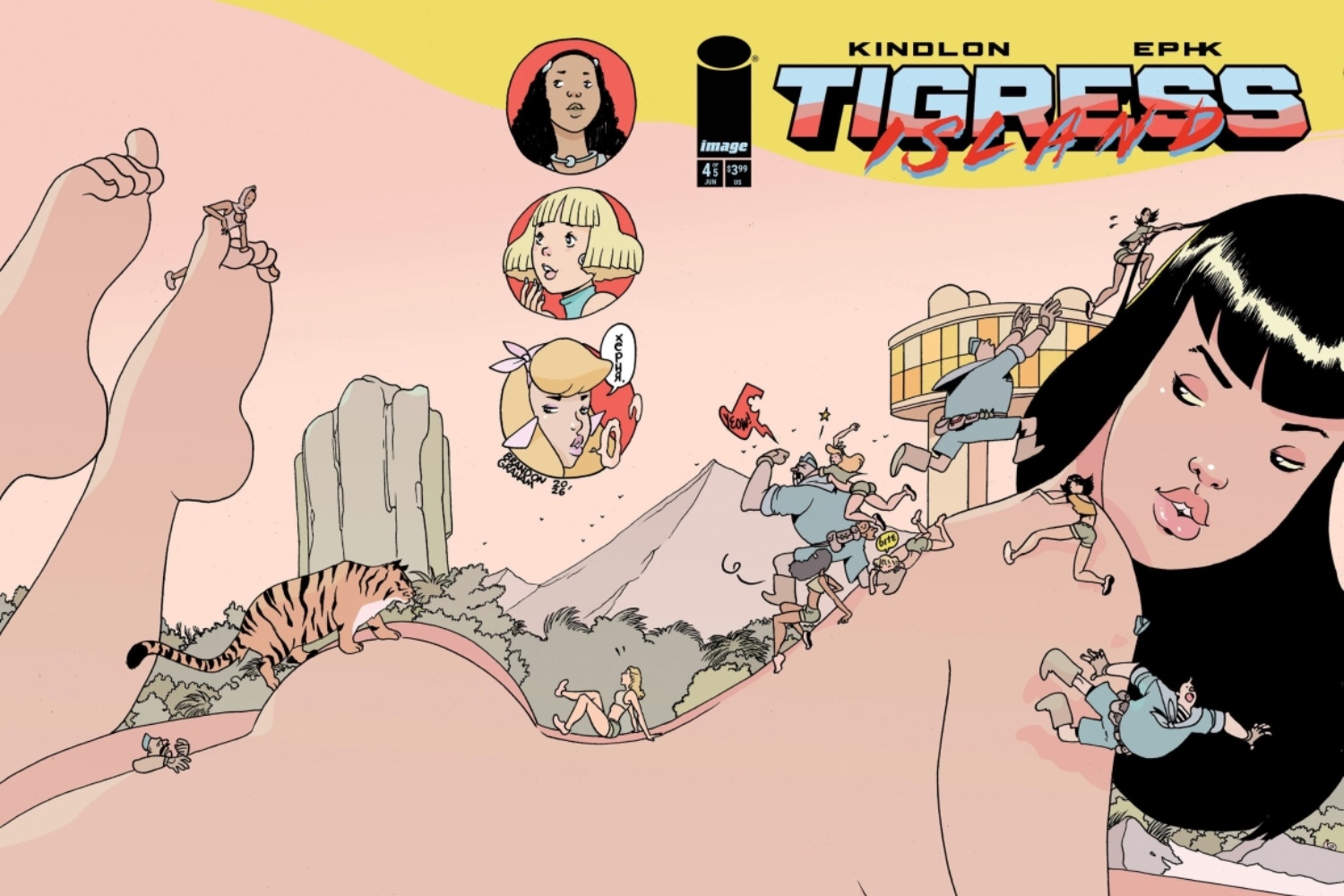
Perhaps the “least” exciting development has to be the jungle that our team finds themselves within. Just as he did with the Cold War-esque bunker, artist EPHK gives us something really cool to latch onto and explore. It’s very much WWII island warfare meets something from a lost Indiana Jones sequel, the kind of dense, sweltering jungle where every leaf and rock is unknowingly dangerous.

Main cover by EPHK. Courtesy of Image Comics.
EPHK also spins in cultural themes and tidbits from all over (Indonesian is mentioned in a subtle but effective bit of worldbuilding), and so this terrain feels familiar but strange in so many different ways. It’s the thing that brings this issue to life, and makes it clear the ladies have tumbled from one dangerous setting to another in what’s a really strong bit of storytelling.
At the same time, this jungle setting is different in that it offers up a couple new players. One is an old A-list actress who may or may not have fallen prey to the same traffickers. (More on her in a bit.) And the other is a man who, quite similarly, may have once held heaps of power only to lose it outright. The man, then, is perhaps the most obvious gesture of the exploitation genre we’ve seen so far in Tigress Island — a bit of wish fulfillment.
Sure, his inclusion is a little cheap, but writer Patrick Kindlon positions his role in a way that, hey, maybe our team has earned a little “beat up the tiny man” as this delicious bit of social commentary. Yes, he serves other roles in the issue (responsibilities that prove narratively significant), but he’s mostly a punching bag. Truly, it’s a sign of how well this story has developed that we’ll absolutely relish his well-deserved treatment by these women. I mean, not that reality didn’t already do much of the heavy lifting.

Variant cover by Bangbez. Courtesy of Image Comics.
The other character, our older actress, feels a wee bit more vital. In some ways — thanks again to the expert ways in which EPHK implements flashbacks — she feels more fully formed than the team. Or, at the very least, she becomes as significant in just a page or two. (I feel lame mentioning the flashbacks with every review, but they’re so far well done to explain and poke us without hampering our immersion.) The same goes for a group of all-women who have occupied this island for some time; perhaps they’re not as robustly developed, but it’s all part of building something larger. All of them (the island, the women, the actress, our squad, etc.) are part of this history, and things feel laid out in a way that’s increasingly telling.
At the end of the day, it’s this robust effort to thoughtfully and utterly contextualize what’s going on here, and to place the ladies in a grander historical context of suffering and abuse. There is a path forward for them (in one way or another), and their struggle is just not their own. It’s maybe one of the best ways that Tigress Island’s core themes and interests come alive, and how hope and reality interplay to really make us feel the massive weight of these women and the structures they’re helping us comprehend.

Courtesy of Image Comics.
It’s another way that the creators are thrilling us but also informing and empowering us, showing us that this island has existed forever and that the girls’ actions add to this narrative against patriarchal power while fostering a celebration of genuine communal collaboration. Again, it’s never so obvious — because the creators have always respected our savvy — but just another way they reward enthusiasm and engagement with this story that’s as much an adventure (with guns and snarky asides galore) as it is this thoughtful dissection of what society has done to women for years. That, and how maybe we can oppose it (by embracing this ugly history and owning up to our intended and unintended contributions).
No one gets to feel really good about it all, obviously, but we’re never made to lose all hope — Tigress Island is about awareness and accountability above all else. As such, it feels less like overt optimism and more like a coming to God moment, and it feels all the more satisfying for its unblinking tendencies.

Courtesy of Image Comics.
You’ll see some more such intensity in the “treatment” of our new cast mates. Without revealing too much, the creators use these characters in a way that respects them but doesn’t mitigate the value of our core team. And at first I was genuinely afraid that, given the grade A rollout of the older actress especially, maybe the squad themselves would feel less significant. That all of their small but potent development (the flashbacks, their strategic reveals, the whip-sharp dialogue, etc.) would be mitigated.
But that’s not the case, and the creators here are skilled enough to move in other directions without denying what’s made Tigress Island work — not only the squad’s dynamics, but the overall tightness and efficiency of the narrative. It makes these new characters feel special and important even as they’re very deliberately positioned in this story.
It’s an attitude that is further maintained when it comes to subsequent “developments” around the main cast. Now, I won’t say what happens to whom, and the severity of said event, injury, etc. But given the nature of the story, and the unrelenting tendencies of its creators, you had to know some things would happen to the cast eventually. What I will say is that, in the two real instances that occur in Tigress Island #4, they’re different enough for all the right reasons.

Courtesy of Image Comics.
One is quick and brutal, which feels significant in kicking us in the guts in a way that’s continually honest to the story. And the second is a little cheesier and more revealing, which feels like a solid counterbalance. Nothing is sacred but everything still gets treated as real and deeply human, and that’s the kind of integrity that has made this book so vital. That, and these moments feel “earned” in that they’re happening at the right time and with the right tone/pacing to make sure the story really sings. There aren’t always happy endings, but you can be happy knowing that nothing is trivialized or taken for granted.
And that feeling, more than perhaps anything else, is exactly what I want to carry forward into Tigress Island #5. I certainly have some idea about how it might all turn out for the girls and the island at large even if I’m not 100% certain. Things simply extended and leapt too much in issue #4 for that much certainty (and that’s obviously a good thing), and the story is in some very different waters (even if the arc of it all makes total sense).
If we keep up this pace for the grand finale, I think the overarching theme will be “Man, Tigress Island really messed us up with its truly sublime power.”




You must be logged in to post a comment.