

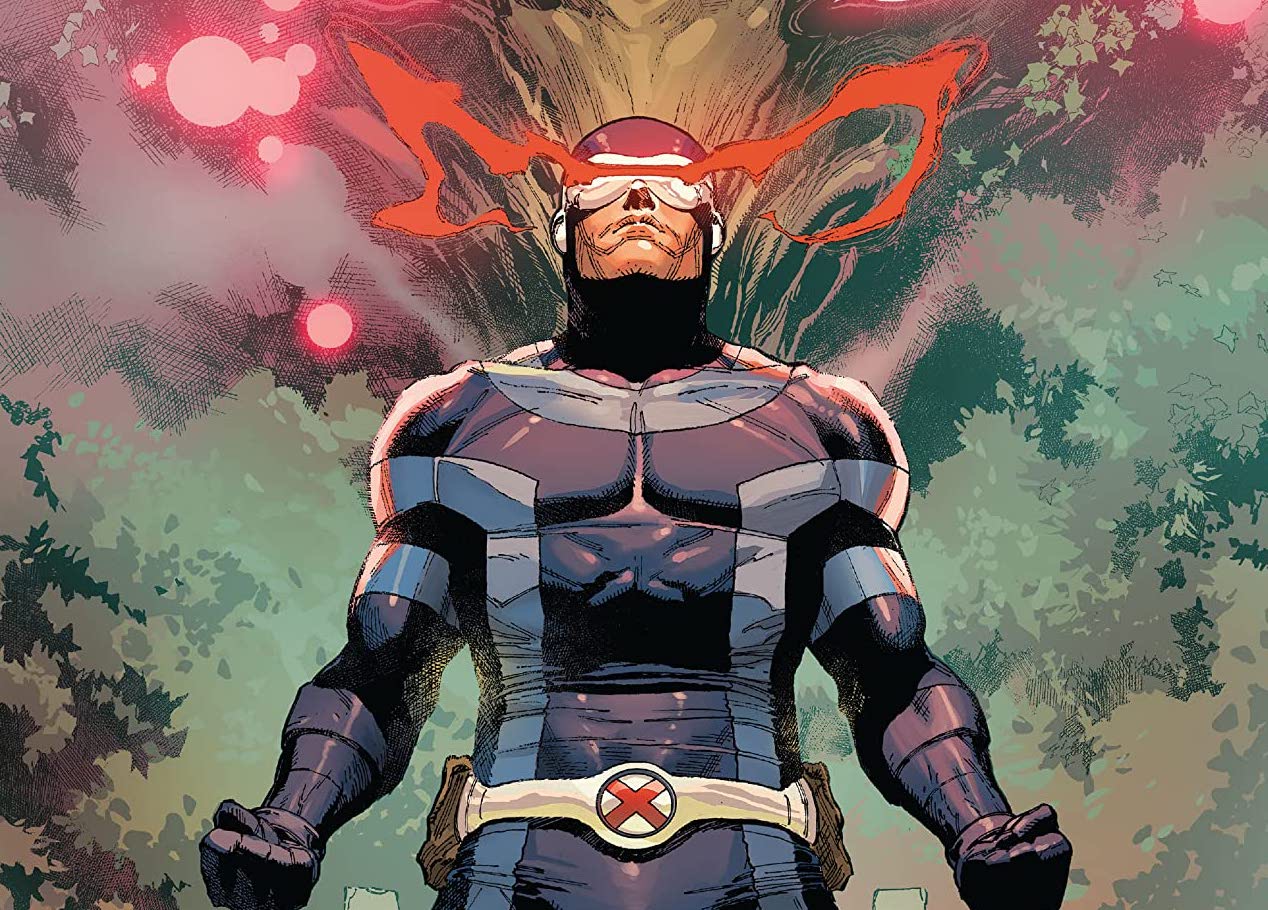

For what is undeniably the superhero equivalent of buying high concepts in bulk, the Krakoan Age of the X-Men has presented, over its many titles, an endless array of new ideas applied to classic, familiar characters. A line-wide reimaging that looks caringly and with high attention to detail to nearly sixty years of continuity, one-off characters, and the minutia of all powersets, it not only looks back but unerringly forward; no title so much as X-Men.

Marvel Comics
In nearly every one of its twenty-one issues, writer-architect Jonathan Hickman (alongside a who’s-who of some of the greatest contemporary artists) has introduced something undeniably new. New villains (or new contexts for old villains), new concepts (building on an abstraction of old concepts), and new ideas (liberally built from very small details). Of all the books, it’s in this last run of X-Men where the weirdest, most high-concept ideas get set up, all for future stories to examine.

Post X of Swords and pre-Hellfire Gala, X-Men by Jonathan Hickman Vol. 3 deals with a huge swath of seemingly disconnected narrative threads. Two sentient islands refuse to communicate; there is a Shi’ar conflict in deep space; a time-sped pocket dimension pushes three young X-Men into hyper-evolution; Mystique gets burned by Xavier and Magneto; the horrifying future from which Nimrod sprang becomes present. Any of these ideas could take up an entire story arc to themselves, an entire trade’s worth of content, and yet all of them (and more) happen in the space of the volume’s five issues.

Marvel Comics
Somehow, this isn’t the case of too-much, too-fast; instead, this is essentially the central purpose of the book. Ever the workhorse, Hickman is churning out the nuclei for story after story, presenting not-quite self-contained snapshots of what it means to be a mutant in this brave new world. Where books like Marauders and Excalibur are showcasing incredible, long-form narratives with a concrete cast and narrative through-line, X-Men wants to be the issue-by-issue equivalent of an establishing montage. This is what X-Men stories will be, now, the book seems to be saying.
This heady (and sometimes disorienting) barrage is never undercut by not seeing any particular concern resolved. Each dangling thread only makes the reader eager for the future.
The longest story — stretched over two whole issues — in Vol. 3 is a perfect distillation of the sorts of “Um. . . What?” high-concept heavy-lifting the book excels at. Issues #18 and #19 concern themselves, as per usual, with an eventual threat to the mutants on Krakoa: the Children of the Vault. The Vault is a pocket, time-compressed world, the occupants of which are subjected to thousands of years of evolutionary pressure. The Quiet Council decides to send someone in to assess the danger of those occupants, who have been gestating for an unknown amount of time. With the usual penchant for looking at old characters under a new light, the Council sends in three mutants who might be able to survive for generations. Laura Kinney, whose mutant healing factor was inherited from a certain Very Old Man; Darwin, whose entire mutant gift is rapid evolution, providing his survival; Synch, whose power is to have their powers, becoming a backup — an extra set of eyes to survive with information if either of the others gets killed on the mission.

Marvel Comics
You know, just the easy-listening sort of comic books.

Marvel Comics
Given its jumping around, Vol. 3 is able to jump styles and tones — a shift aided by the shifting artists. Krakoa’s politics are handled by Phil Noto, whose style is almost becoming synonymous with the Krakoan Age after his run on Cable and turns or covers on a handful of the other books. Space is handled jaggedly and kinetically by Brett Booth; Mystique vs. Nimrod gets the Francesco Mobili treatment.
The Vault, with all its advancements, is rendered full cyberpunk by Mahmud Asrar. He gets to play with multiple iterations of the characters, exploring how they might age or vary with evolutionary crunch, and his style in doing so is a joy to see.

Marvel Comics
For those of us fully committed to the Krakoan experiment in all its messy and mind-blowing splendor, this run of X-Men is a conceptual feast. It isn’t, however, the most accessible book when taken as a whole, its refusal to settle on any one narrative to resolution potentially infuriating and alienating for those wanting to dip their toes in. X-Men: Volume 3, then, is a great showcase, but it never manages to get as comfortable with itself. It never manages to feel as warm and inviting as people might expect from their favorite mutant team of old. For that, they’ll have to wait.




You must be logged in to post a comment Login