

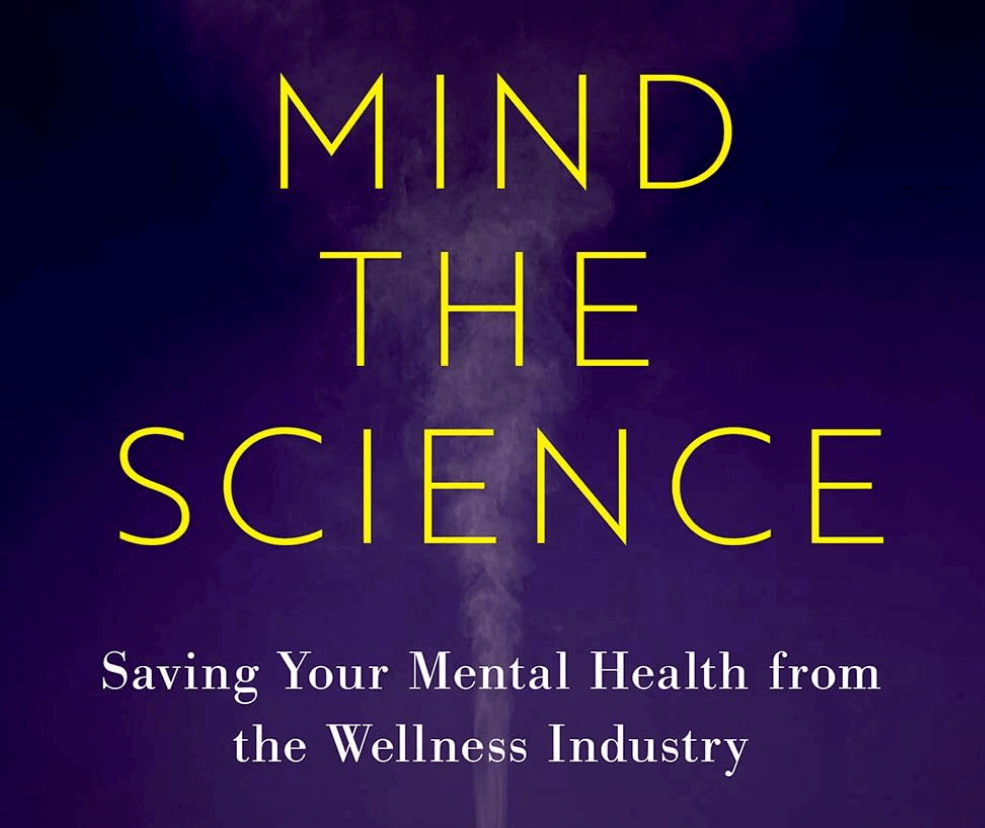

Pseudoscience abounds in the wellness industry, and it can harm people in multiple ways. In his new book, details stories of that harm, and brings the reality of pseudoscientific modalities into harsh relief. And yet this is tempered by a very raw and personal story of the medical establishment, not pseudoscience, failing someone very close to him.
It’s there we begin to see Mind the Science diverge from traditional skeptical literature and chart a course that doesn’t merely ridicule pseudoscience, but actually attempts to meet the reader on a basic human level. Additionally, it’s an important point of clarification. Stea is a Clinical Psychologist doing real scientific research. It might be easy for a reader to assume the author is biased and otherwise predisposed to defend science and established medicine, yet he shows how he’s not. Simple black and white logic will not suffice in this discussion.
Mind the Science also introduces us to cases Stea’s had firsthand experience with. From addiction to kratom and fentanyl, to debilitating obsessive compulsive disorder, these cases weren’t just difficult to read because of the human suffering — they illustrate how anyone can get lost down an unfortunate path of pseudoscience. We’re often led to health pseudoscience by word of mouth from well-meaning people, but those suffering from treatable mental illness can still end up wasting time and money, and in the process suffering further from treatments that don’t work. Quick fixes for mental illness just don’t happen.
In a particularly enlightening section of Mind the Science, Stea gives a history of the anti-psychiatry movement. Fascinatingly, he points out that regardless of their methods, this movement largely achieved its goals by the 1980s. For example, pushing for more rigorous scientific and ethical standards, more effective legal and regulatory structures and oversight, etc. However, as the movement has stuck around past its point of relevance, its most vocal members are now largely purveyors of misinformation and conspiracy theories, and are actually hindering evidence-based care and chronic suffering.

The signs to look for
Mind the Science takes us through the origins of the wellness industry and what characterizes it today. Stea adroitly weaves together the common tropes and contorted manipulations that the worst wellness grifters utilize, and shows us how they’ve used terms like “alternative medicine,” “integrative medicine,” and “functional medicine,” among others, to confuse people and make their products sound effective. The sad fact is that even the National Center for Complementary and Integrative Health, which itself has changed names at least twice over the course of its relatively short history, continues to waste tax payer money studying treatments that have no prior plausibility.
There’s one passage in Mind the Science that particularly captures something that people too often dismiss, the fact that we actually know that many alternative medical practices do great harm:
It’s easy to trivialize alternative medicine as nothing more than harmless placebos. That’s not what I’m demonstrating throughout this book, and it’s not what the research quantifies. We know that Americans spend billions of dollars per year on dietary supplements despite extensive evidence that most are ineffective and sometimes harmful. More than 100,000 over-the-counter herbal and dietary supplements are available to purchase in retail stores and online in the United States, and they account for up to 20% of adult drug-induced liver injuries, which can lead to liver failure, requiring transplant.
Good science
Trends in misinformation and disinformation are greatly amplified by modern social media. Unfortunately, there’s no clean line between facts and misinformation, nor between science and pseudoscience. Thankfully, we’re taken on an engaging walk through numerous examples of these gray areas in Mind the Science. Stea shows how to use simple, repeatable logic to interrogate claims, as well as the historical and scientific facts of clinical psychology needed to weed out baseless conspiracy theories. He points out that most health claims need to be taken on a case-by-case basis.
The end of Mind the Science is stuffed with a number of detailed and helpful appendices. Did you forget what an ad hominem fallacy is? What about homeopathy; is that a pseudoscience? Stea provides outlines and tables that help you to quickly narrow in on the missing details. It’s a very handy reference, whether you’re a mental health professional trying to help a patient navigate their care, a friend or family member discussing wellness options, or a concerned resident thinking about community health.
Regardless of your prior knowledge, you’ll find each chapter of Mind the Science easy to read, informative, and compelling.
AIPT Science is co-presented by AIPT and the New York City Skeptics.



You must be logged in to post a comment.