

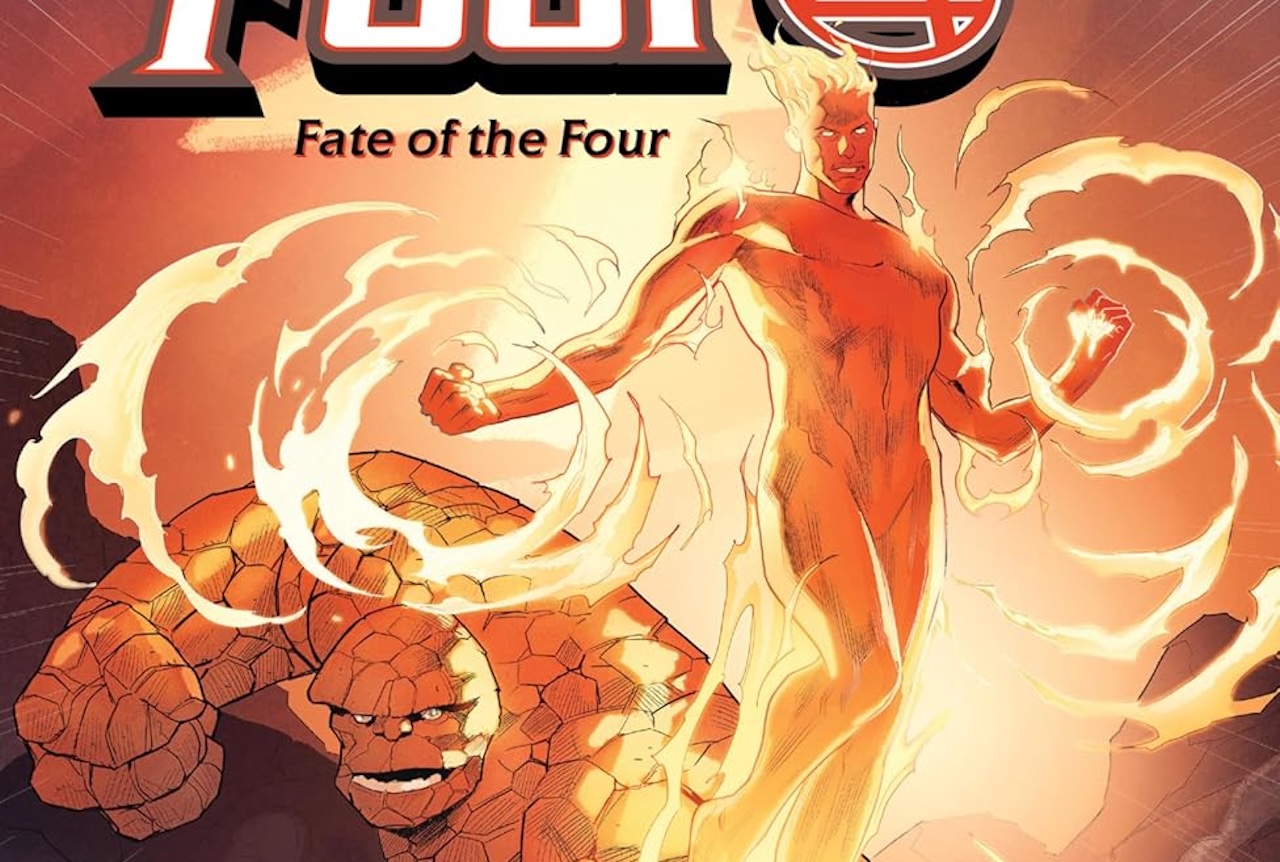

Reed Richards, Sue Storm, and their two children—Franklin and Val—are missing and presumed dead, leaving behind Ben Grimm and Johnny Storm in a world that laments the end of the Fantastic Four. Ben and Johnny’s loss is compounded by the fact that they appear to be losing their powers… but a final gift from Reed might offer a solution: a journey across the Multiverse in search of a remedy for both their power-problems and their grief.
Fantastic Four by Chip Zdarsky: Fate of the Four collects all 12 issues (plus an annual) of a series titled Marvel 2-in-One that ran back in 2017/18. The series is interesting for many reasons, but Marvel historians will likely be drawn to it for the fact that it takes place during the era in which the Fantastic Four ongoing comic had been cancelled for corporate reasons.
Long story short, back in 2015 Marvel Comics—owned by Disney—didn’t own the film rights to the Fantastic Four. Seeing The Fantastic Four comic-book series as essentially ‘free promotion’ for their competitors, 20th Century Fox—who had a new FF movie coming out at the time—Disney cancelled the title, and for years fans were left with no regular Fantastic Four comics for the first time since the series began in 1961.
At the very least, the talented writers at Marvel were able to devise a compelling story-related reason for why the Fantastic Four were no more—read Secret Wars for the details—and Fantastic Four: Fate of the Four picks up in the aftermath of those events. Secret Wars isn’t necessary reading to enjoy this collection though, as writer Chip Zdarsky does an excellent job of conveying all of the necessary information through the plot and characters early on.

Marvel
Fanastic Four: Fate of the Four is primarily a book about Ben and Johnny. It’s no secret that The Thing and the Human Torch have one of the most fun, brotherly relationships in all of superhero history and, if nothing else, Fate of the Four is an excuse to put their dynamic at the forefront for an extended storyline.
That said, while there’s plenty of banter to be had between the pair, the circumstances of this series call for a distinctly more sombre tone at times, which thankfully Zdarsky nails. Grimm and Storm have both suffered an incredible loss, and frequent reminders of this loss adds much-appreciated dimensionality to these already-wonderful characters.
The story is still a ton of fun though. Sure, “a member of the Fantastic Four is losing their powers” has been done plenty of times before, but the way it’s done here really serves to put these heroes at a disadvantage again and again throughout their adventure, and it’s always exciting to see them compensating for their power deficiency with smarts. The reason for their loss of powers is also tied directly to the main plot, so it feels natural.
Adventures across the Multiverse can suffer from a lack of stakes sometimes, but Zdarsky and book’s various artists (such as Jim Cheung, Valerio Schiti, Declan Shalvey, and Ramón K Pérez) do excellent jobs of creating vibrant, new alternate universes. Zdarsky makes the problems plaguing these other universes feel personal for our two main heroes, too.

Marvel
Adding to the charm of the book is the inclusion of the ‘Infamous Iron Man’ himself, Doctor Doom—who has taken to doing good in the aftermath of both Secret Wars and Civil War II. The Annual issue is especially a wonderful exploration of Doom’s character at this point in time, but he adds some much-appreciated snark to the Ben/Johnny dynamic, too.
The book also adds a new character, Rachna Koul, a scientist who specialises in superpowers. Rachna joins Ben and Johnny on their Multiversal adventure, but keeps her cards close to her chest, which lends her an air of mystery. While the character’s developments are enjoyable, the overall story does lose interest in her, and her plot line does end up feeling more like a distraction than an addition. It also wraps up very hurriedly. The secrets she keeps could’ve been used to contrast or highlight the ethical quandary posed by Multiversal travel, but she’s mostly relegated to the background.
For the most part, Fantastic Four: Fate of the Four is an excellent book, especially the first ten issues. That many issues really give the premise room to breathe and explore some interesting corners of the Multiverse. Unfortunately, there’s a huge misstep taken with the book’s final two issues. Essentially, these issues skip past an enormous development that occurred in the pages of a completely different series. (Click here if you’re comfortable knowing what series that is).
Reading this book as a whole will inevitably feel somewhat anticlimactic because of this and retroactively makes much of the series feel incidental and unnecessary, even if it was a lot of fun. Without the context of that series, you’ll be left with tons of unanswered questions by the end of this collection. The storyline also loses Doom towards the end, and his presence is very much missed.
Despite the awkward way the series wraps up, it can’t be denied that Fantastic Four by Chip Zdarsky: Fate of the Four is tons of fun. By focusing on one of the most charming relationships in comics and layering it with both pathos and grand, bonkers, Multiversal adventure, this book is able to evoke a sense of wonderment that Fantastic Four fans are sure to lap up.




You must be logged in to post a comment.