

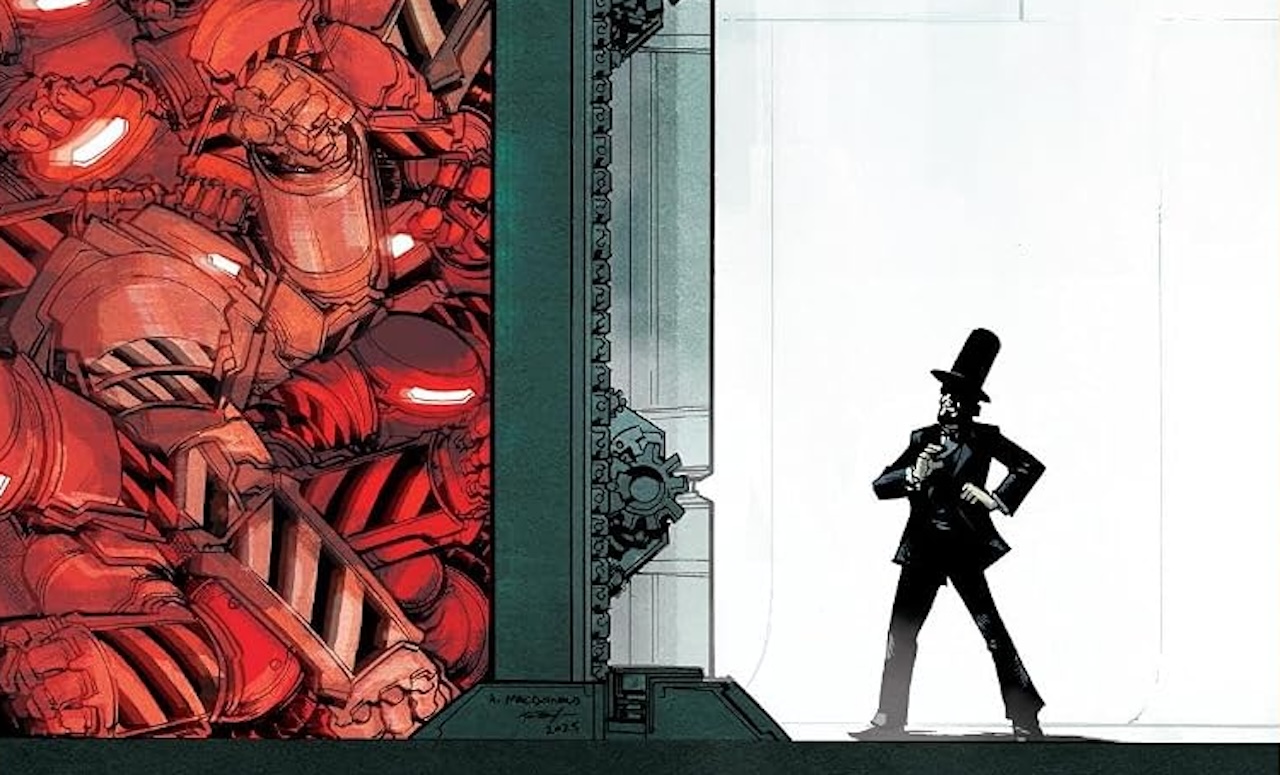

If Destruction Be Our Lot #3 doesn’t waste any time following up on the previous issue’s cliffhanger, its very first page has the animatronic Abraham Lincoln and his new “friend,” Speed, coming face to face with a human girl. Naturally, Abe has questions since all humanity was supposed to be wiped out decades ago. But the girl is in no hurry to answer his questions. On top of that, she, Abe, and Speed have to continue their escape from the processing factory, which holds more dangers within its depths.
At this point, readers have to admire Abe’s dogged determination. Despite all the insults and obstacles hurled at him, he still keeps pressing on, determined to learn the mystery about the little girl. It’s here that Matthew and Mark Rosenberg really hammer home how far apart Abe is from the rest of the world. He doesn’t really fit in with the other robots, as he’s a living reminder of the humans they’ve grown to detest. He can’t fit in with humanity because there’s circuitry and steel beneath his flesh. The only peace he finds is in a broken-down apartment he’s made into a home, where he tends a plant.
The Rosenbergs and Andy MacDonald are also having a great time showcasing the different elements of the robot dystopia. First up is the rest of the processing plant. If you manage to escape, hulking security droids will chase after you. If you fall off the walkway, you’ll be stripped clean by a bunch of miniature robots. And if you’re human, the “decontamination spray” used to clean newly processed robots turns out to be extremely toxic. The previous issue shows that this plant strips robots of their identities, but it can also strip them of their very lives.

Image
MacDonald also fills the streets of said dystopia with a plethora of robotic vices, and just as many robot shapes to carry them out. A towering robot wears a trench coat of sorts, offering other machines spark plugs and memory upgrades. Another bot tries to hold others up for copper using a rusty knife. But the standout is a den where robots gather together and get high on electricity. You read that right. This den is shrouded in darkness, with the only light coming from the flashes of electricity from the “joint” that the other robots are passing around. I don’t know what I’m more impressed with: the way Francesco Segala plays light against dark, or the Rosenbergs’ way of getting robots high.
Hassan Otsmane-Elhaou rounds out the issue by once again giving each robot its own unique style of voice. Some robots have big, blocky walls of text while others merely jabber in code or a more mechanical glint to their words. It’s a small way of showing that each robot feels like its own unique individual, and that the creative team is scratching the surface of a lived-in world.
If Destruction Be Our Lot #3 uses its big reveal to further flesh out its world and to pose lingering questions about identity in the process. It also raises some questions, though my main one is: how does electricity get robots high?




You must be logged in to post a comment.