




Whatever your feelings are towards the work of Paul W. S. Anderson, known for directing plenty of video game movies that have always been a troubled genre, he at least has one great film under his belt. Originally a commercial and critical failure that was released in 1997, Event Horizon has been reassessed as a cult classic that influenced many sci-fi and horror films and video games.

In recent years, there have been attempts to franchise Anderson’s underrated gem – including a television series reported to be in development – and with IDW publishing comic series based on other horror franchises like 30 Days of Night and A Quiet Place, we finally got the official prequel to Event Horizon. Touching upon a major plot thread from the film, this five-issue miniseries explores what really happened to the original crew of the Event Horizon spaceship.
The film gives some insight into the fate of the original crew, positioning this as a prequel puts the comic in a sticky situation, especially in how it opens with the introduction of the film’s protagonist/antagonist Dr William Weir. Following his wife’s funeral, Weir chooses to resume his work as the astrophysics engineer behind the Event Horizon and its gravity drive system. Even though Weir’s tragedy is shown here, as his workaholism led to his wife’s suicide, he serves more as an unnecessary bookend that reminds you that this is a prequel.

IDW
That fleeting glimpse of a character’s tragic backstory becomes a constant theme throughout the main narrative as we are introduced to the crew of the Event Horizon, each accompanied by a caption explaining their occupation and briefly describing what they are running away from. As the first issue ends with the Event Horizon making its gravitational jump, the subsequent issues depict the ship and its crew trapped in a hellish dimension, where they battle demons and their own psychological torment. Although the comic attempts something similar to what the film achieves by using horror to evoke each character’s tragic backstory through a series of flashbacks, writer Christian Ward never gives readers enough time or depth to truly know these characters before the horror ensues.
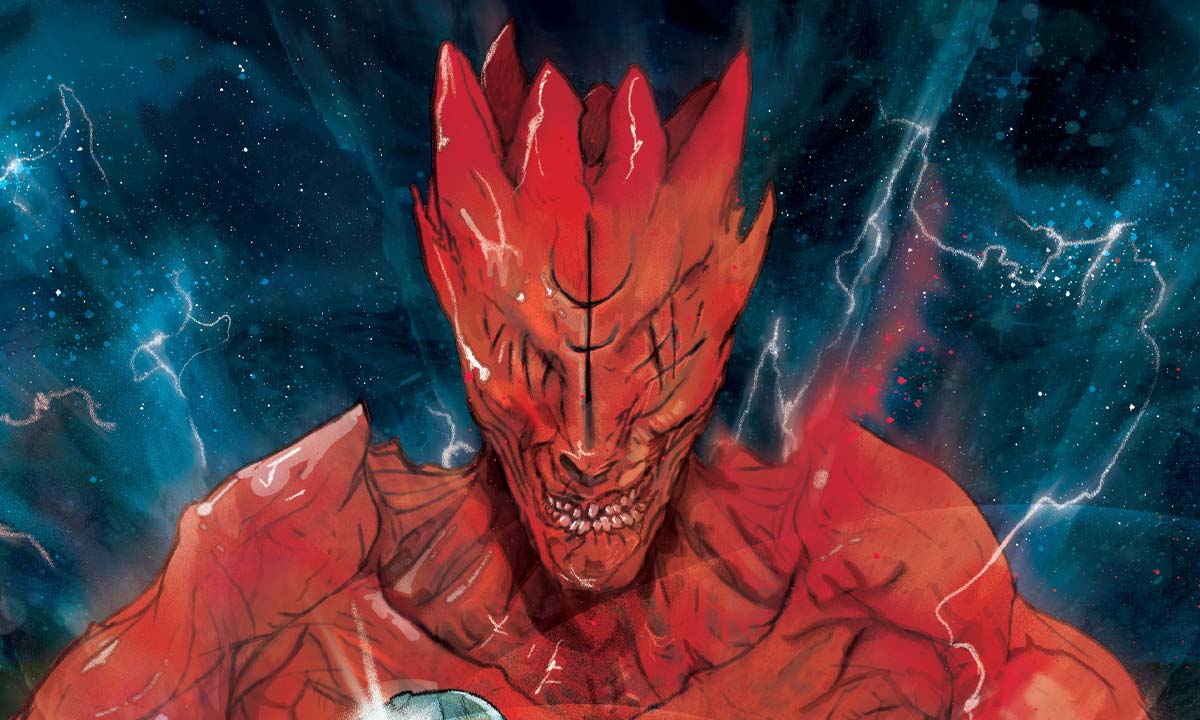
Considering the film’s role as a ghost story allows its narrative to maintain an air of mystery, with its horrors eventually revealed to originate from some form of Hell. Dark Descent, by contrast, shifts into more of a monster flick, particularly with the introduction of the demonic Paimon, who is revealed to be behind the ship’s corruption. While Tristan Jones’s art evokes much of the imagery from the 1997 original—from the titular ship and its Gothic interiors to the disturbing hellish imagery depicting gruesome harm to the human body, enhanced by colorist Pip Martin’s heavy use of red—the comic also owes a debt to John Carpenter’s The Thing, leaning into increasingly freakish monster designs.




You must be logged in to post a comment.