

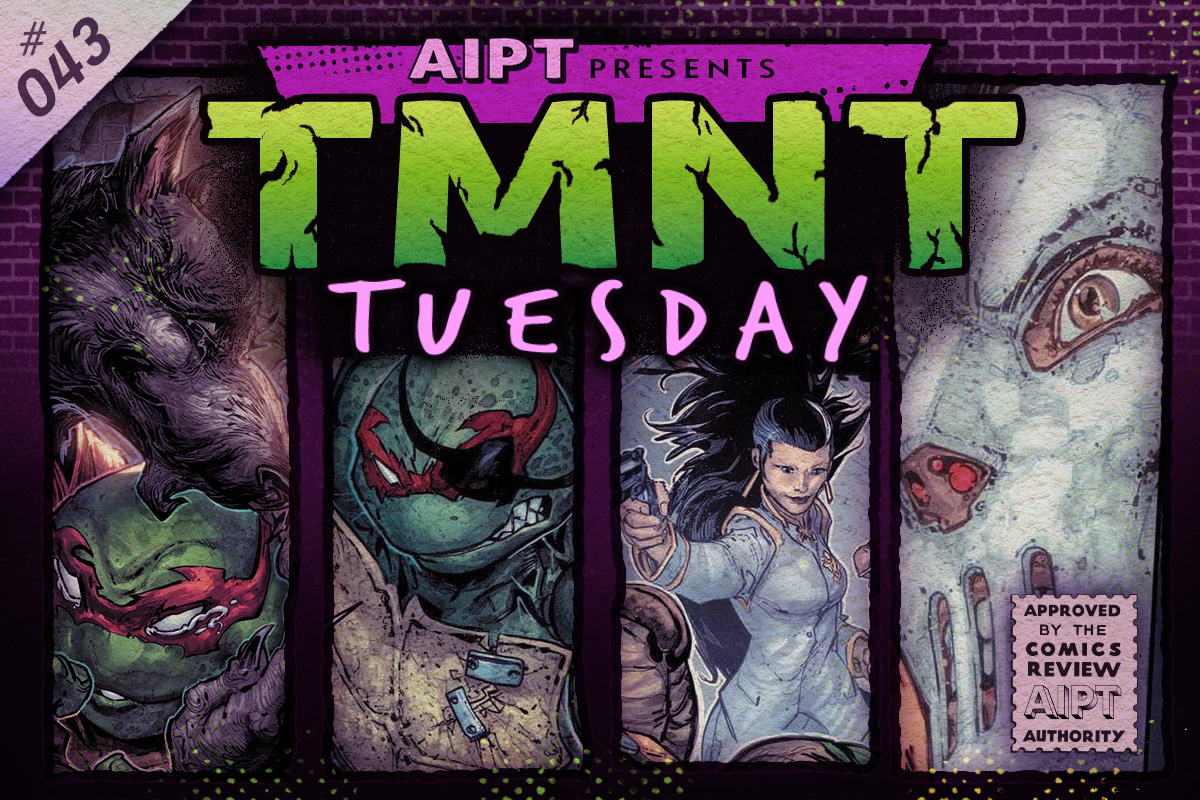

This week’s TMNT Tuesday dives deep into the emotional and mythic core of IDW’s current Teenage Mutant Ninja Turtles run. As the fallout from Ujigami’s shocking reveal continues to ripple through the series, we’re joined by writer Gene Luen Yang, who is redefining what family means for the Turtles—by turning their greatest source of guidance into their most dangerous moral dilemma.
Before we dig in, a quick heads-up: the full, unedited conversation with Gene Luen Yang will air this Sunday on the AIPT Comics Podcast, where we unpack even more about the arc’s inspirations, long-term plans, and surprises still to come.
This TMNT Tuesday also features an exclusive preview of Teenage Mutant Ninja Turtles #15, due out February 11 (FOC January 5), which promises a long-awaited family reunion—and a new magical threat that may shatter it just as quickly.
Splinter, Ujigami, and the fear every parent knows
Issue #13’s revelation, that the mysterious Ujigami hunting the Turtles’ enemies is actually Splinter himself, hit readers like a gut punch. When asked what emotional note he wanted to strike first, Yang didn’t hesitate.
“One of the things I love most about Ninja Turtles is they’re all about family,” Yang said. “The bond between the brothers, and the brothers’ relationship with their father.”
In the IDW continuity, that bond is more explicit than ever. The Turtles aren’t just students or wards—they are literally Splinter’s sons, reincarnated from a human family. For Yang, that clarity opened the door to something deeply personal.
“I have four kids,” he explained. “And what Splinter is struggling with in this storyline is something that I struggle with as a dad—the fear you have about the bad things that might happen to your kids.”
That fear, Yang noted, often leads to overprotection—something modern parents are uniquely equipped (and tempted) to do.
“Overprotecting doesn’t allow kids to find their own place,” he said. “That’s the dynamic I really wanted to play with.”
Ujigami, then, isn’t a mustache-twirling villain. He’s a father acting out of love—just taken to a lethal extreme.
A father crossing the line his sons won’t
One of the most compelling tensions in the arc is that the Turtles don’t yet know they’re opposing their own father. As they split up to protect former enemies, they’re unknowingly following Splinter’s teachings—even as those teachings put them directly in conflict with him.
“They don’t kill. That’s part of who they are,” Yang said. “Despite what happened in issue #50, that’s what their father taught them.”
The irony is deliberate. Splinter, once the moral compass of the family, is now crossing a line his sons refuse to step over.
“Even though what he’s doing isn’t good, his motivation is understandable,” Yang said. “He’s acting out of something very Splinter—even if he’s not doing the right thing.”
Japanese myth, modern New York, and moral gray areas
Yang’s work has long explored identity caught between cultures, and TMNT gives him a uniquely literal playground.
“Splinter is caught between two moral systems,” he explained. “An ancient feudal Japanese moral system, and a modern American one.”
That clash finds its embodiment in Ujigami itself—a term rooted in Shinto belief, often describing a local or familial protector spirit.
“I thought that would be a perfect way of exploring that overprotectiveness,” Yang said.
This arc also leans harder into mysticism than much of the series’ recent street-level storytelling, pulling from Shinto concepts like Yomi no Kuni, the land of the dead.
“The Japanese-ness of the Turtles has been there from the beginning,” Yang said. “We just wanted to lean into it more for this storyline.”
Shinigami, magic, and the horror edge
That mystical turn includes the introduction of Shinigami, redesigned for the IDW universe by artist Suli.
“She’s definitely a ninja witch,” Yang said. “But parts of her outfit have been updated to fit the IDW version.”
Her inclusion was sparked by a suggestion from Paramount’s Jeff Whitman, and Yang embraced the chance to expand the supernatural side of the mythos—especially following Jason Aaron’s run, which ended with Splinter’s resurrection.
“I didn’t want to brush any of that aside,” Yang said. “Jason Aaron’s run is top-notch Turtle storytelling.”
Four brothers, four reactions
One of Yang’s clever structural choices is rotating internal narration between the brothers.
“Each episode belongs to a different Turtle,” he explained. “Donnie first, then Leo, then Raph. Everyone gets their turn.”
That approach reinforces a key idea: there is no single ‘correct’ response to what Splinter has become. Each Turtle processes the betrayal—and the love behind it—differently.
“This is a story about conflict inside a family,” Yang said. “And how that conflict pushes them apart… and hopefully how they find their way back together.”
Looking ahead: heartbreak, redemption, and sticking the landing
Asked what readers should emotionally brace for, Yang was clear.
“I hope it’s both heartbreak and redemption.”
As for the issue he’s most nervous about?
“It’s always the ending,” he admitted. “You want to stick the landing.”
If the arc so far is any indication, that landing is going to hurt—in the best possible way.
Exclusive preview: Teenage Mutant Ninja Turtles #15
The emotional stakes rise even higher in TMNT #15, where Splinter finally reunites with his sons.
Father and sons, together again! The Turtles are overjoyed to have Splinter back with them—but there are dark things lurking in the shadows. A mysterious new magic-wielding foe disrupts the family reunion, and the race is on to save one of the Turtles’ greatest allies as Ujigami’s next target is revealed.
Issue #15 hits comic shops February 11, and if Yang’s words are any indication, the reunion won’t be the comfort readers are hoping for.


Don’t miss the full, unedited conversation with Gene Luen Yang this Sunday on the AIPT Comics Podcast, where we go even deeper into Ujigami, Shinigami, and what comes next for the TMNT family.tmnt tue



You must be logged in to post a comment.