

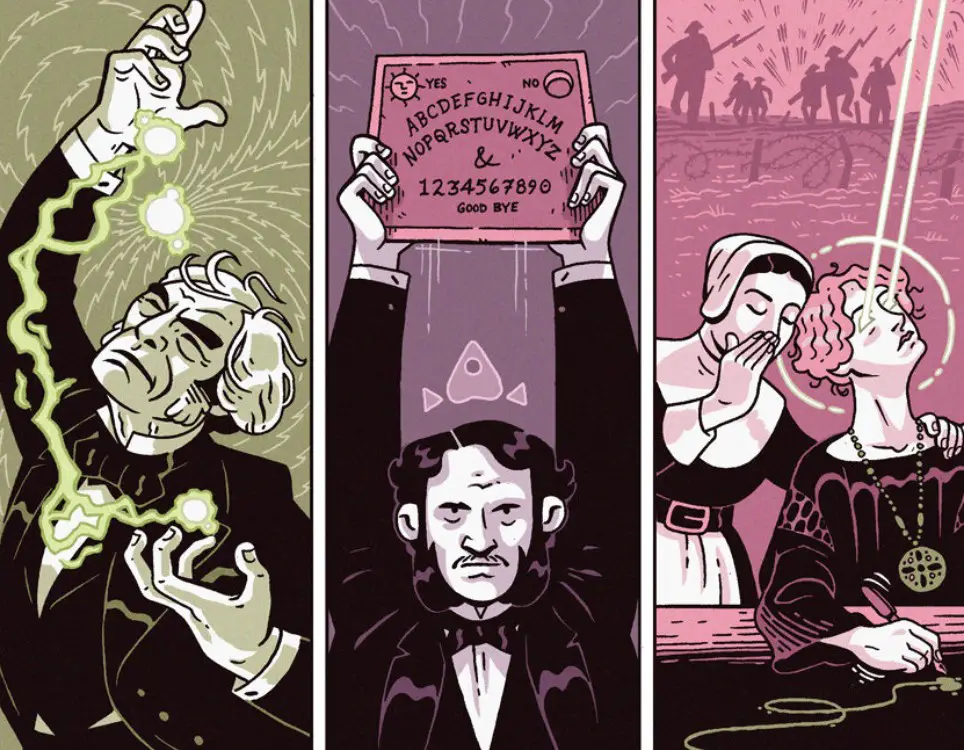

Professor Richard Wiseman has a long history of teaching the public about quirks of psychology (“Quirkology” is actually the title of one of his books). A well-known figure in the skeptical community, Wiseman has examined a multitude of subjects that fit into the arena of “weird stuff,” and the first issue of Hocus Pocus: Magic, Mystery, & the Mind, described as an“interactive comic series about the history and science of the paranormal,” is no exception.
Wiseman teamed up with writer Rik Worth and comic artist Jordan Collver to examine the alleged abilities of three mind-reading performers from history — two humans, and one horse. Without giving too much away, I appreciated the little Easter eggs, including one gimmick that relies on a choose-your-own-adventure mechanic to demonstrate the Forer Effect (don’t click if you want to avoid spoilers; read the book and all will be revealed).
Hocus Pocus brings a few disciplines to the drawing table besides solid sequential art storytelling, offering vignettes of historical mind-reading techniques and a bit of insight into those who attempted to understand such powers. Sir Arthur Conan Doyle makes an appearance (Doyle and Harry Houdini are the subjects of Worth and Collver’s 2014 comic, A Certain Symmetry), and we see the “father of parapsychology,” J. B. Rhine, team up with Dr. Karl Zener (for whom the “Zener cards used in the beginning of Ghostbusters are named).

The magician’s hand is evident, as the first issue of Hocus Pocus actually performs a couple of “tricks” as you read along. Wiseman, it should be noted, is not just a Professor of the Public Understanding of Psychology, he’s also a member of the Inner Magic Circle, an exclusive British organization dedicated to promoting and advancing the art of magic.
“Mind Reading!” is only the first of a five-part series; the first three issues, on mind reading, seances, and ghosts, are available now. These comics, while certainly entertaining, also educate readers on critical thinking and experimental design. As such, the creators offer them as free digital downloads in order to make them widely available (though you can choose to pay something, if you wish). I found the Gumroad app easy to install and use, and the art was pristine when viewed on that platform. Trying to use the “read now” button on my laptop, however, resulted in a lower-res version that was not as readable.
Nevertheless, a spin around the Hocus Pocus website is incredibly rewarding. Extras like a printable PDF of a charming cartoon dragon you can assemble yourself into a 3D illusion are fun, but the short comic introduction to pareidolia is required reading for any comic artist or fan. As a cartoonist and longtime skeptic myself, knowing that Wiseman was behind this comic, I went into the first issue armed with knowledge about the psychological tricks used to tell a story with pictures, all the comic psychology theories of Scott McCloud, and the gag deconstruction of Newgarden and Karasik.

But as I clicked through the pages, I found myself simply carried along by the stories, enjoying the nostalgic, time-travel feeling created by Owen Watts’ limited palette that seems to blend cowboy sepia tones with a touch of the superhero fantastic. When a favorite old-timey comedy duo popped up in supporting roles, the cameo delighted me. I failed to deconstruct; I merely enjoyed.
I’ve heard from magician friends that this is the feeling they get when they watch a true master of the craft. While knowledgeable about the gimmicks, techniques, and means of misdirection, they nevertheless get swept up by the performance and it leaves them as amazed as the average audience member.
Every February, to help celebrate Darwin Day, the Science section of AIPT cranks up the critical thinking for SKEPTICISM MONTH! Skepticism is an approach to evaluating claims that emphasizes evidence and applies the tools of science. Every day this month we’ll be highlighting skepticism in pop culture and skepticism of pop culture.
AIPT Science is co-presented by AIPT and the New York City Skeptics.



You must be logged in to post a comment Login