

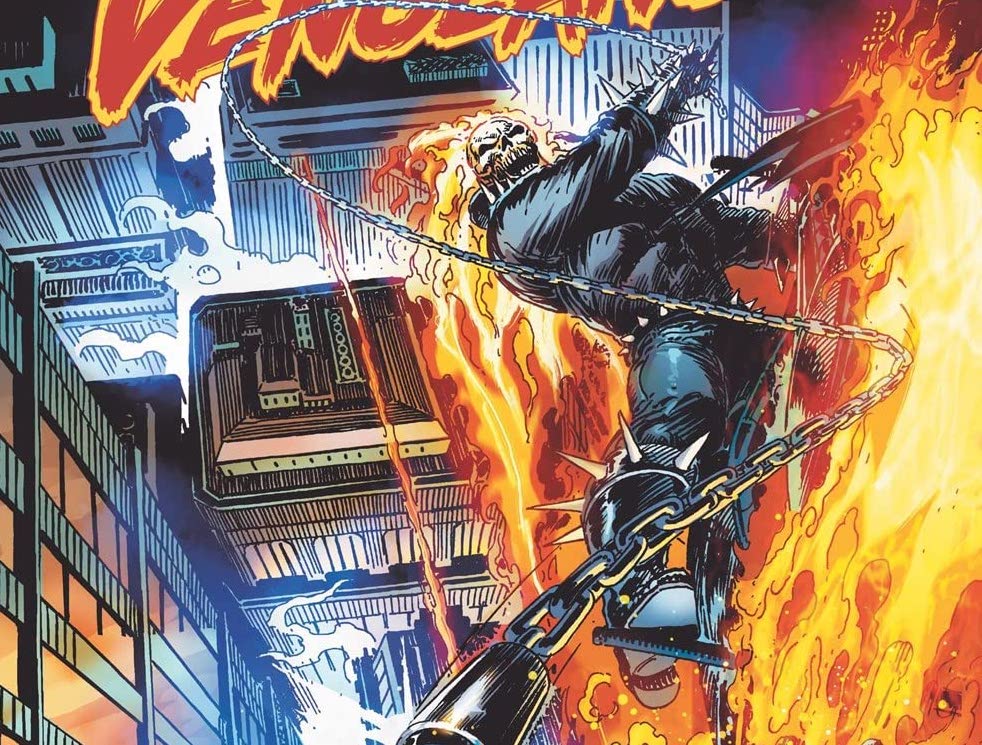

Gruesome, dark nearly to the point of oppression, filled with implications of serial murder and infanticide, and dealing—however loosely—with lingering grief, 1990’s Ghost Rider was a far cry from the sometimes goofy, sometimes epic series that had concluded seven years earlier.
It was also a far cry from its contemporaries. Debuting the same year as Todd McFarlane’s Spider-Man, Claremont and Lee’s X-Men, and Jim Valentino’s Guardians of the Galaxy, Howard Mackie’s Ghost Rider felt isolated to the darkness, lurking in the graveyards and tenements scarcely visited by the brighter, more bombastic heroes of New York City.

Marvel Comics
It was an isolation that seemed to confuse and challenge Marvel Editorial. Despite near-constant crossovers with other (tonally inconsistent) characters—it was a rare issue when Ghost Rider had room to deal with his own concerns without Punisher, Spider-Man, or a variety of mutants diving in to divert him—the unique success and flavor of the book never seemed to translate or spread.

Marvel Comics—especially the Marvel Comics of the 1990s—did not take kindly to isolated books. The goal, in the end, was to make a franchise of popular properties; the X-Men had spawned any number of fellow books (starting, after pressure from earlier editor-in-chief Jim Shooter, with New Mutants). The aforementioned Spider-Man was, at the time of its release, the fourth ongoing Spider-Man series.
How, then, to make Ghost Rider a franchise? After being approached by editor-in-chief Tom DeFalco, editor Bobbie Chase began to gather pitches. If Ghost Rider didn’t make sense in the Marvel Universe, why not bring the Marvel Universe to Ghost Rider?
1992’s Rise of the Midnight Sons brought other neglected horror properties of the Universe into the dark, demonic aesthetic Howard Mackie and his rotating artist cohorts had been cultivating. Spawning four new titles—Spirits of Vengeance, Morbius the Living Vampire, Darkhold: Pages from the Book of Sins, and Nightstalkers—the crossover looked to be the opening opus of something larger, something with room to grow.

It also looked to solve some of the problems with Ghost Rider—namely, a lacking sense of consistent threat. Introducing the demon queen Lilith and her diverse offspring of monstrous children (and incorporating the new Rider’s most interesting existing villain, Blackout), the crossover began the hard work of creating—finally—mythology, a sense of larger purpose.
While that larger franchise umbrella was ultimately a failure (most of the new titles wouldn’t make it through their second year), this initial story is a near-masterpiece of mythmaking, and it remains the high water mark of the series.
The crossover created a breathtaking visual aesthetic across all six titles that remains iconic and uncanny. Full black pages, heavy inks, and unearthly lime-greens and pale blues, with character-defining pencils by Andy and Adam Kubert, Ron Wagner, Richard Case, and Ron Garney, the book feels different than anything else Marvel was producing, and rightfully so. Rise of the Midnight Sons represented a wholly new experience.

Though the event doesn’t get the acclaim that other crossovers of the era get, that tone, as well as the largeness of scope (if not the mythology itself) remains influential on Ghost Rider books today. Large, morality play epics, looming demonic forces, and far spread allies are staples in the Daniel Way, Jason Aaron, and Ed Brisson runs on Rider, and both gritty artistic heaviness and fleshy, demonic monstrosities have already played their part in the new series by Benjamin Percy and Cory Smith.
We can lament the loss of Christopher Cooper’s wonderfully episodic Darkhold concept or Len Kaminsky’s more horror-centric Morbius—and, obviously, wish Blade still shared a stuffy office with a vampire, as in Chichester’s Nightstalkers; those takes on those specific properties certainly haven’t lasted. Nonetheless, they were building blocks in one of the most subtly horrifying and brilliant corners of the Marvel Universe.

Marvel Comics
Unlike other collections of the era, Spirits of Vengeance: Rise of the Midnight Sons functions as more than a time capsule. It represents our tragic near-miss of a deeper, richer horror in the Marvel Universe. It’s foundational to Ghost Rider as a character, despite not even being that Ghost Rider. Now is a good time to celebrate it in the way it deserves.




You must be logged in to post a comment Login