

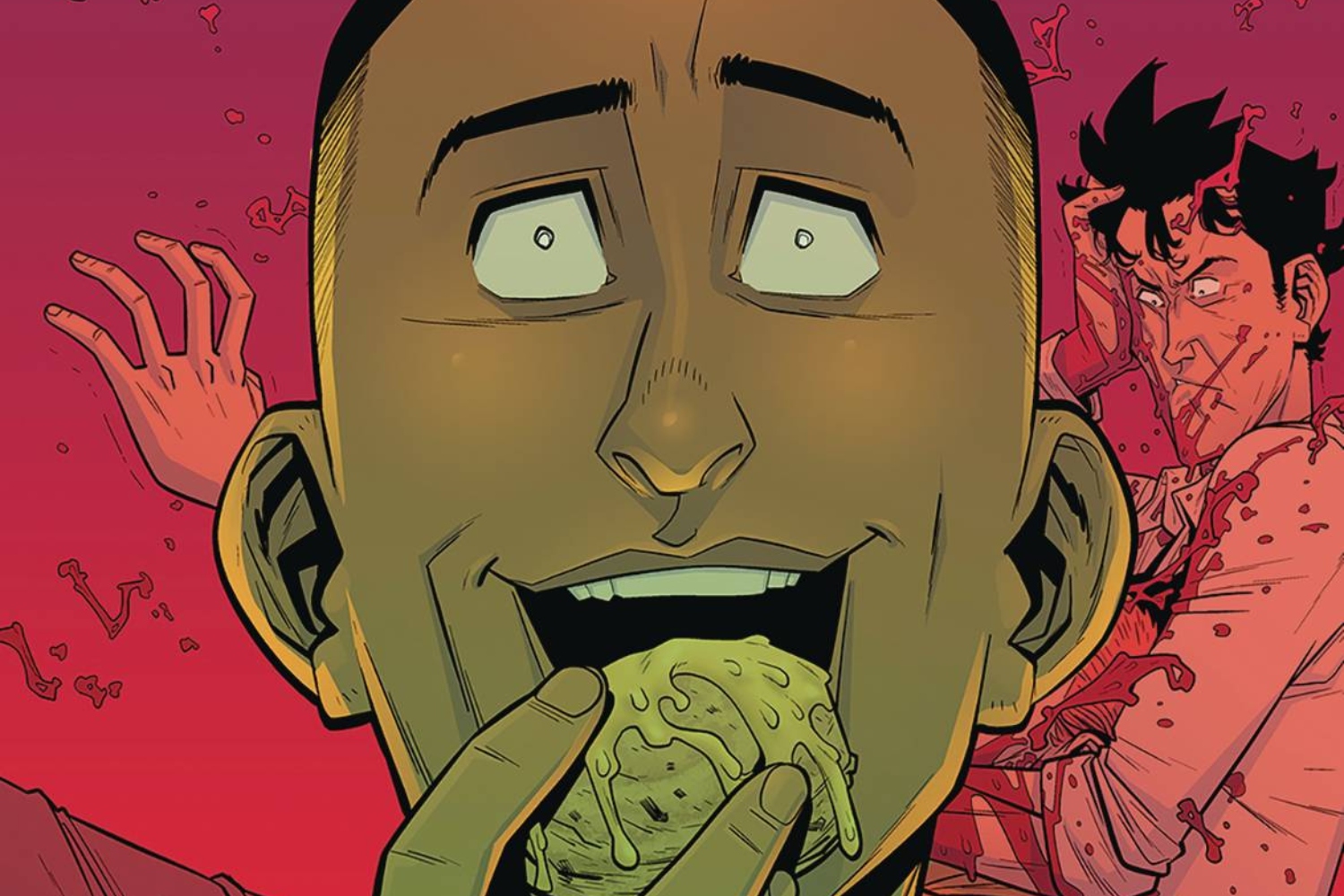

Issue #1 of Plastic: Death & Dolls was a clear cut instance of the Goldilocks principle. Writer Doug Wagner and artist Daniel Hillyard hit that perfect midway between overly romanticizing Edwyn’s origins and disconnecting us outright from this compelling but bloody character study. The end result was the start of a really great story about what makes us as people, how we forge ourselves, and what that means for living out in the big, wide world.
But issue #2 could have been where this porridge of perverse comics insanity got a little cold, and we lost the plot entirely. Luckily, Plastic continues its development into a deeply and richly human story that I continue to suck down by the bowlful.
As with the debut, issue #2 of Plastic: Death & Dolls gives us both ample time in both the present day and Edwyn’s past. I’d even argue that this time around, the two eras felt even more cohesive, and the way we dipped back and forth between felt fully aligned around some big ideas while proving that Wagner and company are guiding us in this curated experience of memory. In the present, Edwyn lends his blind buddy Edwyn some much-needed romantic advice and even deals with some extra stupid bullies and loud-mouth patrons. In the past, meanwhile, Edwyn and his mother bond over some dolls before another kind of bully potentially interrupts their weird but picturesque life.
So, what’s it all mean? For one, you shouldn’t really mess with Edwyn’s friends/family. Also, we have a pretty clear understanding of where his obsession with severed heads came from. Those ideas together inform the tentpoles of Edwyn’s life and identity, defining him as this loving man who also happens to be a murderous psychopath. So, is he a good person gone astray, or a fiend with some “minor” upsides? The creative team continue to avoid making distinctions or decisions like true pros, and they instead leave you grappling with said decision. Maybe the decision’s a bit more obvious for you. Or, maybe you’re generally torn. Either way, all of that says heaps more about you than the creative team and even Edwyn.
I think some part of that has always been central to the Plastic series — it’s a story about an interesting but massively complicated man. But here, as we delve into Edwyn’s white-hot core, the whole process feels elemental, as if we’re delving into something with a kind of universal quality of power. We are all shaped by things we cannot control and are forced to reconcile with that throughout our entire lives. Even if we’re nothing like Edwyn, we’ve all had to make those decisions and live with them even as we don’t entirely understand the process.

Main cover by Daniel Hillyard and Michelle Madsen. Courtesy of Image Comics.
In that way, Edwyn becomes a kind of archetype, transcending some of his more obvious traits and any corresponding upsides or downsides to become this idea about fate and choice or destiny and autonomy. He’s like Ahab with a hacksaw and a semi-crummy job — a character we’re meant not to relate with personally but to follow along as we try and sort out our own biases, misfiring wires, and vaguely redeeming qualities.
And while Edwyn is this robust, fully fleshed out character growing and extending in front of our very eyes, so much of this story is only possible because of the work of Hillyard (as joined by colorist Michelle Madsen). It’s the way the pair develop and regard Edwyn’s world that really matters, placing him in this rich context that offers us a few important ideas and insights to mull over.
There was some of this in issue #1 of Plastic, but I love the way the past is especially treated here. There’s this mostly subtle, slightly romanticized feel about it. It’s less that this is somehow all that different from Edwyn’s current life, but rather I think the segments in the past are muted in just the right ways, referencing a color palette of browns and vaguely sepia tones that might be at home circa 1977. And that choice is huge — it distinguishes these eras, yeah, but it also grounds and maybe humanizes Edwyn in a subtle way.
It’s another choice by the creative team to explore how ideas of nostalgia and romanticism exist, and how these can shape or warp our perceptions and understanding. When we do see Edwyn’s modern life, it’s all the more robust and vivid (peep that blue in the diner!), and that says so much about his state of being but also how our connotations and understandings grow or diminish depending upon what happens as we age. It’s really novel and compelling, and it offers so much power without proving overwhelming.
Similarly, past and present are also used to explore the primary theme of violence in this book. Obviously we’re meant to abhor Edwyn for his tendency to, um, decapitate folks with a hacksaw, which is totally what I’m doing right now. Except, and maybe this is just my perceptions, but there’s no overt violence in the past. Instead, we may see a dead bird (Edwyn’s new BFF Birdie) or some hint of blood. But a pronounced act of violence (including Edwyn’s reaction to his mom’s new “friend”) is only ever hinted at.

Variant cover by Daniel Hillyard and Michelle Madsen. Courtesy of Image Comics.
Meanwhile, in the present, we’ve had two beheadings in two issues. Maybe this says something about Edwyn’s development? Or perhaps it’s some idea about how the past is misremembered? It could also be that violence has layers, and Edwyn’s evolution is more nuanced than you’d think. Who knows?! But what I do reckon I know is that, as an extension of this, there’s horror vibes that fluctuate here. In some overarching ways, the past feels like some twisted remake of The Omen — all that slightly abnormal energies and ideas, despite no true violence, is unnerving.
Even when the blood flows in the present, we can’t overcome the sense that something even worse has already happened/taken root. It’s just another way the visuals here inform and add powerful subtext to Plastic‘s efforts to play with our morals and perceptions. It’s about using time and tone together to pull us in, present tough decisions, and show us the process of really making a person whatever they’ll eventually become.
If we’re really going to use the Goldilocks analogy, there’s going to come a time when the bears chickens come home to roost, and Edwyn has to face the consequences (which is certainly hinted at in the solicitation to issue #3). And whatever happens there, I already know it’s going to be about extending, informing, growing, and texturizing our psychotic lead.
The first issue might’ve laid it out solidly enough, but it’s truly this second issue of Plastic: Death & Dolls that confirmed just how far the team will go to give us this truly powerful tale of one man’s arc and a battle between our baser interests and better angels. If you don’t like this, I’ll happily finish the whole meal for you.



You must be logged in to post a comment Login