

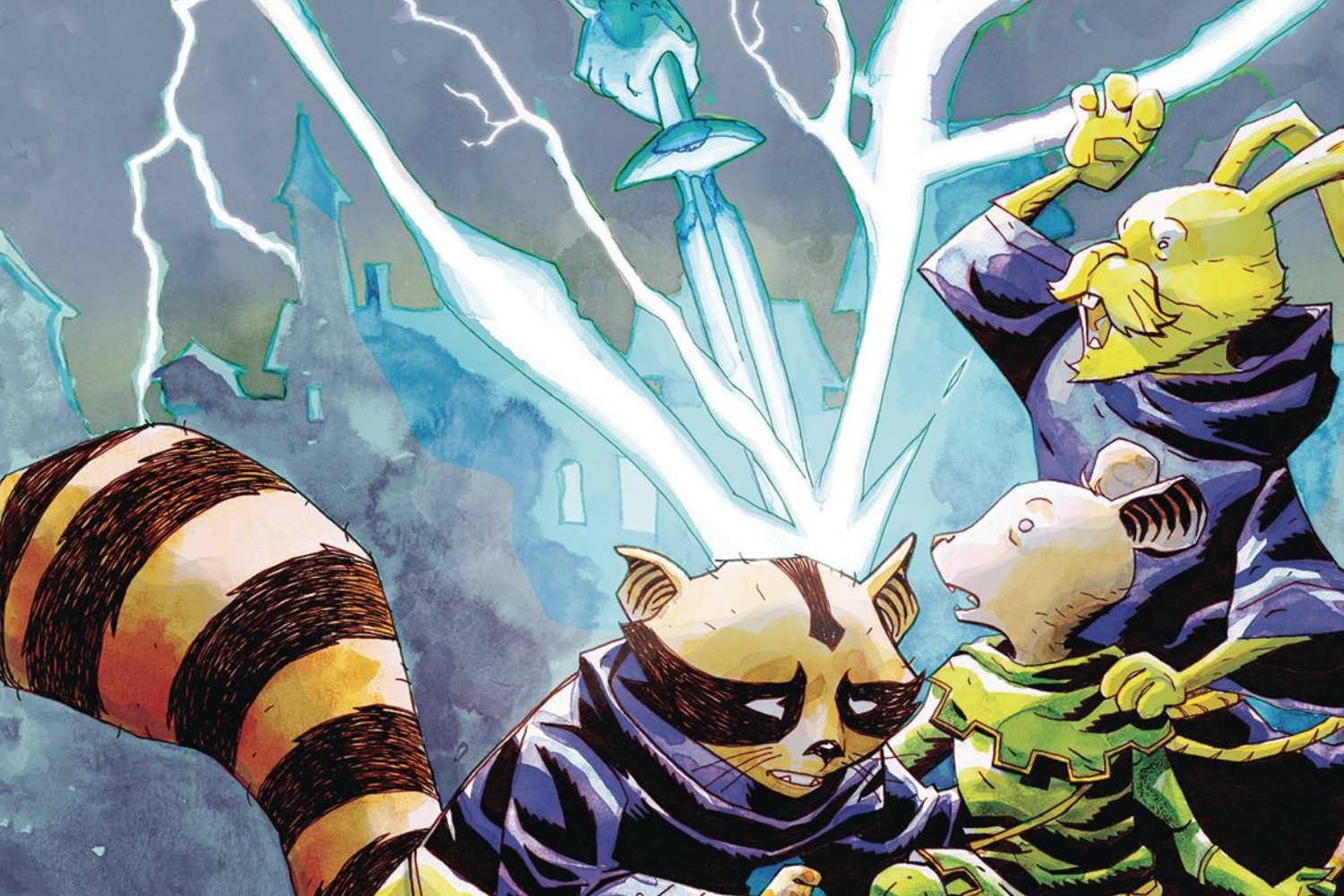

Issue #1 of William of Newbury had a big enough problem: too much love for its source material. Namely, the Mignola-verse in general (and especially Baltimore and Witchfinder). What happened, then, was too much familiarity in a story that should’ve been way more novel (a raccoon monk fights evil spirits circa the Black Plague). Luckily, issue #2 saw artist-writer Michael Avon Oeming lean further away from certain tropes and influences to give William of Newbury room near but not right atop those aforementioned inspirations, and we got something with more poetic beauty and contextual heft.
So, then, where’s that leave us after issue #3 of William of Newbury? If you guessed in even more compelling territory, then you’re going straight to heaven. (Editor’s Note: Chris doesn’t have the power to affirm your ascension to the afterlife of any spiritual practice.)
So, what made the difference this time? I think, to some extent, it was a lot of what made issue #2 of William of Newbury so solid: the greater interest in hope and religion in general; the more nuanced approach to exploring history; and the balance of William’s neurotic tendencies and his robust wisdom and piousness. But there’s also something more here.
After issue #2, where William was arrested by his brother Edward, we get to see a lot more of William’s early life. I don’t want to spoil that really compelling story from Edward, but it very much gives even more texture and depth to William, and we better understand why he does what he does. It also gives us some contrast between the two brothers (where one’s a rabbit and the other’s a raccoon) — we can see how they view their roles as religious leaders and how they take a markedly different approach.

Courtesy of Dark Horse Comics.
Edward would rather pray and devote himself through good deeds and prayer, while William is all about fighting for the Lord. It’s a way to really delve into how faith plays a role in our lives and how we use these practices and ideas to augment and contextualize our daily lives. It’s a mighty powerful means to add an even more personal tone to William’s work, and it does wonders to let us connect with him in a way that transcends religion. He is even less a mystery, and someone battling the odds with great heart and passion.
I also quite enjoyed what this infusion of Edward offers from a wholly visual standpoint. The flashbacks into their childhood, for instance, are this really intriguing mix of nostalgia while also feeling rather creepy (in how they portray some dark and/or spiritual elements). I love what that might be saying about memory and family and how William may ultimately be running from a really complicated life into something he can better grasp and understand (fighting ghosts).

Courtesy of Dark Horse Comics.
We also get what I think are some biblically accurate angels in the present day, and that slightly different kind of wonder-mixed-with-horror affirms this book’s unique interest in religion and spirituality as well as doing a lot to drive it further into its own place thematically and visually. It’s good to see Avon Oeming really grow this world, and we’re getting all these different pockets of energy and inspiration to make this a version of the medieval times that’s more alive and organic than some other series. It’s a place where deep history and huge magic fight for space, and it brings us in even further and makes us feel the many layers of this story.
And if we’re adding layers, then it’s about time that Winnie really got a time to shine. After a couple issues where it feels like the lovable rapscallion was either a sidekick or just comic relief, I left issue #3 of William of Newbury feeling like she was bigger and more lively than ever before. Without revealing too much, something happens where William may have to rely on Winnie now that the whole “being arrested for heresy” may be an actual thing. It’s a fully solid way to play up the tension between the brothers as well as give Winnie her own time to shine amid chaos.

Courtesy of Dark Horse Comics.
But even before this issue’s finale, it seemed like Winnie was being set up for a bigger role, with talk of learning her letters and really helping William with one extra nasty ghoul. This world is alive in even bigger and bolder ways, and Winnie is very much apart of that as she grows from a one-note character into this unlikely hero who may help speak to the grounding of spirituality and how the true power of belief is in how that connects us with others.
At the same time, so much of Winnie’s “ascension” here is also about empowering William even further. She’s a surprisingly good influence for our neurotic lead, and she pushes him to behave a little more joyously and recklessly by doing what he does best: help people even if it might hurt him. And that uptick of reckless abandon and joy is felt in William’s arc here — he sees what he must do to be effective in his job, and through his uncertainty, believes in Winnie and finds the courage to abandon some rules and structure. That’s then rewarded by letting him do what makes him the most happy: engage with the Lord and help people find rest and peace and general satisfaction.

Courtesy of Dark Horse Comics.
It’s a really great way to push William’s whole world into compelling fresh directions and to let the geeky hero really flourish like never before and to grow himself while staying true to his core. You can even see some of that joy expressed visually in this issue — there’s extra whimsy in the way William and Winnie escape Edward, or a slightly frenetic sense to a scene at the issue’s end that should be more dire (but instead feels especially exciting). It’s maybe more subtle, and not as powerful as some of the angel stuff, but it’s just another way to specifically develop these characters and to give us more to play with as this story continues. That, and it just makes this an even more robust adventure.
August’s issue #4 is meant to be the finale for William of Newbury. I’ll be a disappointed enough to see it go, as the series has done some big, big work to transition from something with promise galore but a lack of specific focus into something with the heart, humor, and wisdom to tell a rich story about how we move through an indecent world with intent and humanity. Whatever twists, turns, and ghoulish encounters still await William of Newbury, it’ll likely be yet another big step up in storytelling might.




You must be logged in to post a comment Login