

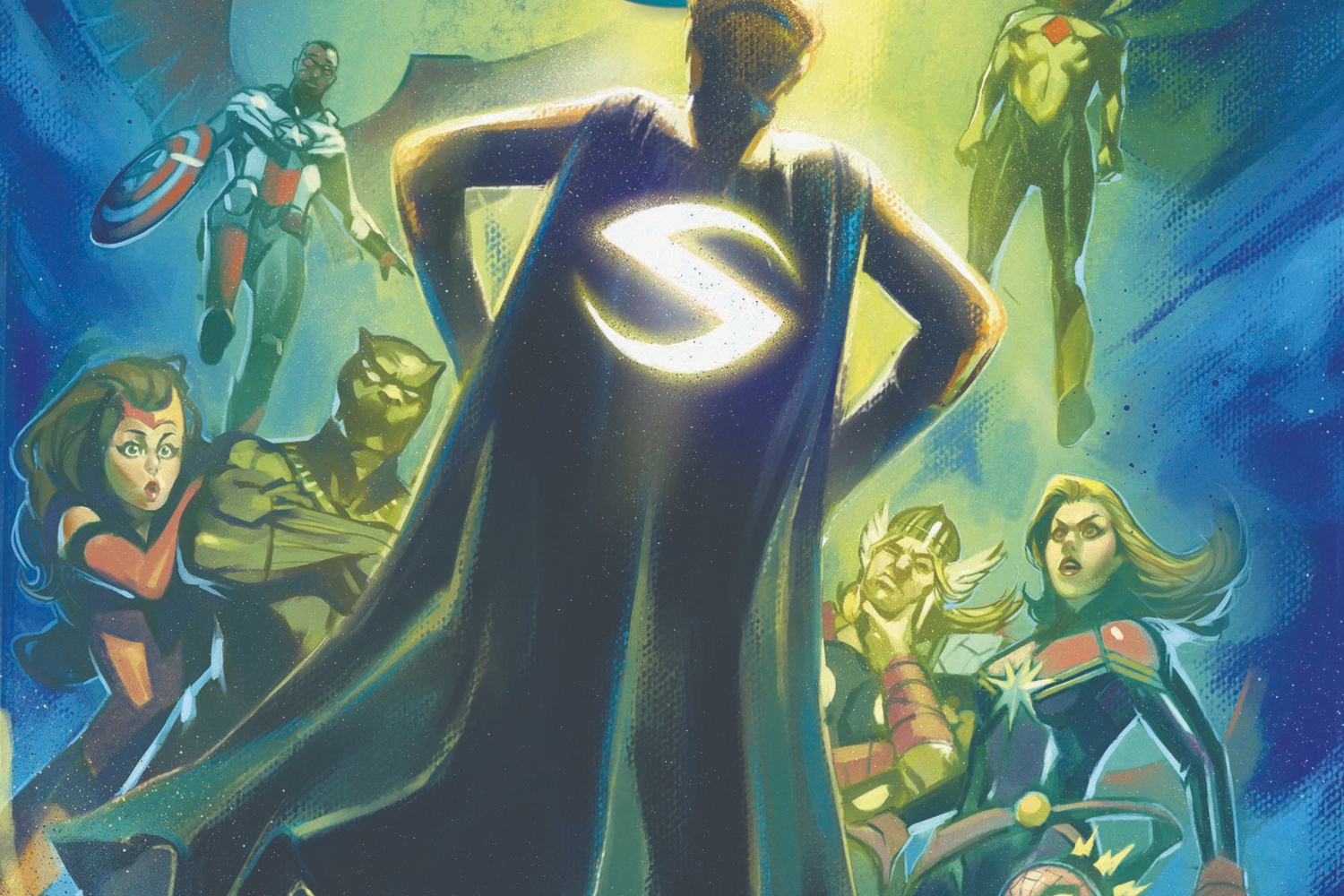

The Sentry is a tricky character. With the “power of a million exploding suns,” he represents the upper limits of the Marvel power spectrum, a man made into a reluctant – and unstable – god.
Writers never seemed sure how to handle the character after his introduction by Paul Jenkins and Jae Lee some 24 years ago; though he played a major role in Brian Michael Bendis’ New Avengers and that era’s chain of massive crossovers (culminating by a fantastic, horrifying moment in 2010’s Siege), he was mostly relegated to deus ex machina usage, prop and plot over character.
In the years since Siege, his appearances grew sparser and sparser until his 2021’s King in Black, which featured his death. Perhaps the problem lay in his massive power – even against the most powerful Avengers threat, those powers made him the overkill option – or maybe it lay in the looming, ticking time bomb of his other half, the mysterious Void, to which a ceaseless mystery was always pinned.

Courtesy of Marvel Comics.
I’m not certain Jason Loo, Luigi Zagaria, and David Cutler’s The Sentry miniseries “solves” the Sentry problem so much as transplants its potential to a new character, but at least the series immediately grounds the power levels in character. It frames them as a burden, never allowing the reader to imagine the Sentry as an erstwhile Superman figure. Even neglecting Void concerns, the powers are dangerous, unsteady, and corrupting.
The powers are so overwhelming that when a Sentry-possessed zombie explodes the powers are split between six bystanders – implying, perhaps, that any one person might not be able to handle the full load.

Courtesy of Marvel Comics.
That one of those people happens to be a power-hungry sociopath is somewhat a given. Ryan Topper – who presents himself to the Avengers as Ryan Sentry (very clever, bud) – realizes that killing his fellow Sentries means the power will transfer to him (or at least balance out). There’s precedent for this sort of cosmic-balance power-swapping; when the Phoenix Force was split between several X-Men during the AvX event, it didn’t take them very long to go power mad.
Luckily, our protagonist Mallory is given to the instantly altruistic application of superpowers, despite being horrified that any cerebral palsy-induced tremor might spell the deaths of untold thousands of people. She spends time isolating herself on the moon (like you do), but ultimately that “great power, great responsibility” nagging sets in and she’s off to the life-saving races.
The art team skews to the human rather than the super-heroic, developing each member of the Sentry Six as unique, lived-in characters in deference to the overpowered: none of these characters go full “million exploding suns.” Rather, the art gives us plenty of benevolent Superman poses – floating angelically above, eyes glowing, ready to do good or ill. It’s a wise visual choice, keeping us in the intimate rather than the unknowable.

Courtesy of Marvel Comics.
Ryan and Mallory’s ultimate conflict feels modestly epic, but the book’s conclusion leaves the Marvel Universe no closer to solving the Sentry problem. Mallory (now Solarus) is left full Sentry, living under the supervision of a superhero oversight committee. It’s not much different than when the New Avengers tasked themselves with keeping tabs on the original Sentry, which leaves the reader feeling as if they’ve spent four issues watching some narrative housekeeping: can’t leave these powers out there, unaddressed and unexploited, so we best tuck them away for later.




You must be logged in to post a comment Login