

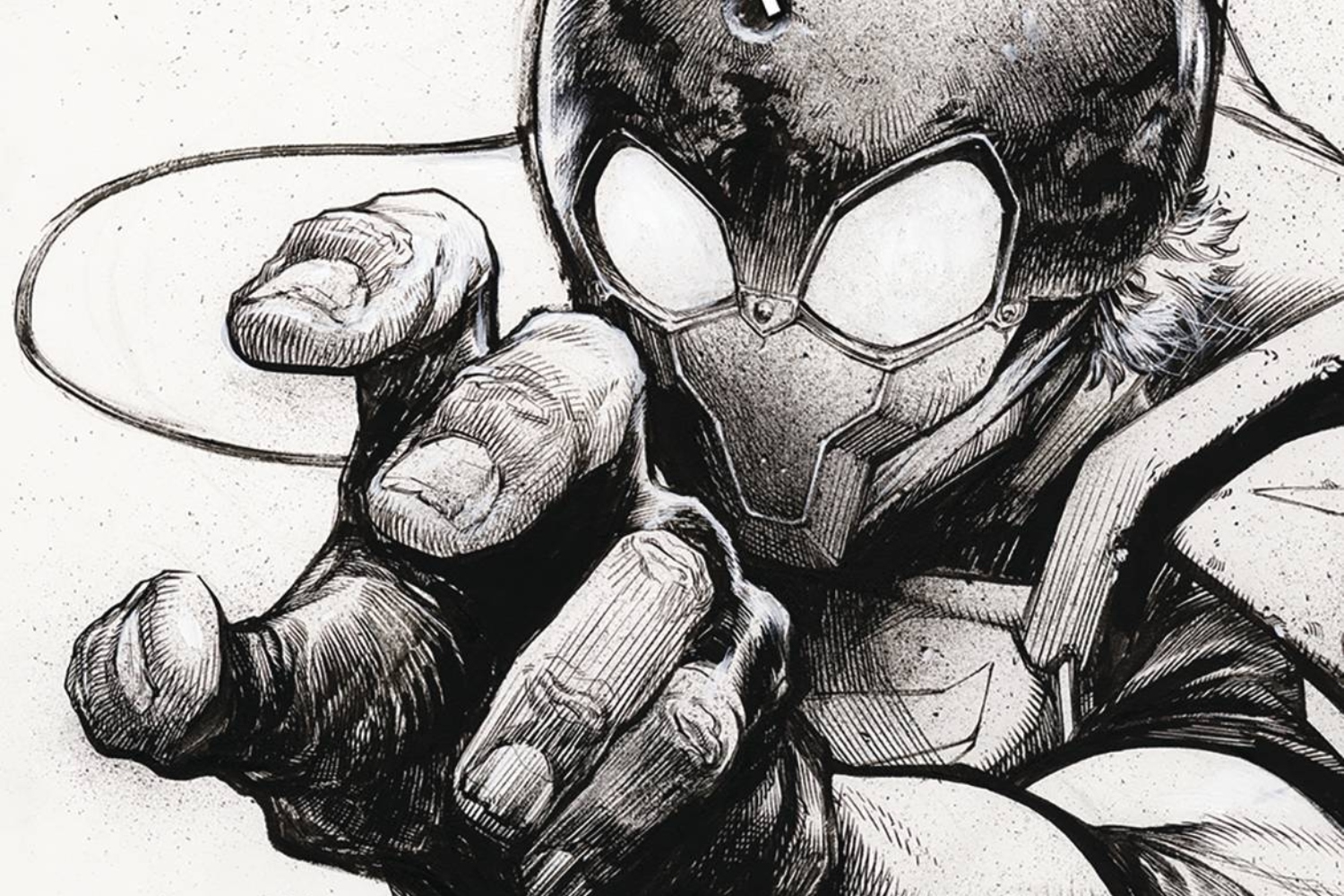

What was that thing I said recently about penultimate issues? Because while I thought we were in a golden age of sorts, The Holy Roller #8 is a clear end to the “run” I’ve experienced as of late. But on the upside, the gifts it does offer are as tasty and wonderful as bowling alley nachos.
If you’ve kept up with my reviews, you’ll know one of my biggest problems with The Holy Roller is the humor from our writers (Rick Remender, Joe Trohman, and Andy Samberg). More specifically, they can routinely fall prey to some extra sophomoric humor. Sure, they’ve also demonstrated an ability to pull back and use humor more efficiently, but that tendency has loomed over The Holy Roller this whole time like some irksome rain cloud.
In issue #8, though, we get to play both lanes, as it were. As we deal with a rather serious issue — issue #7 saw Levi stabbed by Mr. Henry as he tried to shutdown the nefarious business man’s mind-control tower — it makes sense for some of the jokes to subside. (Really, they just become the purview of Holo-Hitler, and that’s maybe the best we can hope for logistically and thematically.) And with a more serious, but nonetheless still silly tone, The Holy Roller felt like a proper superhero tale of its own making.
A tale that near-perfectly maintained that humor while still crafting a pointed tale about a good man being tested. I won’t really spoil what said test is, but suffice to say, Levi’s whole approach and future is put into question, and we really get a chance to see this man-child develop in some really effective directions. Ways, I’d also add, that feel earned: Levi has fought through all the lame hijinks to get to be a real hero, and this is part of The Holy Roller is such a massively textured moment in his development. It’s everything we’d want in a satire but with the heart and glory of a meaningful superhero story.

Courtesy of Image Comics.
Just don’t go pinning a medal on the creators’ chests just yet. Because where a lot of issue #8 focused on Levi exploring these big questions about heroics and self-sacrifice, there were a few thematic issues abounding. Mainly, the issue’s big confrontation between Henry and Levi gets turned into what feels like another overly-involved gag — one that strips away some of the seriousness for more hackneyed jokes in a moment that clearly this book just can’t or won’t help itself.
But more than that, it feels like a kind of perversion of what The Holy Roller has been trying to do: build into something with depth and insight that still respects the joy and silliness of its core story. It was the first time that some of the over-joking really impacted the thematic efforts here, and while I don’t want to spoil what this is, I can say that it’ll leave a nasty taste in your mouth. Sure, it’s a topic that feels extra relevant, but it’s done in such an over-the-top way that it feels more icky than hilarious.
And a big part of that resulting feeling is that it comes mere pages after a really big thematic accomplishment for The Holy Roller. If that aforementioned closing “joke” is all about a kind of generational lampooning, then the “gag” before focuses purely on modern conservatism and the far right. It’s a sly reveal that works because it does two important things. For one, it takes something that’s happened already (neo-Nazis have taken over the city) and provides a spin that offers an even greater, especially relevant bit of social commentary that transcends jokes and gimmicks for a deep truth.

Courtesy of Image Comics.
And, secondly, that whole thing also feels deeply earned; The Holy Roller team has built up to that moment in such a way that when it happens, it’s genuinely rather hilarious in just how true, upsetting, hilarious, and ultimately unnerving it is to its very core. It’s this “ah ha” or “holy shit” moment that crystalizes everything good about this book and its work in dissecting modern politics and the superhero story. A truly earned reveal that lets this story solidify in your hearts and minds. The fact that it’s then ruined contextually is maybe the worst crime of this book so far.
But while some of the story stuff clearly had issues, the art team (artist Roland Boschi and colorist Moreno Dinisio) stayed winning as they have for the bulk of The Holy Roller. The duo have been a huge source of consistency across this story: they’ve given us a real familiar but decidedly stylized world (like a Troma film over, say, DC Comics), and that’s been so great to explore and delve into as this story built towards its end goals.
Issue #8 was more of the same, but more importantly, there were other vital developments. Specifically, and especially since The Holy Roller #7, Boschi and Dinisio have given us a doubly robust, decidedly more serious world with lots of battles and blood loss. This approach doesn’t just match the increasingly sturdy tone of the story, but it’s also a counter to the storyline’s ongoing issues with humor. That even as some of the jokes might flop, or they feel like they might overpower the events, there’s this brutal honesty and intensity to this world that keeps us grounded in these bigger, emotionally resonant moments. That as the city burns, or Levi gets smashed on the ground, there’s this unflinching commitment to making sure we know how rough things are and how there’s real stakes here. I found myself many time in issue #8 feeling like I was in the best, most earnest kind of action film.

Courtesy of Image Comics.
At the same time, the art team really proved to be quite the jokesters themselves across issue #8. If the gags and dialogue elsewhere interfered or impacted the story’s flow, there were a few moments here that made me chuckle amid the intensity and carnage. Like a cheesy smile from Levi as he and Amy Henry have a terse convo, and what that one gesture says about his mood and his big plan. Or, the continued use/placement of Holo-Hitler — some of the jokes may have been iffy, but he’s regarded physically in the world in a way that his over-the-topness feels grounded and slightly less distracting. Even the way Mr. Henry is handled as a foe; it’s a much better realization of the issues’ closing gag/commentary than what he actually discusses.
All of these were a way for the humor to live in the world, and not just on top of it. A chance for us to feel these big emotions and the mirrored humor in a way that we that we were forced to confront the dichotomy and our own discomfort as to let the story’s true ideas and interests take hold. There’s a certain subtlety required for satire like this, and the excitement and energy of this book doesn’t always make that as feasible. But it’s the art where you’re allowed a bit more time and space with these ideas, and to engage with the concepts a bit more organically. It couldn’t always help, but when it did, it gave The Holy Roller the grace it needed.

Courtesy of Image Comics.
Was there enough such grace to make issue #8 ultimately a success — to make compel me into reading the finale? Sure. (Also, issue #9’s solicitation makes mention of a “long-winded villain monologue,” and those are always my faves.) But before we see what happens with Levi and company, issue #8 deserves as much praise as it does a stern finger-wag. Because while it did fall prey to its own baser instincts, this issue exemplified what happens when this book gets out of its own way.
Maybe it can just as quickly trip over its own feet, but you have to give it to the team (especially as there’s a few robust superhero spoofs going on today). Hopefully they can really stick the landing, or The Holy Roller may want to consider retiring the old flame ball entirely.



You must be logged in to post a comment Login