

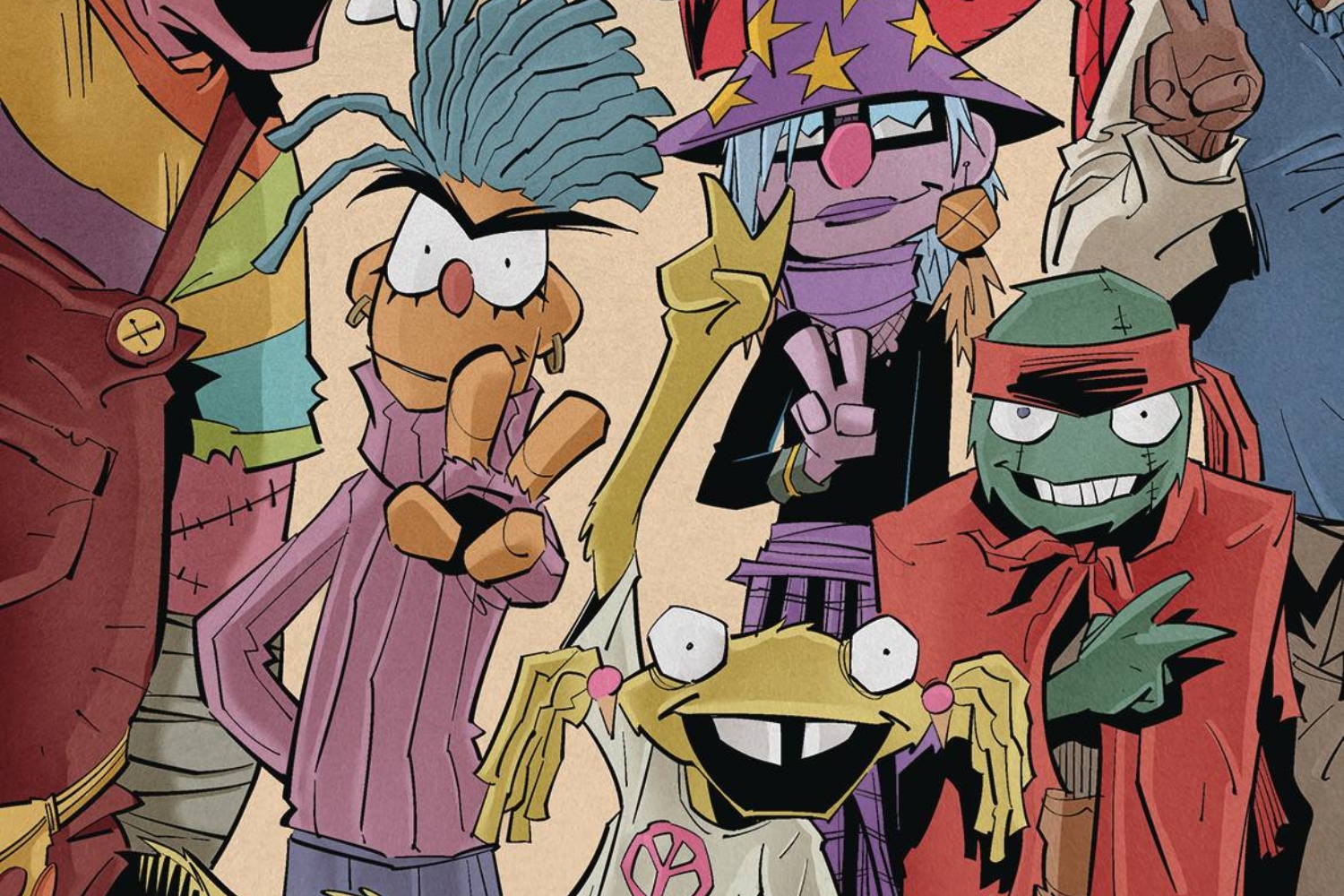

In fall 2022, we found out what happens when you combine puppets with fascist dystopias. Survival Street was an appropriately weird, nonetheless massively relevant dissection of our modern times as told through an A-Team-esque gang of freedom-fighting monster puppets. Now, Survival Street’s creative team — writers James Asmus and Jim Festante and artist Abylay Kussainov — have reunited for a second series.
The aptly-titled Survival Street: The Radical Left continues from the first series after the Survival Street team rescued kids from “cruel company towns” after the bulk of America had been sold off to various private companies. Only, as we see in this second four-issue series, “Portland can’t hold everyone, and the cracks are about to break.” What we get with Survival Street: The Radical Left, then, is a “radical departure” but nonetheless more of the wit, insanity, and oddly affirmations might of the original Survival Street. And if you’re somehow not on board already for radical puppets, maybe sort your life out, broseph.
Survival Street: The Radical Left #1 is due out this week (September 25) from Dark Horse Comics. In the lead up, we got to field Asmus, Festante, and Kussainov some burning questions via email. That includes the prescience of Survival Street, their collaborative process, the introduction of an AI-centric storyline, and a possible third volume.

Variant cover by Benjamin Dewey. Courtesy of Dark Horse Comics.
AIPT: What was the reception like to the first Survival Street? Did that surprise you at all?
James Asmus: I’ve been writing comics for 16 years now (!), and Survival Street has gotten as enthusiastic a response as anything I’ve worked on. Especially for a four-issue original miniseries, the amount of fan art, outreach, and ongoing requests for more has been amazing. But as much as the whole creative team was excited for the idea, and just clicked in making the book — the premise was weird (and political) enough that I worried puppets-as-real people fighting “end stage capitalism” would be too niche or bizarre — even as I hoped it would feel as new and resonant to people as it did to us.
AIPT: Did you feel like you were oddly prescient with some of the things/story elements that happened in volume one?
Jim Festante: We had been writing the scripts for a while before issue one came out, and in that time Ted Cruz picked a fight with Big Bird for doing COVID PSAs. That was a lot funnier than the kids who were found working in a dangerous meatpacking plant. That’s why we tried to focus less on specific events and more on “what if”s, but the “what if”s have become reality a lot faster lately (especially with volume two of the series).

Courtesy of Dark Horse Comics.
AIPT: Were you ever afraid (even a little) that “dystopian puppets” had a shelf life, and that you couldn’t do a second volume/story?
JA: Well, puppets and dystopian stories certainly endure on their own, so the issue was probably the same as any sequel / return / continuation — is there something meaningful to add that wasn’t already said / done the first time? And while we could easily run the series for 100 issues with new examples of nightmare capitalism, what Jim and I always wanted to do for a follow up was expand our scope to examine some uneasy issues and divides among “the Resistance” — while also having fun exploring other types of puppets in the world.
AIPT: Is there more of an AI focus in this volume than the first? There feels like a sizable enough focus with some of the book’s solicitations.
Abylay Kussainov: Indeed, there is! No spoilers, but we actually have a whole issue dedicated to AI and its absurdities. I personally had so much fun drawing this issue (of course, after I won the battle with depression reading the script for the first time and realizing all the madness is already happening in real time). Again, all the applause to James and Jim for their ability to poke at our brains in just the right spots, making us laugh and cry at the same time.

Courtesy of Dark Horse Comics.
AIPT: How do you think this volume differs from the first? Perhaps in tone, aesthetic, etc.
JF: We wanted to keep a similar format to volume one with a “Capitalism Villain of the Week” structure throughout the issues, but also take a look at internal friction within the team and the “resistance” at large. Because the 1% are the problem, the 99% have a difficult time agreeing on priorities, focus, even methods for pushing back. We see it in Birdie’s more level-headed approach to missions versus Herbert’s desire to go in loud. I mean, history shows you that most gains in democracy aren’t bloodless (French and American Revolutions, labor strikes, etc.), which isn’t to say non-violent civil movements can’t also be successful. But it’s hard to organize a disparate group and rally them to a sustainable cause for justice when there are so many different points of view.
AIPT: How has the collaborative process between the team evolved over the course of this story?
AK: James and Jim have set a gold standard for how writers can make an artist’s life 100% easier. They crafted the scripts to be as rich and detailed as possible, allowing me to fully understand all the quirks and premises they wanted to convey. As someone who’s not from the U.S. and being unfamiliar with some idioms, pop culture references, and current struggles related to the plot, the team made sure I had all the links and images I needed. Over time, with the help of Google, Wikipedia, and a bit of curiosity, I found myself becoming more and more prepared to tackle the tasks J&J threw at me. I went from asking a lot of questions and seeking approval for every pencil sketch to being quiet for a week and then suddenly bursting with a chunk of finished lines, waiting for the team to hit me with a round of small edits. Of course, I have to mention Ellie’s great work as well. Her ability to express the mood with bold colors hit all the right notes and only got better with each issue down the road!

Courtesy of Dark Horse Comics.
AIPT: The first volume had really great satire that rode that solid line between seriousness and overt humor. Does that satirical formula change at all with this new volume?
JF: Not particularly. James and I really value satire and we wield it with a pretty heavy hammer. I definitely wouldn’t accuse us of being subtle. When reality outpaces satire, that’s not ideal, because being able to step back from a problem and view it through a lens that might be ridiculous allows us to get a new perspective on what’s happening right in front of our faces on the daily basis. So we’ve tried to keep pace. And as comedians, making jokes has always been a sort-of survival mechanism for us both, so of course that translates to how we write.
AIPT: Has doing two volumes made you feel better about the world? Do things seem less dire somehow right now?
JA: The fact that there were so many readers who relate to the book certainly made us feel less alone. [Laughs] But as long as the world is wired to let multi-billionaires keep vacuuming up endless wealth at the expense of everyone else’s wellness, future, and dignity… I remain skeptical and concerned. (And anxious. Always anxious.)

Courtesy of Dark Horse Comics.
AIPT: Looking back at volume one, was there something you wished you’d done differently?
AK: James and Jim will kick my butt when they read this, but honestly, this idea came to me right when I read this question. One thing I regret not fully expanding on is the prints on Gurgle’s t-shirts. Imagine how much of a storytelling detail that could have been! Teasing a topic for the next chapter on it? Or concluding a current one? Maybe even sending a secret message to our readers? Who knows…
AIPT: Is there a page/panel/moment you can tease or spoil that encapsulates this chapter?
JF: I think the end of issue one sets things up pretty well. Our team is trying to do right, but that doesn’t always mean they’re successful (externally and internally). There wouldn’t be much conflict if they always came out on top! But we see what happens when pressure finally gets to them and how they each respond in kind. It’s sad and a little desperate, and it’s clear things aren’t going to be the same by the time issue #4 drops.

Courtesy of Dark Horse Comics.
AIPT: Could we expect even more from Survival Street down the road?
JA: We love the world and the team so much that all of us are game to do more! We’ve already had lots of ideas for new ways to expand the series and what Survival Street could be. But of course, what opportunities we’ll have always depend on the response from readers and comic shops. Hopefully, folks who dug the first series will get just as much out of this — and even help get the book into the hands of new readers who it might resonate with. So much of the success so far is thanks to word of mouth, and personal recommendations.
AIPT: Anything else you’d like to add about the story, puppets, technology, tech bros, our current hellscape, etc.?
JF: I really believe a lot of what we lack, what Capitalism took from us by forcing us into tiny little cubicles, is community. As a species, we’ve only been able to get this far because we have an innate ability to work together as a social unit. I wish technology’s promise of better connectivity was realized, but it definitely feels like it’s divided us more than ever. But when I go out and spend time with “the people in my neighborhood,” that faith and familiarity in humankind gets a bit restored, there’s a way forward if we can take it.
JA: I think the last 10 or 20 years proved we need to stop waiting for technology to save us. Any innovation with promise gets bought and repurposed purely to pursue Maximum Profit. So it’s up to the regular people to be more conscious about our own choices, and look for the ways we can make things better — even if only slightly — for others. Without spoiling anything, we hope these new Survival Street issues explore that complex experience in a relatable way – with enough ridiculousness and fur-flying comic book action to make it cathartic and enjoyable.



You must be logged in to post a comment.