

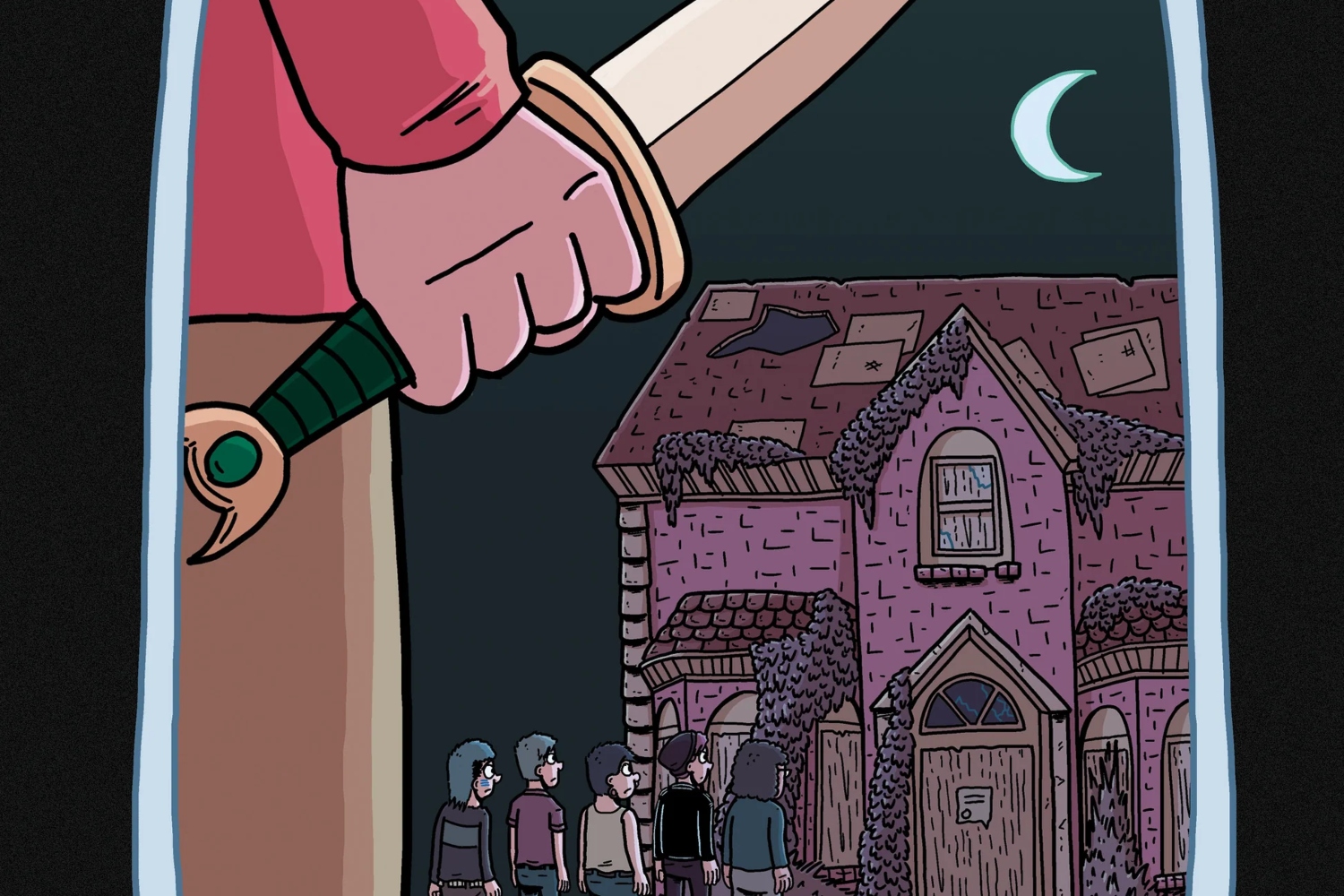

Lots of great horror comics and films tackle big topics like race/class, commercialism, and even if we’re truly alone in the universe. But what about a title that explores that most haunted prospect of them all: turning 30? If you haven’t yet run away in fear, you may want to hear more about The Night Never Ends.
Written and drawn by Steve Thueson, The Night Never Ends follows a group of friends as they celebrate the 30th birthday of their beloved pal Kate. But rather than opt for, say, a nice evening at a local seafood restaurant, the group organizes a seance as a “fun way to relive their punk adolescence before accepting the weight of adulthood,” which almost immediately becomes a “night of fleeing bloodthirsty cultists.” Equally heartfelt, gory, and rather contemplative, The Night Never Ends tackles our shared fears of growing old, perceived irrelevance, and a slow march to the grave in a way that’ll delight and unnerve all at once. It’s horror as it was truly intended: to scare and shock you into new perspectives and understandings.
The Night Never Ends is out now via Silver Sprocket. To get a better idea of the ins and outs of the story, we fielded Thueson some of our biggest questions via email. That includes how they worked through their own aging “crisis,” melding horror and comedy, any connections to their past work, and even a very special cameo.

Courtesy of Silver Sprocket.
AIPT: I assume you’re exploring your own fears of aging with The Night Never Ends. What happened when you hit 30/a similar milestone?
Steve Thueson: Yeah, 100%. I don’t remember ever really caring about my age until I turned 29, and then I basically freaked out about turning 30 every single day for a year. When I was a teenager I was reading about The Cure album Disintegration and how Robert Smith made it at 29 because he felt that every great artist makes their masterpiece before they turn 30 and he hadn’t made his yet. Now, I currently believe that idea is bullshit (also, The Head on the Door is better than Disintegration so I don’t know what the hell he’s talking about), but when I read it it really stuck with me.
So yeah once I turned 29 I was like “I’m fucked, this is my last chance to make anything of value,” and so anything I tried to do that year had this pressure that it had to be important. Of course that pressure made it almost impossible for me to actually finish anything, much less anything good. I make a little joke about it in the book, but once I turned 30 literally nothing changed other than that I was 30 instead of 29. So I lost that self imposed pressure and started just making art instead of forcing myself to make “Important” art. I’m 35 now and everything I’ve worked on creatively in the last 5 years is way more artistically fulfilling and interesting than anything I did in my 20s.
That being said, I have to wear special shoes at work to stop my back from hurting now and I just bought a book on Civil War history, so, you know, aging is not without its downsides.
AIPT: Similarly, is there a character among the five that you associate with. And why?
ST: I started writing the book 100% with Kate as my surrogate. I pulled a lot of her history from my life growing up in Utah and dumb shit me and my friends did in high school. I also work as a barista and like I said I was very concerned with aging not doing anything cool anymore. But if I’m being honest I really just wanna leave wherever I am early, hang out with my wife, watch movies, and get a good night’s sleep. So I’m Brett.

Courtesy of Silver Sprocket.
AIPT: Can or should we talk about the very special cameo from a certain artist?
ST: Hell yeah. I hadn’t designed that character at all so I just had a generic stand-in figure there for the longest time. But then I thought, you know, if I can’t draw myself getting murdered in my own book then what am I making comics for?
AIPT: This book’s very much about not just losing youth but that moment where we’re OK with that change and embrace a new idea of being happy. Is there any truth to that idea?
ST: Oh, for sure. Even though the characters are all roughly the same age I wanted them to be on different sides of accepting where they were at/where they were headed. Kate, I don’t think, has any specific goal she’s not achieving; I think she just knows she’s not satisfied and feels stuck and is seeing her friends move forward. So, yeah, I think as much as it’s about her trying to not get murdered, it’s also about her trying to find some peace with who she and her friends are now.
AIPT: Do you reference or pull from any stories specifically? And why that one/those?
ST: There’s a couple shoutouts to Brian De Palma. He’s my favorite filmmaker and is so good at creating and maintaining suspense. It’s a comedy, but I still wanted there to be a feeling of dread throughout the book even if they’re making a bunch of jokes, so I tried to take some of De Palma’s stylistic hallmarks and translate it into comics. So for example, the sequence that’s in the killer’s POV is directly referencing the opening scene of Blow Out.
AIPT: This is one of the most effective horror-comedy mashups I’ve seen in quite some time. Is there a secret to the balance, or a formula involved?
ST: Thank you so much! Everything I make I just want to be funny. I think for this book I wanted to try and make the comedy and the horror work on their own terms as much as possible. So the comedy is mainly character driven and more about how these friends relate to each other and how they’d respond to a given situation. I didn’t want the humor to deflate or poke holes in any of the horror. Like I didn’t want Alison to turn to the reader and say, “so that happened.” Likewise I wanted the stakes to feel real, and for it to genuinely be a horror comic. It’s a fine line between horror comedy and horror parody, and hopefully this is more in line with An American Werewolf In London than Shriek If You Know What I Did Last Friday The 13th.

Courtesy of Silver Sprocket.
AIPT: How can violence and death be funny or deeply entertaining? I think here, it’s the shine and exaggeration of the blood shed.
ST: Yeah, I mean, it’s all tone, right? Like slashers are super violent, but when you’re watching them with an audience everyone’s hootin’ and hollerin’ during the kills. I think ’cause everything around those kills is trying to be fun and entertain the audience, and the kills themselves fit that same fun tone. And, yeah, like you say, with this book I think the exaggeration helps keep it fun. I wanted the blood to be bright red like a ’70s giallo and be over the top spraying everywhere. Like, if we very somberly watched an accurate depiction of somebody getting their throat slit and blood drained, it would be tough for me to swing back to the dick jokes.
AIPT: I’m a big fan of Quest Mania — do you see any of that story in this book?
ST: Hey, thank you, I really appreciate that! Yeah I think that Quest Mania and NNE are kind of a piece in that they’re both genre comics about slacker punk kids growing up. Quest Mania was my first attempt at writing long form fiction and my first go at working in a genre. I think I figured out a way to put my personality and my life into genre fiction with that story, so yeah, there’s no way I’d be able to make The Night Never Ends without making Quest Mania first.
AIPT: I had a phase about the whole ‘80s Satanic panic stuff. Do you think this book taps into those feelings. Also, why is that stuff so dang compelling?
ST: Yeah, dude I totally get that. I was raised mormon in a very mormon community and would hear stories as a kid about the devil entering peoples homes through ouija boards or dungeons and dragons. And like, as a kid I was genuinely terrified of all of that. I think looking back now all that 80s satanic panic shit has a real campiness to it, like nobody reads a Chick tract sincerely.
I did want to play into that a little bit with this book, like I think all the characters’ understanding and ideas of ghosts and Satan come from pop culture, and the idea that this is some scary new teen trend is in line with those same fears. I wanted to be a little careful though cause I’d say we’re currently in the middle of a new satanic panic that is, uh, a little less cute and campy.
AIPT: Do you consider The Night Never Ends a queer horror-comedy or a horror-comedy with queer characters? And does that distinction matter at all?
ST: I guess I’d say horror comedy with queer characters. I don’t know if I’d say that distinction doesn’t matter, ’cause I do think there are obviously great pieces of art where queerness is essential to the work. I’m just not entirely sure if The Night Never Ends is one of those. With this book, I was really trying to write characters that felt true to life and acted like me and my friends. I’m a 35-year0old barista in West Philly — basically everyone I know is punk and queer. So honestly it would’ve felt more like a deliberate choice to have the characters all be straight.

Courtesy of Silver Sprocket.
AIPT: What do you think ultimately happens with a group of friends like this? Can you have the proper happy ending as a friend group when you reach this level/phase of life?
ST: I think so! I do think part of that is realizing and accepting that you and your friends are different people than you once were. And maybe the happy ending is allowing yourselves to amicably grow apart instead of forcing some kind of stasis. Obviously, though, this specific friend group is trauma-bonded for life.
AIPT: Anything else you’d like to add about The Night Never Ends, your work, life and art in general, etc?
ST: I’m just very proud of the book. It’s been a story I’ve been trying to get out there for years, and I hope people read and enjoy it.



You must be logged in to post a comment.