

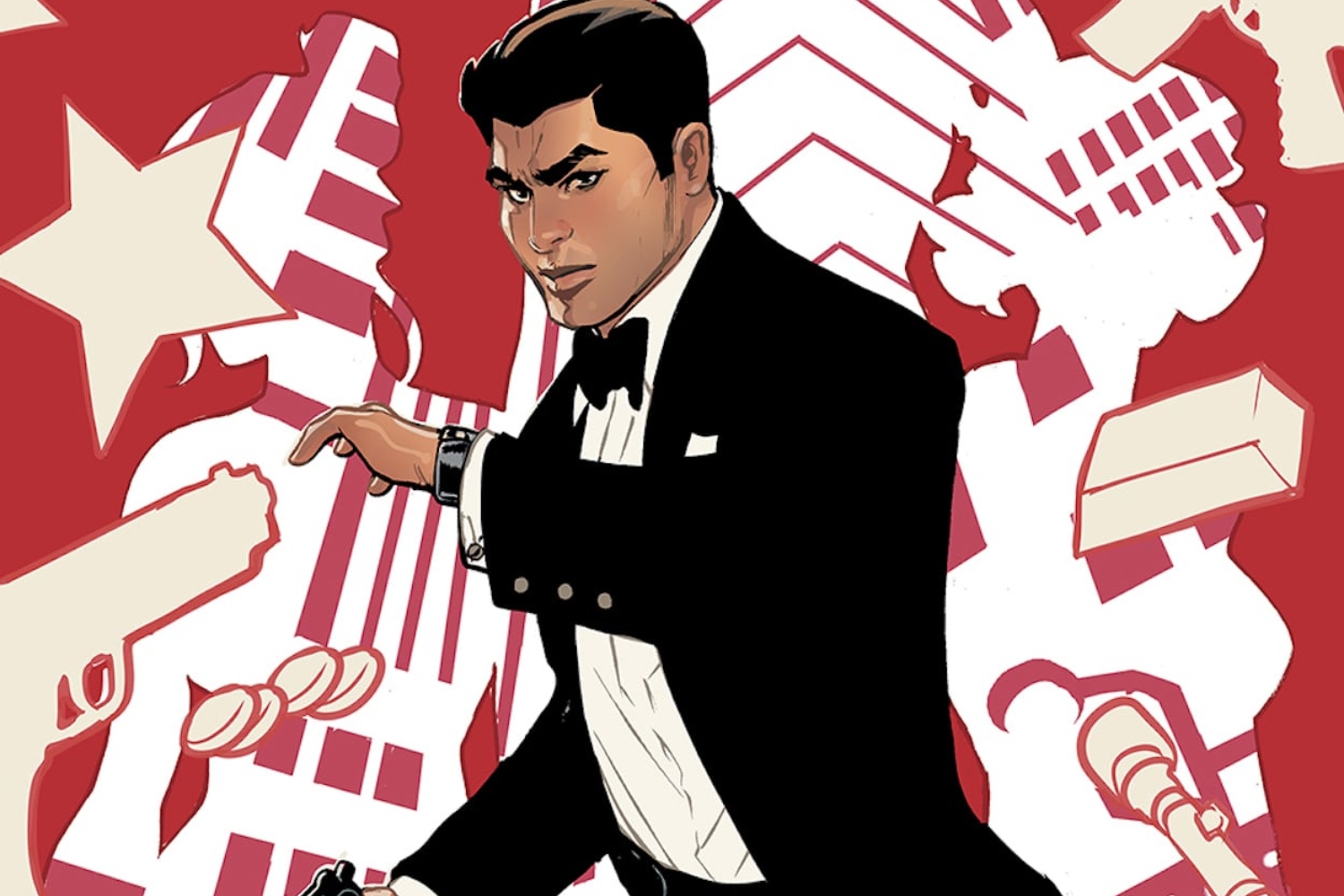

Earlier this year, writer/editor Pornsak Pichetshote announced The Horizon Experiment. The series of five one-shots would see Pichetshote collaborate with A-list comics artists as well as writers from TV, literature, and film. Each book, then, would feature “original protagonists from marginalized backgrounds set in a popular genre and inspired by pop culture icons.” First up for the project is a whiz-bang of a start with The Horizon Experiment: The Manchurian #1
Created by Pichetshote alongside artists Terry and Rachel Dodson and letterer Jeff Powell, The Manchurian is about Calvin, “a Chinese James Bond running covert missions in America for the enemy.” But expect far fewer less volcano lairs and laser watches and way more emotion and intrigue, as The Manchurian explores global politics and interpersonal tension with proper depth and prowess. Yes, there’s slick action and loads of backroom dealings (complete with neat-o code-talk), but The Manchurian is ultimately a story about how we all live in an ever-changing, wholly complicated world of both truths and lies.
The Manchurian is out now via Image Comics. To get a better idea at the story behind the espionage, we fielded Pichetshote and Terry Dodson some not so top secret questions. That includes the pair’s interest in the spy genre, their connection to our lead, Calvin, the political elements of this story, and their influences and inspirations.

Variant cover by Tula Lotay. Courtesy of Image Comics.
AIPT: What appeals to you personally about spy stories?
Pornsak Pichetshote: Generally speaking, spy stories have cool action with cool set pieces while, amidst all that, getting into the complicated, duplicitous ways the world works. Plus, I love their twisty-turniness. But in this particular case, it was Chinese espionage I found so fascinating—specifically, their “thousand grains of sand” approach where, as opposed to relying on one person illegally stealing secure information, you rely on a legion legally obtaining small morsels of it until all those bits put together result in more than what any one person could steal illegally. It’s the power of the collective, a philosophy at the root of Eastern culture.
The Horizon Experiment: The Manchurian follows a super spy who acts as a “fixer”— tasked to help any of those citizen spies who might be in over their heads. So, he’s someone whose job it is to help good people, even if they’re doing things against American interests (the Chinese only recruit good, honest people looking to help their country prosper; they don’t feel dishonest people are reliable enough). This felt like a fun way to invert spy tropes while telling a story about disillusionment — a theme at the heart of so many espionage stories — with characters who sign on for a cause only to realize nothing is as virtuous as they seem.
Terry Dodson: I grew up on James Bond movies, went along with my love of all things action and adventure as a youngster. Today, I still love the action and intrigue, but the mix of international locales and characters, modern fashion, and stylistic lighting and design are appealing things to play with as a creator. And on a slightly related note, I loved what Pornsak had done with The Good Asian and was just happy to work on something new with him.

Courtesy of Image Comics.
AIPT: Because this is the first book, do you feel an obligation to set the tone for the other Horizon Experiment titles at all?
PP: Oh, absolutely. Luckily, I had perfect confidence it would look gorgeous, because Terry is drawing it, and it really does. Together, I think we did something that looks amazing that sits in its own unique place. And I’d like to think it has thrills and heart as well. I’ve come to really like our protagonist and how complicated he is.
TD: I feel like I’ve launched enough stuff that this just feels like a normal level of expectation for me. Everything you do should be your best and knowing this is the launch book in the series just helps reinforce that. I think I put more pressure on myself because it’s “my book.”
AIPT: With a Chinese spy in the U.S., were you afraid of being overly political somehow? Or, maybe more accurately, how do you own that kind of extra relevant approach?
PP: It’s a challenge I’ve found with all my Image books honestly. There’s always the concern that some news article will pop up that will render the whole project irrelevant —or even worse, in bad taste. For The Manchurian specifically, I believe our grace comes from how, while we’re building on something real, we’re constructing a larger than life tableau on which to play on. This is no more accurate to how Chinese espionage works today than James Bond accurately recounts MI:6. What this book really is about is the power of community, the different forms of American disillusionment, and the threat of corporations — although hopefully packaging those ideas in a way different from how people are used to seeing them.
TD: Honestly, this was the selling point for me. I always like the view of the outsider, the normalization of the abnormal, the things on the cutting edge, the unexplored.

Courtesy of Image Comics.
AIPT: Similar to that last question, I felt as if this story was about, among several other things, how the real cultural differences are in the approach and perception to life and key issues. Is there any truth to that?
PP: 100%. As someone who spent his childhood in both America and Asia, I find those culture clashes — and the conflicts that come with them — both fascinating and heartbreaking. On a personal level, my father’s generation was raised to believe you sacrifice your personal enjoyment for your family’s comfort with the knowledge that when your children come of age, they will make those same sacrifices for you. But of course, here in America, we believe and glamorize personal agency. So growing up, I felt that push and pull between loyalty and agency. In many ways, The Manchurian is me exploring those feelings.
TD: I do think Pornsak created a story that turns norms of the spy genre on their head.
AIPT: Are there any spy films directly referenced here or that inspired the core narrative — especially those originating from a Chinese or Asian background?
PP: Most of the Chinese spy movies I know are either period pieces or military stories, but there’s a non-fiction book called Tiger Trap: America’s Secret Spy War with China which is where I learned about the “thousand grains of sand” model of espionage so much of The Manchurian is based on. From there, I was influenced by a lot of spy stories, from James Bond to The Bourne Identity to Mission: Impossible to Tinker, Tailor, Soldier, Spy to The Americans and Slow Horses. But also, very much from old crime procedurals like The Equalizer.
TD: I think Pornsak and I have a lot of similar influences with the Western spy genre but everything else within the Chinese spy world was new to explore, which was fun.
AIPT: There’s so much humanity here and it doesn’t feel hokey or forced like other spy stories (coough007cough). Is this just a great story that happens to be a spy thriller?
PP: I mean, I would very much hope that is the case, but I know I’m biased…

Courtesy of Image Comics.
TD: This was really what made this a fun book to draw. With all those human elements, and the acting and staging involved, it made it a great challenge as the artist.
AIPT: What about the manshu angle felt really interesting to bring to the table? How does that change this from similar spy thrillers?
PP: In some ways, it’s very typical in that you commonly see spies helping out other embedded spies. I’d argue what makes it unique is not the manshu role itself per se, but the people manshus are tasked with helping. Chinese espionage does not believe in relying on untrustworthy, dishonest people for espionage. After all, why would you trust a dishonest person to help you? They’re looking for good, honest people interested in helping China prosper. That’s where the story gets interesting for me. A person helping good people is a superhero at the end of the day, right? Except this superhero helps people against American interests. Or at least against American corporate interests. Which might also make him a hero…? So it becomes a fun way to explore someone doing dishonest things to help good people, although other good people might not see it that way…It felt to me like a fun way to play with the already twisty-turny nature of spy stories.
AIPT: Do you connect with Calvin at all — is he somebody you could almost admire despite his lifestyle and work?
PP: It’s a really interesting question. There’s a lot I relate to. His adoration for the strength of community. His questions about what place “being good” has in society. But what I think makes him really interesting is how much this man who has to lie so much ultimately lies to himself. And the depths to which that goes. I hope I’m not that bad.
TD: It’s his humanity that makes him very easy to connect with — plus, his ability as a “spy” makes him intriguing.
AIPT: Pornsak, do you see this as a kind of spiritual sequel or successor at all to The Good Asian?
PP: I wouldn’t call it a spiritual sequel, but one aspect that definitely came out of The Good Asian is that we explored the Hapa perspective in that book as well (a POV not talked about a lot, despite how common it is here in the States), but the Hapa character in The Good Asian was very darkly complex, and because of that, it didn’t showcase some of the more nuanced traits. The Manchurian balances those scales somewhat and I would love to explore those themes and that unique perspective more in a contemporary setting.

Courtesy of Image Comics.
AIPT: What are some of the visual considerations or must-haves in a spy story like this?
PP: I’m sure Terry has more ideas than I do. I just really wanted to see him in a suit.
TD: I know that it was important to establish strong color palettes to set scenes and mood. Using a lot of cut shots was important to get that spy like flair. We needed to have “beautiful people” and “locales” tropes for a spy story, so that was fun to play with.
AIPT: Would you want to keep going with The Manchurian? And if so, what do you think that resulting story might look like?
PP: Oh, I’d love to do more. I’m excited to further explore the types of people who Calvin would have to help — which provides a way to explore the different reasons people might become disillusioned with America and the corporate priorities that have seemingly consumed the country. Which means we could also explore the corporations trying to stop him as we up the ante. Terry and I talked about how this book is our Casino Royale and our follow up would be more Goldfinger.
TD: Yes, I do want to keep going as this truly was just a set up story — an introduction to set the stage for a bigger spy story.

Courtesy of Image Comics.
AIPT: This story (and seemingly Horizon at large) is about disillusionment. Does that also mean the role we play in ourselves becoming disillusioned with these institutions, people, ideas, etc.? Calvin is aware enough and yet he operates in a pattern.
PP: This story is very much about disillusionment. I’m not sure I would say Horizon at large is, although that is a theme that does crop up in some of the stories. Personally, I’d say Horizon is about potential and all the different places it can sit. But yes, the role Calvin plays in his own denial and self-rationalization — and by extension, the role we all do — I think is very much a question worth asking.
AIPT: Is there anything else we should know about the story, Horizon, comics, life, etc.?
PP: Well, Horizon is the only thing I personally feel comfortable being an authority on, so all I have to say is if you’re interested in The Manchurian or any of the Horizon one-shots, please tell your store to put one aside for you. I think there’s a good chance these comics will sell out quickly, so make sure you tell your store that you want one!
TD: Horizon delivers a great opportunity for readers to jump into a whole range of new stories and ideas from such an amazing and diverse group of talent!



You must be logged in to post a comment.