

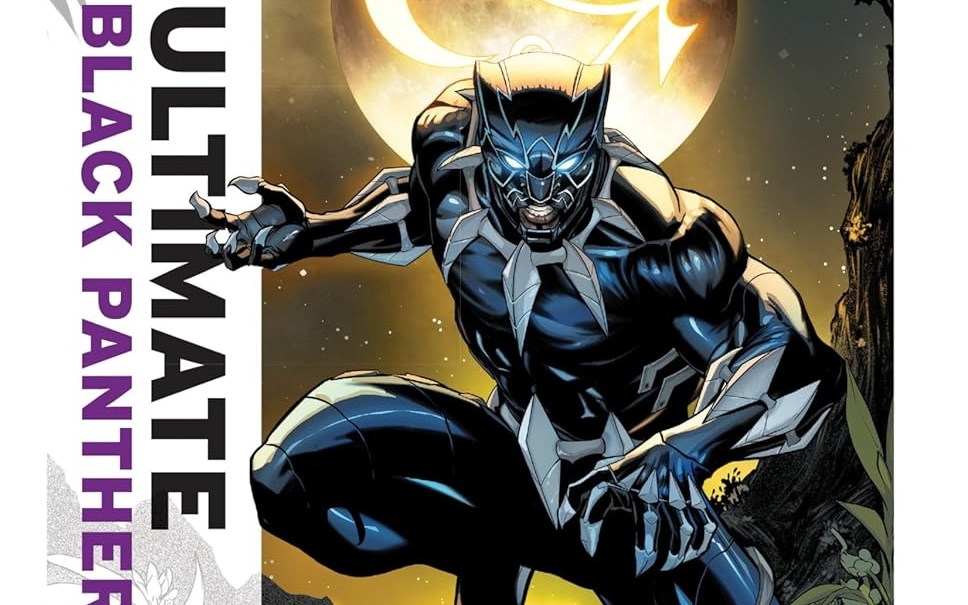

Initially, I approached the revival of the Ultimate Universe with skepticism. While the modernized titles did bring in new readers and allowed writers to craft stories untethered by the decades of canon, I found the arcs trended towards dark and moody versions of iconic characters, something that is rarely my cup of tea. However, when the new Ultimates line was recently revealed, I was surprised with the variety and tonal playfulness present in many titles. Thus, Ultimate Black Panther found a noteworthy way to give T’Challa and Wakanda a reworking, exploring contemporary themes around faith within its first few issues. It’s a skillful first arc in Bryan Hill’s Black Panther narrative, although too similar to other versions of the character to make it stand out.
The Ultimate Black Panther trade compiles issues #1-6, establishing this reimagined tale of T’Challa and Wakanda in the Ultimate Universe. As Khonshu and Ra—known collectively as Moon Knight—seek to extend their dominion over Africa, Wakanda stands as the solitary barrier against their expansion. Following an assault on their nation, King T’Challa joins forces with Shuri and the Dora Milaje to address the external threat and uncover a surprising betrayal within their own ranks. The emergence of characters like Killmonger and Storm adds further complexity to the escalating conflict.

Marvel Comics
The narrative explores themes of faith, trust, and the influence of religion. Writer Bryan Hill depicts Khonshu leveraging a mysterious mineral to perform acts that inspire devotion, such as healing the sick and revitalizing barren lands. This manipulation of faith not only bolsters his following but also poses a significant threat to Wakanda due to the zealotry it fosters. Internal dynamics, particularly the differing perspectives between T’Challa and Shuri on trusting outsiders, add depth to the story. While the artwork varies in consistency, the series sets the stage for an impending war, leaving readers intrigued about how these elements will unfold in future arcs.
Hill’s writing is punchy and enjoyable, and the art by Stefano Caselli and Carlos Nieto is understandably sturdy, but there are places where it feels rushed and feebly assembled. However, my biggest problem with this version of Black Panther is that it isn’t radically different than the mainstream 616 version. When compared to the truly radical version of the X-Men found in Peach Momoko’s Ultimate title, this book simply feels like a slightly different version of his contemporary. Hopefully Hill will take this title in some new and interesting directions as he begins to develop the direction for this title in future arcs.

Marvel Comics
Fans of Black Panther who want to see a slightly different version of the iconic character should find something to appreciate in this first collection of the Ultimates version, even if it doesn’t differ radically from the 616 T’Challa. However, the exploration of faith and religion opens many interesting opportunities for this title, and hopefully they the book will continue to explore those themes in future volumes.




You must be logged in to post a comment.