

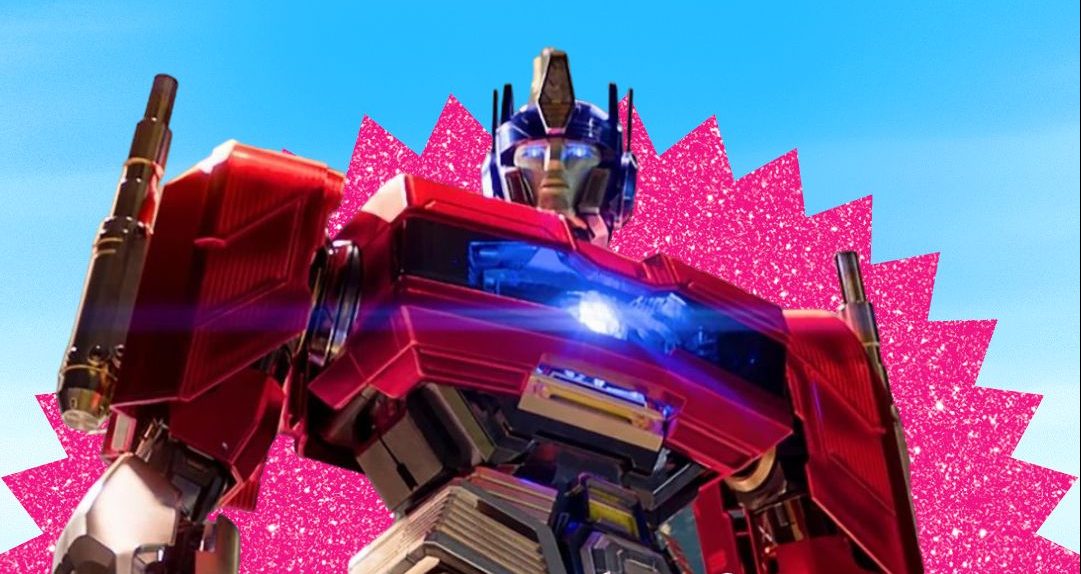

These existential brands are getting out of hand.
Growing up, I collected Transformers toys. They were my favorites once. It’s like having two toys in one; what an engineering and marketing marvel they are. I still have them, they’re just in a container somewhere collecting dust. I never had Barbie (this is relevant for later). When I was old enough, my dad took me to watch Revenge of the Fallen, and I loved it. I had its comic tie-ins and everything. I begged him to buy me the 6 construction vehicles that could combine into a giant toy robot.
By Michael Bay’s fifth and final movie, however, I was tired of it, it was just so much stuff that amounted to nothing. I stopped wanting the toys. Years later when the Barbie movie came out, I loved it more than the Transformers of that same year, the one that jangles previous theme tunes as if reminding someone of their past merits joy. This leads me to Transformers One, the first fully animated Transformers movie since 1986, which funnily enough, reminded me of Barbie out of everything else.
Directed by the guy who made Toy Story 4, Josh Cooley, comes a movie that brings toys to life. Where the previous five films were an exhibition of excess, and the last two were a shot of what this brand could be after breaking up with Bay, this new film is completely fresh. It feels light, without all the baggage of a billion-dollar blockbuster, spared from past expectations. With its lightness, comes an intimately personal story about freedom and friendship. At its heart, the film is structured like a parallel superhero origin story, with two characters undergoing their hero’s journeys that end with them going in opposing directions. A lot of people rightly compare this to X-Men: First Class. But, I’d argue it has just as many similarities to (bear with me) Barbie, if not from its plot, then through its themes.

Courtesy of Warner Bros. Pictures
In Greta Gerwig’s Barbie, the titular Barbie senses something wrong in her facile world. She answers the call to adventure from the “real” and leaves Barbie Land, with Ken following her. There, they are acclimated to an array of information, that radicalizes Ken to a patriarchal ideology and empowers Barbie to actualize her and her fellow residents through empathy. Returning to their home, they both change it according to what they have learned abroad, splitting Barbie Land into two sects. Ken indoctrinates everyone to his male-oriented rule, with every woman docile and servile to men. It is not until Barbie reveals another way, that the system of deception gets broken down, and the way society works and should work is questioned. Barbie emancipates her friends, breaking their bonds – their assigned roles – and inspires others to do the same. By the end, both Barbie and Ken become more than meets the eye.

Courtesy of Mattel
Transformers One follows a similar beat. Their world, Cybertron, is one with class struggle taken to its extreme. It is not only opportunity that is not equal across all the populace, but also physical ability. There are those who can transform and those who cannot. These disenfranchised “cogless” have to take public transportation every day to work as miners. They have no dream of achieving the same heights as the privileged, and can only do the labor they’ve been assigned to from inception. Or so they thought. By the film’s midpoint, both proto Optimus and Megatron (the main characters destined to be ultimate enemies) realize that their values are inherently owned, and can never be taken away from them. They have been deceived by the system they live by, by the people they work so hard for.
Their government uses lies to subjugate the masses. The miners’ work is told to be mandatory for survival, while the elites seek a made-up salvation. To stop people from asking too many questions, they distract them with spectacles. There are live-streamed citywide races to tame the herd and prevent an uprising. And the cogless who are never allowed entry, are doomed to always look up at their betters, never to participate. The status quo is kept intact without so much as a protest. The ones above bask in gold while the ones below look up, smiling, accepting their allocated worth. It is not unlike our world, with Hollywood and celebrity culture drip-feeding entertainment. Except this film, one that is a part of that spectacle, not exempt from that culture, is also one that inspires change. It is an entertainment that recognizes itself and makes people realize something in the world. Aware of its origin as a toy commercial, it proudly reconciles with it by serving its purpose whilst propagating values against blind obedience, thus being more art than ad.
Thanks to a happy accident, our heroes heed the call to action, visit the world’s real surface, and learn the truth. They find out that their universal birthright, the ability to transform, was stolen from them. Privilege that should be the possession of all becomes monopolized by the corruption of one. The need for class is orchestrated and easily prevented. Power is perverted to benefit the powerful. In this state, choice is held hostage. The non-transforming Transformers are told that they have limited options, so they take what work they are given, leaving them open to be mistreated in a labor force, slavishly working under a government that only cares about itself.
Once the wall of lies has been torn down, the workers are incited to revolt. But the solution the movie presents is that, even after every wrong done to you, if you keep to your principles, unwaveringly selfless and honorable, you earn deliverance. In the structure of the prototypical hero’s journey, this is the death and rebirth that precede transformation. In the movie, this is where Optimus Prime is born, a sacrifice that earns him his world’s highest ranking. Where the lowest of the low, becomes the pinnacle of society. An inspiring parable. This is where Luke – moisture farmer, becomes a Skywalker – Jedi.

Courtesy of Paramount Pictures
Optimus blames the person and not the people, still trusting society to hear reason and wake up from the spell of exploitation. He preaches the values of freedom, abolishing the previous system of government. Not unlike what Barbie did to liberate her land. The opposite is true of Megatron, who once idolized his leader to the point of devotion. After realizing his mistake, he is too angry to see past the corpse he made and sees the betrayer in every facet of the world except himself.

Courtesy of Hasbro
Transformation here is presented by two extremes, reformation and revolution. Optimus effectively becomes the government, takes over from Megatron’s coup, and attempts to fix the system from within, putting his trust in people, believing they are wise enough to be responsibly righteous. Megatron on the other hand is disillusioned by the deception that he has endured all his life, the rights that were taken away from him. His blinding hatred for politics and governance drives him towards despotic destruction. He doesn’t want to change the government, he wants to end it.
It is only appropriate that a story called Transformers uses the meaning of the word not only to illustrate the brand’s gimmick of physical change but also to evoke personal metamorphoses; from friend to enemy, from slave to leader, from nobody to a hero. Even the names of the two factions are rationalized, the Autobots coming from autonomy, their root in freeing everyone from the previous autocracy. They intend to seize the means of production and cease unnecessary labor. On the other hand, the Decepticons come from the deceptions that shaped their entire lives and blinded by rage, they only seek to raze everything to the ground.
For kids, it is a heartbreaking story, a break up of brothers, and an excuse to ask parents for toys. But for adults, it is not so much an escape as it is a reminder, of the injustices that many face in all corners of the globe. Optimus Prime’s closing speech is a rallying cry. Transformers One justifies itself being a movie about toys that lives off of its merchandise by acknowledging it and putting it as the contents of the text. Here, totalitarianism in the guise of state capitalism is the antagonist. There is an irony in there though.

Courtesy of Paramount Pictures
A film about the working class where their own is output distributed to others while they gain nothing. Transformers toys are imported – built by unsung workers. The film is made from the toil of countless VFX artists, whose names fade from memory as soon as the credits finish rolling. We, the audience, are being delivered the fruits of their labor, and we want more. A sequel, a franchise. The system both hurts and benefits us. It is this system that supplies us with this movie in the first place. Maybe there is a better way, either reform or revolt. Either choice you take home, don’t forget to buy the toys, they are saying.
Altogether, both Barbie and Transformers One tell us that, when you don’t feel at home in your own world, when you feel less than, as if you have to be something else to exist, maybe there needs to be a change. When things don’t fit, they have to transform. In Barbie Land, the women have the power because the men need them. In Transformers One, the workers have the power because the ruling class is doomed without them. It is only when they realize that, can they finally liberate themselves, opening up what is to what can be.
That’s how these brands can stay in the public consciousness. Other than being malleable, coming out of the factory with a new coat of paint or dress every quarter, they also have to be able to stand for something. Previously, Transformers were just vehicles for the human characters to struggle and triumph over. They were stepping stones for Shia Labeouf or Mark Wahlberg to regain their masculinity. The robot characters could even get killed from off-screen politics, such as when certain car models get discontinued, so the company would opt out of promoting them on-screen. They were products first and characters second.

Courtesy of Paramount Pictures
Even in the original 1986 movie, the reason all the original Transformers were massacred, including (spoilers) Optimus and Megatron, was because they wanted to increase sales by introducing a new toy line. Thus new characters take over from the old: a new villain, a new Prime. Movies targeted at a consumer tend to objectify, giving a spotlight to the product, actor, or brand. But movies intended for an audience instead humanize, give life in animated eyes, the intention is not to coax desire for something, but to move, so that when you walk out of the theater, your gait is motivated, and your feet fall with feeling.
In Transformers One, the absence of humans leaves room for the alien robots to be who we are meant to relate to. What makes a film based on toys more than the sum of its parts is its message, and its humanity, making these toys not just products, but living breathing characters. They can still show how cool-looking these characters are, and how good it would be to possess them in plastic form, but that shouldn’t stop them from having meaning and drama. Here, the famous tagline “freedom is the right of all sentient beings” is given new meaning within the context of the movie, not just something Peter Cullen says before the credits roll with Linkin Park’s tune. Here, the familiar slogan doubly means equal rights. In the end, that is what creates relatability, when a brand is not just a product, but one with a soul. An empathetic story with depth can spark change, beginning in the audience’s heart, outward to the world.
It’s funny how toys, with different insignias and paint jobs – wigs and accessories, can be given retroactive meaning for being. For there to be a war, a reason for kids to buy two different action figures and mush them together, a team of writers produced a compelling sci-fi story of a classist society. It is nothing short of a miracle that both of these brands, Barbie and Transformers, got made and had as much heart as they did. Both films say, in their own way: buy our toys, sure, but also, be human. If we can, with our fake plastic skin, so can you. Choose, do not slavishly submit to what the world says you are, be who you feel you should be. Become. Transform. You’ve got the touch. You’ve got the power.



You must be logged in to post a comment.