

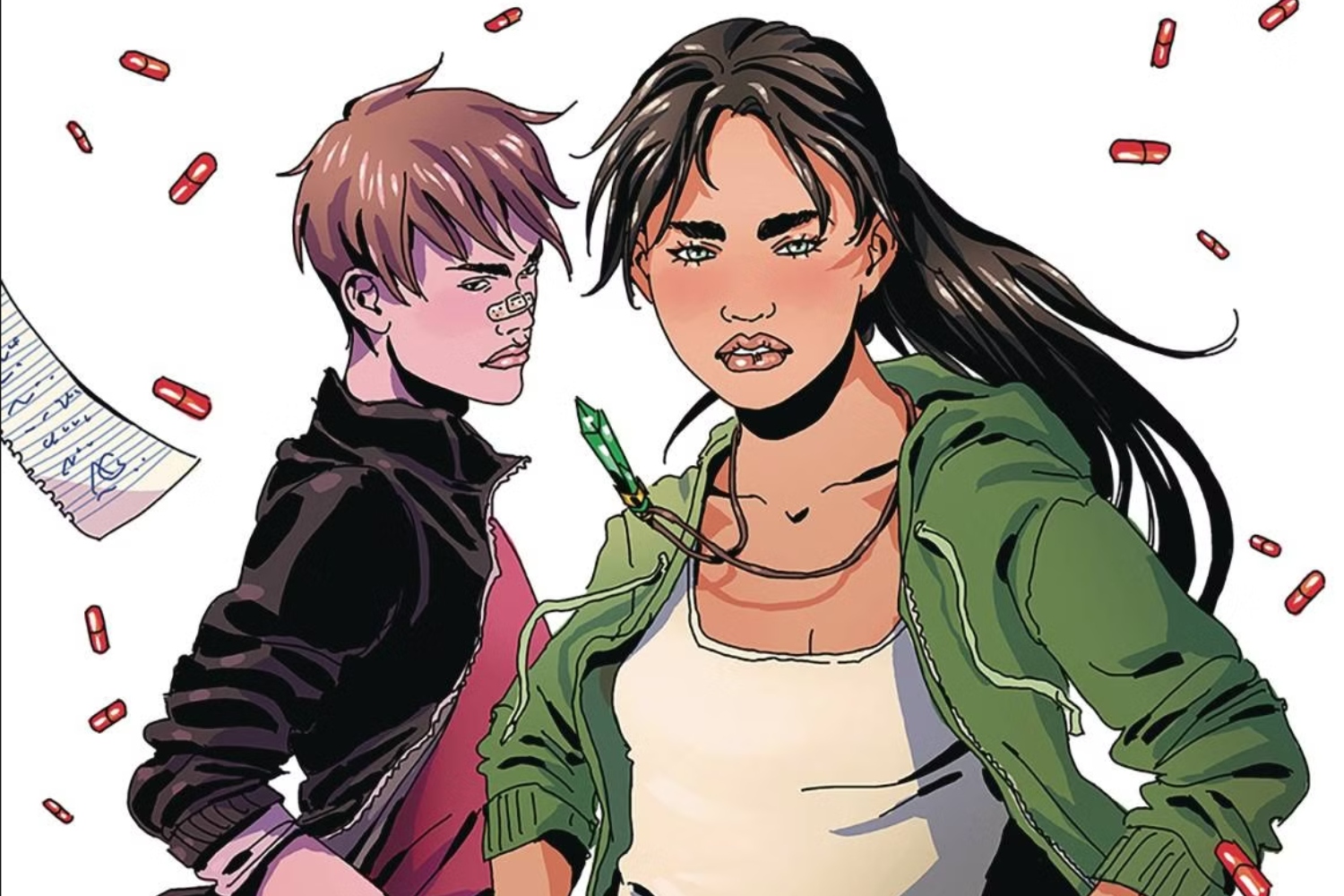

Growing up has never been an easy prospect. And those woes have only been compounded in recent years amid a global pandemic and general social upheaval. But compared to the kids in the forthcoming Image Comics miniseries Juvenile, adolescence is practically a breeze.
Created by filmmaker and writer-artist Jesús Orellana (Rosa), Juvenile focuses on a world where “a deadly virus kills everyone upon reaching adulthood,” with teens, including our leads Sara and Max, locked up in “massive medical facilities” like El Castillo. Only, as we find out pretty quickly into Juvenile, the virus isn’t so much killing the kids as giving them incredible superpowers.
The resulting five-issue story sees Sara, Max, and the rest of the kids at El Castillo trying to sort out truth from conspiracy and escape into a world they don’t fully understand (but whose fate is clearly aligned with their own). While the sci-fi elements fill the story with ample excitement and energy, Juvenile is ultimately a sturdy commentary on growing up amid chaotic times, finding strength in community, and forging a better future with strength and commitment.
Juvenile #1 is due out December 4. (The FOC is Monday, November 11, FYI.) In the lead-up, Orellana was kind enough to answer some of our most burning questions. That includes where the story came from, how he leans into his filmmaking background in making comics, the threads of Gen Z across the story, and connecting to and writing for his teen leads.

Main cover by Jesús Orellana. Courtesy of Image Comics.
AIPT: Where did the idea for Juvenile come from? Do you feel like it’s part of a tradition of properties like Children of Men or The Park?
Jesús Orellana: Juvenile actually started as an older concept of mine in that tradition. After I made my sci-fi short Rosa, Fox brought me on to adapt it into a live-action film, but the scale of that world kept it from ever getting off the ground. For my next project, I wanted to work with a smaller budget, one location, and a limited cast, but all my ideas were still too big in scale. Revisiting this old project about teens with powers surviving alone in a post-apocalyptic world, I thought it would be interesting to get to the essence of that story. That’s how Juvenile came to be.
After years of struggling with the development of a big Hollywood film, at that point in my life I felt this vital need to return to comics, where you only depend on yourself to bring an idea to life. That’s something you just can’t do in film. With animation it’s technically possible, but I know from my experience with Rosa that creating an animated film entirely on your own is completely draining and limiting in terms of duration and scope. Sure, I could make an animated film solo, but it would probably take me several decades, so it’s not a real option. In that sense, I see comics as the perfect medium for a solo creator. It’s always been a bit baffling to me that more creators don’t choose to make their own comics instead of working on existing properties.
AIPT: How do you see comics and filmmaking as being comparable? How do they differ?
To me, they’re almost the same thing. I grew up immersed in comics and films, so the line between the two has always been blurry. Especially with manga and its anime adaptations having such a unified style, blending comics, film, TV and animation even more. That said, there are obvious differences. Without movement or audio, comics tend to be more exaggerated, while film allows for more subtlety. In that sense, comics surprisingly have a lot in common with theater, where acting and dialogue are more dramatic so it can be read from afar. For a creator, every visual medium has its own set of tools, but at its core is just about telling a story in a visual medium, each with its own pros and cons.

Courtesy of Image Comics.
AIPT: Do you feel like this is a more universal exploration of being young and growing up, or do you see it influenced more by the unique challenges and opportunities of youth in our post-COVID world?
Juvenile was actually created before COVID, so while the virus and quarantine themes feel eerily similar, they weren’t directly inspired by the pandemic. What I was seeing at the time, and what became a core theme in Juvenile, was how major tech shifts were already changing the way we communicate, consume, and connect, creating an unprecedented generational gap that has only got worse with the pandemic. The telekinetic powers in the story are an amplified version of this, with the adults feeling increasingly frustrated by their inability to understand the younger generation’s way of thinking and communicating, which only deepens the tension and misunderstanding.
AIPT: I think the art in Juvenile does a great job capturing the energy and excitement (but also tension) of being young. Can you talk more about your goals or objectives with the visuals?
When it came to art direction, I knew I wanted the costumes and backgrounds to start out very gray and lifeless. Then, as the characters grow and free themselves, the colors gradually come in. Another thing to keep in mind is that Juvenile was drawn years ago, so you’ll notice a style progression between the pages and the covers I made more recently, where I lean more towards simplification, using strong black areas.
Going back to my inability to separate film from comics, all my pages use the same four-panel panoramic layout, similar to a film storyboard. I approach it this way because I see the story as scenes, not individual pages. This lets me create a visual flow that keeps the reader focused on the narrative rather than on shifting layouts. But again, it’s not a strict rule for me, just how my brain works.

Courtesy of Image Comics.
AIPT: Do you see this story as being about empowerment for young people everywhere? Is it more a warning to adults instead?
For me, it’s mainly about change and how it affects us all, whether we welcome it or not. Change is inevitable, but it’s all about how you react. The older generation tends to resist change, to hold on to what they know, while the younger generation leans toward revolution and shaking things up. When these perspectives become too polarized, conflict arises, especially when those in power resort to authoritarian measures to suppress that drive for change. In real life, that’s obviously troubling, but for a fictional story it’s great material.
And of course, the story is told from the young people’s perspective who are forced to react under a very extreme situation, so in that sense it’s definitely about empowerment and finding one’s place in a hostile world.
AIPT: Is there a reason why you chose telekinesis? What about that power made sense with the story and the main themes?
I was a kid in the ’80s, and telekinesis was a big thing back then: Carrie, The Fury, Scanners, Firestarter, and obviously Otomo’s Akira, which of course takes it to a whole new level. There’s also another short gem by Otomo called Domu that also tackles telekinetic powers in a beautiful way.
Telekinesis is a perfect power to parallel puberty, which can often feel chaotic, out of control and threatening to the adults. Especially if these powers emerge during an age when the characters are still struggling with self-identity and emotional control.
AIPT: I kept thinking this story is basically like an ‘80s teen film updated for 2024 — would you happen to agree?
That’s absolutely intentional. Obviously John Hughes was a major reference when it comes to portray teenage characters. I love how he treated them seriously and with respect. He really was a master at capturing their essence.

Courtesy of Image Comics.
AIPT: I think this book touches on a real history of how we’ve treated certain groups, like with Indian schools in the American southwest. Was that a purposeful approach, and is something like that hard to discuss/address?
I wasn’t directly drawing from that specific history, so if there’s a parallel it certainly wasn’t intentional. The themes in Juvenile are universal, and it’s tragic how certain patterns of governmental oppression and control keep recurring throughout history, particularly against vulnerable groups.
AIPT: This book feels not only timely with COVID stuff about youth movements, but maybe feels appropriate for life amid the scourge of Trump. Do you connect this story with some of those overarching ideas or anxieties?
Actually, Juvenile was created before the pandemic and even before Trump’s first term, so while it may seem timely, it wasn’t influenced by those events. That said, the story highlights recurring patterns throughout history, particularly how younger generations often find themselves in need to fight for their future against authoritarian systems.
When there is a major collective shock, whether it’s a pandemic, a global crisis, a war or events like 9/11, it’s always the young who suffer the most because it’s their future that’s at stake. That’s something we should always be very mindful of.
AIPT: Who do you resonate more with and why, Max or Sara?
I can assure you I have nothing in common with Max, so if I have to choose it has to be Sara. who is far more responsible and thoughtful. Writing teenage characters was a real challenge for me. I’ve always been a very introvert person, so I tend to draw more from media than real life for inspiration. It’s not ideal, of course, but hopefully it’s enough!
AIPT: Do you have a favorite moment in either of the give issues — something that feels indicative of the whole series?
I love issues #4 and #5; both are pretty much one big sequence, and there are moments in issue #5 that I’m especially proud of. So if you enjoy issue #1, you can trust that things will keep getting better and better!

Courtesy of Image Comics.
AIPT: What big elements would you tease for issues #2-5 — I’m thinking about some possible family reveals and relationship trauma.
Without giving too much away, I can promise that things will get a lot more personal and intense as the story progresses. There are big surprises coming ahead, especially in issue #5.
AIPT: Is there anything else we should know about Juvenile, your work, comics, film, life, etc.?
Now I’m working on several comic projects, a cyberpunk series which hopefully will be released next year, and then will come an extremely long gestating Rosa adaptation that I’m dying to get to work on.
You are also probably wondering how did I get Maria Llovet to make a cover for each of the five issues of Juvenile. That’s because we are married and been together since we met at a comic school 20 years ago. Her constant push and support is also the reason why Juvenile is finally been released. So, you could say she didn’t have much of a choice!


You must be logged in to post a comment.