

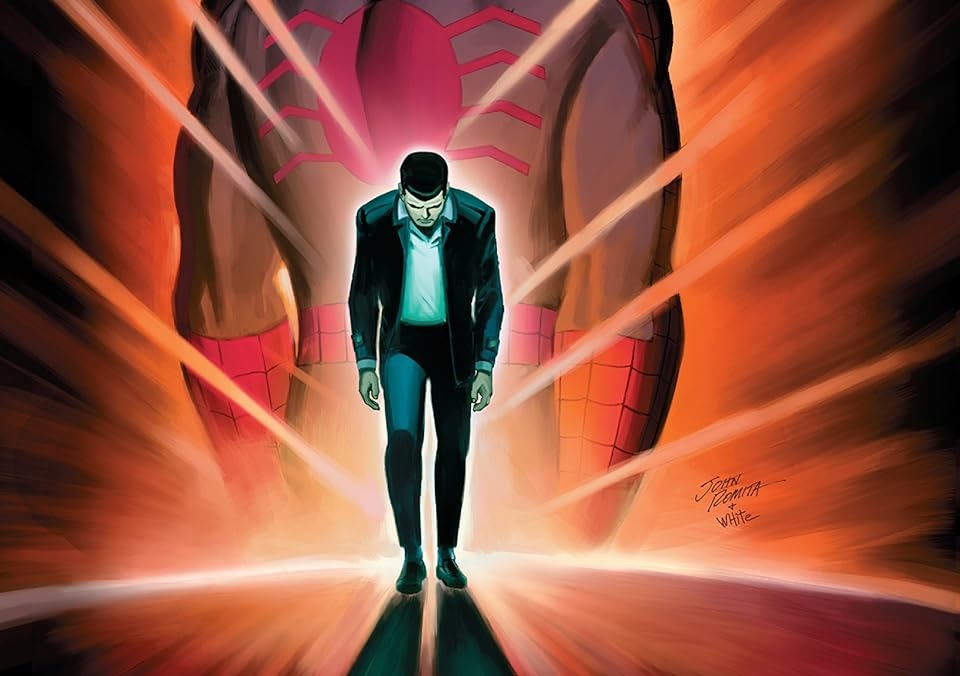

What a weird week to be writing about a Spider-Man comic. The nature of culture (and politics) generally looking backward toward some imagined golden age where everyone was happy and taken care of, and how that has caused every system imaginable to cave in on itself in the last 30 or so years almost makes me want to reactionarily hate this book out of principle. That’s doubled because it really is good, and I hate that people can justifiably point at this book to say “why isn’t it as good as that was?!”
I did enjoy this book quite a bit, and am happy these reprints have finally gotten to the Romita years, which I’ve heard on terrible authority are worse than the Ditko ones. What an incorrect thought! I was actually surprised by how much the book hedged toward those issues; I expected a sudden, wild departure, and instead it felt like Romita was apeing Ditko until late in the collection. Very weird to act like these issues aren’t a direct extension from what had already been made.
This collection was really cooking with the melodrama, though. Peter gets to be such a sad boy here, and it shines so well across the book. Amazing Spider-Man is at its best when Peter is whining about being lonely even as he’s growing his social circle. He worries (almost to the point of complaining) about Aunt May even while trying to justify his moving out. Of course she would be happier and safer without her only living relative! It would be much better if she lived with her friend, I’m sure that is the best person to care for her in her decrepit age.
And all of this leads to some delicious little moments for our little Peter B Parker. He gets to sit around and question why he’s Spider-Man, including the very self-hating liberal, “have I an insane lust for power…a need to feel more important than those around me?” all while the family he saved is happily praising him at the bottom of the page. The Lizard issues are particularly fun as they let Pete be alone more for a bit, and give a hint at what a lonely whiner he can be. Even when he’s got a new friend group who will tolerate his general assholery, he still finds time to go in the corner and meow at all hours of the night. This might come off as a negative critique, but I can’t really think of a more accurate depiction of a quirked up white boy.
Maybe my favorite moment in that vein is the last page though, which is just about as perfect a depiction of family abandonment I’ve ever seen. See, Peter finally gets to move out, gets the freedom to do his self-obsessed heroics behind closed doors, where he won’t endanger May with stress. He’s tossed her into the neighbor’s guest bedroom and traipsed right out of the suburbs, the typical teenager dream. And immediately feels like the little urchin he is as soon as he’s alone in a room. It’s perfectly true to the actual feeling of moving out of your parent’s house for no reason but your friend said you should, and it’s insane that Lee and Romita had that so true back when my dad was a teenager.
Is some of this book unbelievably hokey? Am I unsure whether it’s healthy for a culture to be so obsessed with stories from 60 years ago that we can’t learn to read and develop ones today? Is fandom leading to a more fascist society? Yeah. Is this book still a banger? YEAH.
This week I am scared, disappointed, anxious, and mad. Amazing Spider-Man Masterworks Vol. 5 didn’t fix that. It also was good enough that I couldn’t just take my anger out on it (you should see some drafts though, I did try). Maybe the book–or the weird attachment nerds have to it – was part of the formula of the cultural disintegration in the US, or maybe Peter’s individualism is evidence of no, I just want to blame Spider-Man. Just for this week.




