

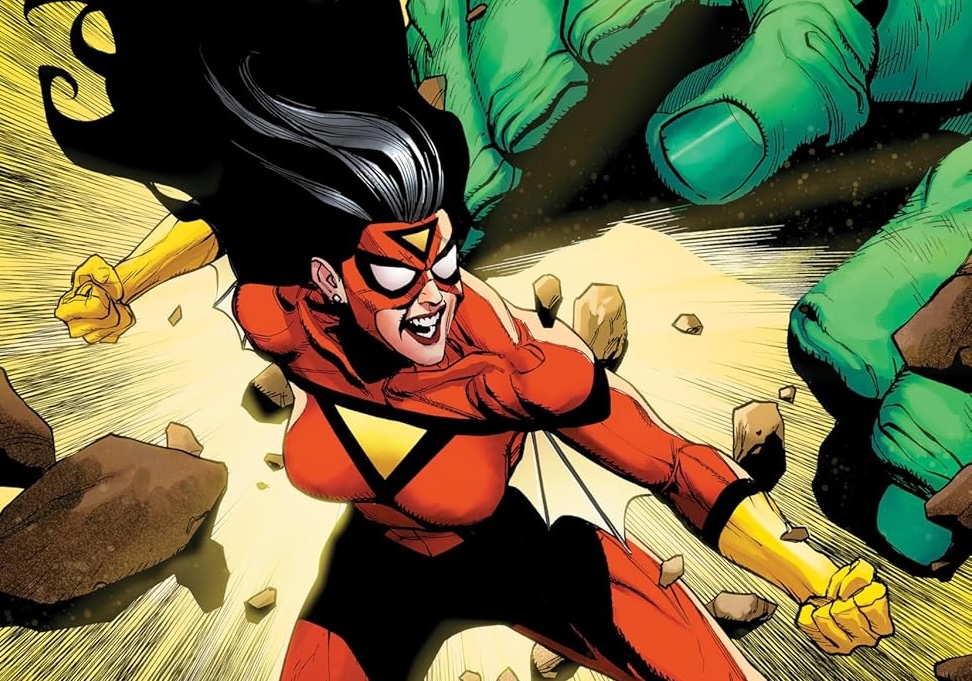

In our review of the last volume of Spider-Woman, we expressed concern over the book’s longevity — Jessica Drew has a history of short-lived solo books with unsteady narrative foundations. That concern, it would seem, was well founded—this week’s The Assembly marks the end of writer Steve Foxe’s run with the character, which ends here after ten issues.
It’s wearisome but understandable – one wishes Jessica could find a decent platform, but she isn’t exactly an A-list character. The trouble with The Assembly doesn’t just lie in less Jessica Drew, however, but that its conclusion all but invalidates much of its narrative, let alone makes waste of at least one issue collected in Gang War.

Marvel Comics
That isn’t to say that the stories here aren’t fun – there is action, an exciting twist, the return of a classic villain, and the debut of several young heroes – it’s that those stories have nowhere to develop, refine, or conclude.
Bold swings are a necessity in uncertain books, and Steve Foxe made sure to make those swings: the volume’s major plot, which saw Jessica’s son, Gerry, aged up and converted into a Hydra baddie, is nothing but bold. It was the sort of narrative that demanded deeper focus, but the book – seemingly optimistic of a future it did not have – casually diverted its attentions to disposable guest star issues and parts of a larger narrative that, without the time to gel, begin to feel extraneous.
Even the bulk of The Assembly, which features the titular crew of (as Jess refers to them) even younger Young Avengers, feels like a diversion. Worse, it feels like an incomplete fragment – something that, with a bit of forewarning of the book’s impending end, might have been better refined. The book sets out to introduce the team and its conflict but doesn’t quite succeed in developing each character in a way that makes them noteworthy on their own merits.
This is the gamble made in a serial medium where the fates of books are defined by their sales; there are hundreds of examples of books cut short before they could fulfill their promise, and this is just one of a handful of recent examples. It’s unfortunate, but it is also, sadly, unavoidable.

Marvel Comics
The Assembly attempts to recenter our character. Jess relocates to her old hometown of San Francisco, where she reconnects with an ex (and ex-supporting character). It feels as if the book is attempting to establish Jessica so that she can dive into a book unburdened by the crossover event from which it sprang (let alone Spider-Boy). This collection’s first issue, which features a fight with Star as Jess travels across the country, feels like a strong introduction to a conflict-a-month series. Even the foundation upon which the new teen superheroes build their narrative – and evil, Hydra-facade corporation that is slowly displacing San Fran’s unhoused – feels like a worthy setup for Spider-Woman’s conflicts-to-be.
The diversion, then, of introducing all these kids, does Spider-Woman a disservice, both as a character and as a solo title – it shunts all the important drama away from our main character and disconnects her from the truly horrifying motivation of a mother whose son has been abducted.

Marvel Comics
The reasons for Spider-Woman’s cancellation, then, feel apparent in the unanchored mess of the book’s loosely connected events: we don’t know who we should care about, we don’t know what’s at stake, and we certainly don’t believe in our titular heroine’s motivation. It’s a bummer because all the free-floating pieces (the members of The Assembly included) are so cool that we really, really wish we could care about them.
Ultimately, Spider-Woman by Steve Foxe Vol. 2: The Assembly becomes a document of its cancellation rather than a memorable outing for its heroine. It’s all fun and games, but it’s a sort of weightless fun – a fun that will tragically float without any chance of landing.




You must be logged in to post a comment.