

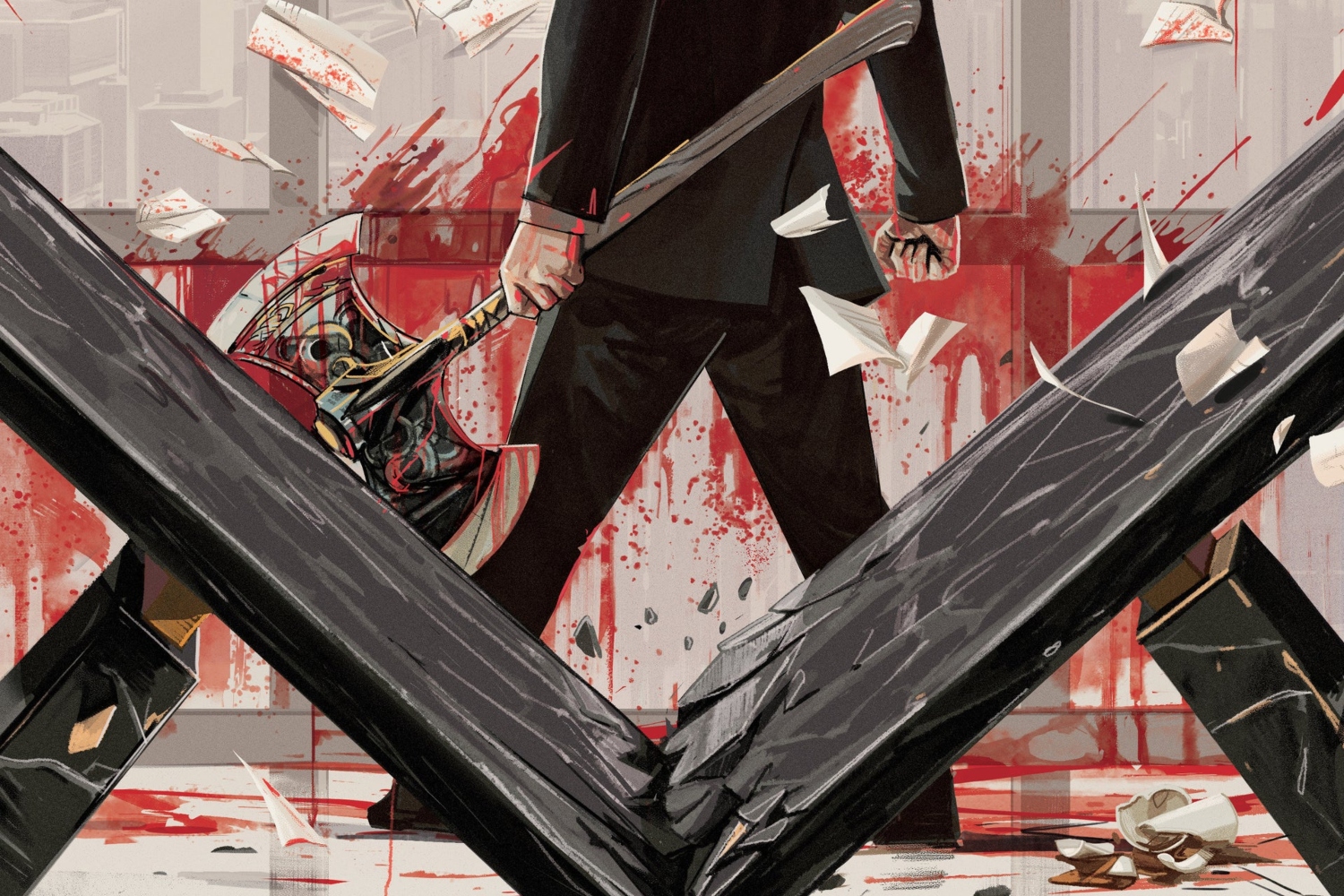

I’ve commented before how delays can often be the death nail for a series. Kill All Immortals, especially, had so much bubbling and simmering after October’s fourth issue. We not only discovered the source of the Vikings’ immortality, but Frey made some hard, hard sacrifices in the lead-up to a final confrontation with her family.
So, then, would having to wait a couple months stymy this profound story of family drama and end-stage capitalism? Or did the Vikings’ power and intrigue mean they could wait out a few meager months like it was a long lunch? As it turns out, the delay may have been worth it as we got a mostly mighty finale and perhaps even a bright future for Kill All Immortals.

Courtesy of Dark Horse Comics.
Having to go out on such a high (or is that low?) point following issue #4 gave me a lot of time to stew. Just how would Frey be coming into said confrontation? How could she deal with what she’d done to Owen? And how would her family treat her after all of this? A little extra time meant that we’d feel the true weight of these people’s lives, and as writer Zack Kaplan has done across the first four issues of Kill All Immortals, he affected us deeply leading into the series’ conclusion.
What we got, then, was the kind of big, visceral battle that we’d truly wanted. The art team — artist Fico Ossio, colorist Thiago Rocha, and letterer Hassan Otsmane-Elhaou — once more delivered some deeply personal, massively bloody battles between Frey and the rest of the Asvald clan. Everyone and their mother has called this series “John Wick-ian” from the get go, and this issue was as brutal and unrelenting as ever. There’s something about wailing about family while you’ve been partially vivisected, or yelling about honor and business with a sword in your chest that just feels deeply moving. The blood felt darker and more intense somehow, and we got to feel the release of such violence even as we understood its larger, contextual value.

Courtesy of Dark Horse Comics.
Similarly, the family’s battle was structured and laid out in a way that wasn’t just about sweet bloodshed. For instance, the brothers all fight/battle in a way that feels deeply indicative of their personalities. Steinn is more lithe and prone for surprise attacks, which speaks to his nature as the youngest; Thor is all size and strength, and that speaks to his emotional stability and larger role in the family; and Leif, the oldest, fights with the anger and intensity of someone who clearly has a lot to prove. But even those expert displays paled as to how father Erik existed on the page. He tore through his offspring with a brutal efficiency, managing to operate like each of his children in a way that spoke to some deep connection and understanding.
Sure, that cohesion was warped as father bested his kiddies, but it just further speaks to how the action and visuals in general were expertly crafted to bring us in with blood and guts and yet slowly reveal these deep character insights. That even with our mouth slack-jawed at the sheer violence in every panel, we could resonate and know these characters with a power heretofore unseen. It’s another way that Kill All Immortals has been surprising in its way, and tried to make these characters and their deliberate development a vital component no matter how much blood was flying. It’s a testament to the series’ real prowess, and why it made itself so much more than its premise or inspirations.

Courtesy of Dark Horse Comics.
At the same time, the true “hook” of this finale isn’t quite so understated or nuanced. I don’t want to spoil too much, but the fight scene plays out in a way that maybe is a little too obvious. It’s a path you likely saw coming already, and one that means the father truly must pay for the sins of his nefarious ways at the hand of his children. And from that whole path/arc, I feel a few different ways.
One, I did think it was a little too on the nose. Yes, it’s something we all saw coming, and it has to happen if the sons are to learn any lessons; if the father’s to pay any kind of karmic justice; and if Frey’s path is going to be cemented and her uneven journey made meaningful. But even then, it happens in a way that just feels a touch too uneven in parts.
Yes, I love the way that, for instance, it begins with Thor, who very much had this robust emotional presence across Kill All Immortals, and if big changes were going to happen, it’d have to begin with the big guy. On the other hand, Leif’s move to the “winning side” felt a little awkward and half-cocked, and while I’m glad he finally joined his siblings for the book’s final true confrontation, it could’ve happened more deliberately and meaningfully.

Courtesy of Dark Horse Comics.
Still, despite any of these “missteps,” I think a more obvious level or kind of payoff for the audience, as well as a rather overt pacing and approach, actually works. I mentioned the John Wick-ian nature already, but part of that story’s appeal is that, yes, things happen not only how you want them, but in this very bright, bold, and obvious manner. That this approach, I think, isn’t about phoning it in, but rather contextualizing the pain and anguish we feel for these characters in a way that makes us sure a mighty resolution will come.
That while we will struggle with them, relief will be big, unavoidable, and all-consuming. That you don’t have to be sly and subtle in every gesture, and something direct and in your face reminds us of why we invest in these stories and why we care in the first place. Life’s payoffs aren’t always so flashy, but in Kill All Immortals, important events land like an axe to the face, and we’re all more happy and satisfied knowing that our hard work and commitment will earn its just desserts.
In the end, the overtness of the Asvald children’s ways assured us that a page had been turned (in a loud, bloody way), that they were more connected and unified than they’d been in centuries, and they were free to live how they wanted to. And, sure, the big question hanging over them was made triply clear for us in another slightly awkward way, but again there’s a purpose: sometimes it’s nice to scream change/development from the rooftops, and to make people really aware that what was is no longer and that the characters occupy a fresh world. The fun, then, is to not only celebrate these achievements, but to feel satisfied in the fact that their pain and sacrifice truly meant something, and that we’re engaged with characters in facing new challenges and opportunities.

Courtesy of Dark Horse Comics.
What those challenges are I can’t say, but in a neat little ending, the book reveals and/or teases at a possible second chapter for Kill All Immortals. Again, without revealing too much, it’s totally on brand and a neat little spin to really get the most out of this “family of immortal warriors” premise. And if it happens, I’ll totally be on board given the events of Kill All Immortals part one.
But even if nothing else happens, I’m satisfied thoroughly with Kill All Immortals as it ends right here. Yes, there was some super-overtness and slightly awkward bumps along the way. But as a whole, this book/story gave us everything we could want: violent battles with heaps of subtext; characters moving and growing in a dark, complicated world; and great thematic insights. (In terms of the book’s interest in capitalism and nepo babies and transparency, the ending really ought to put the fear of god in the elite.)
Waiting only made it all the more clear: Kill All Immortals is a hell of a book about family, lineage, and what happens when we seize our destiny with blood and emotional strength.




You must be logged in to post a comment.