

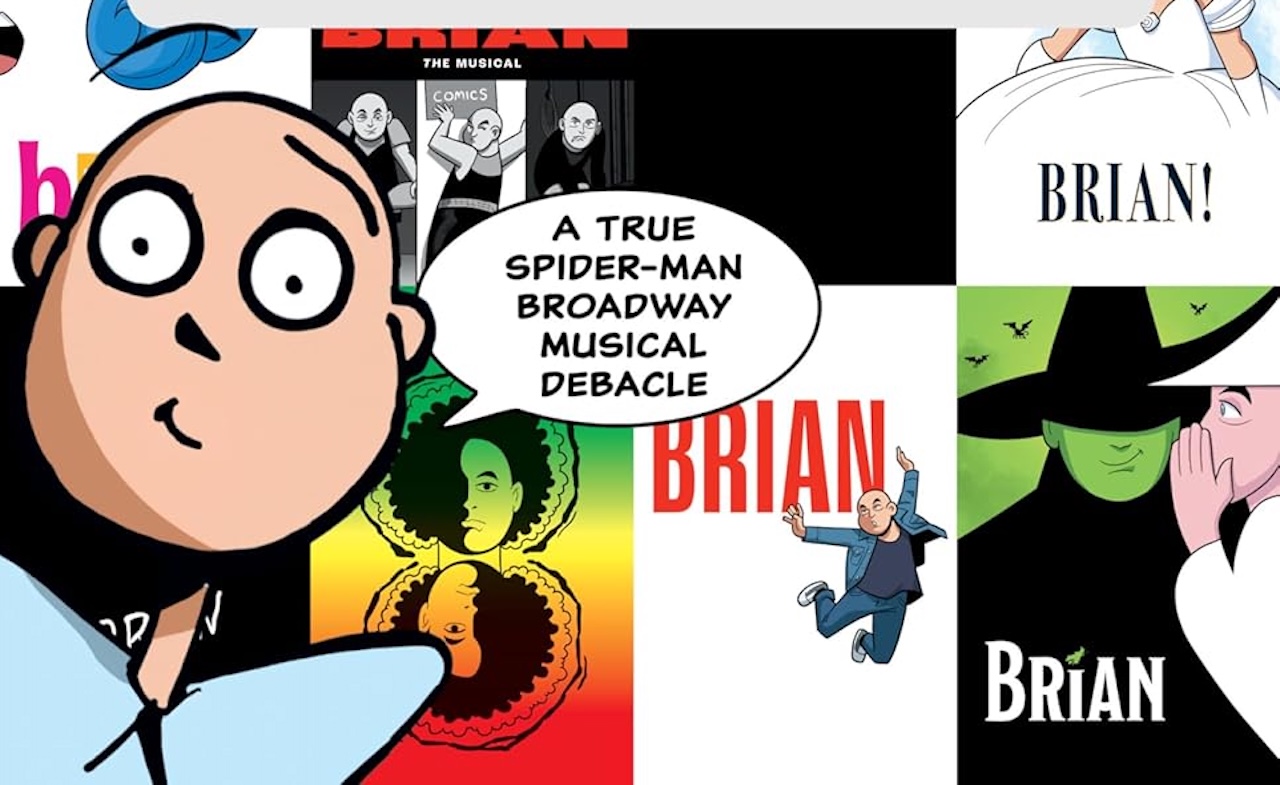

Brian Michael Bendis is well known for his storied comics career, including his work on the original Ultimate Spider-Man with Mark Bagley. But did you know he was once tapped to write a Spider-Man musical? Fortune and Glory: The Musical, originally serialized on Bendis’ Substack, is the true story of how Bendis was approached to write the book for Spider-Man: Turn Off The Dark. Yes, that Spider-Man: Turn Off The Dark.
Fortune and Glory: The Musical serves as a sequel to Bendis’ graphic novel Fortune and Glory, which was another story involving the ups and downs of a media machine. There, it was Hollywood, and the events that happened when his Goldfish comic was optioned for the big screen. Here, the story is split between two different tracks; Track A details Bendis’ experience with the musical, and Track B explores how he got into comics – including his historic run at Marvel.
It’s a unique way to approach the subject, but it also puts comics front and center. After all, if there were no Spider-Man comics, how could you make a musical? But Bendis, in a way, is showing his fans that he shares a bit in common with them. He was once a wide-eyed kid who fell in love with Walt Simonson’s Thor and Frank Miller’s Ronin; he loved comics enough to make a recording of a Fantastic Four issue; he loved comics enough to look after a comic shop when the owner got called into court (despite the fact that he wasn’t employed at said shop and came there to trade comics). As a result, Fortune and Glory: The Musical straddles the line between “professionally published comic” and “story you might hear at a party”.

Dark Horse
But don’t worry, the musical gets brought up too. In a stunning example of Bendis’ wit (and a harbinger of things to come) during a phone conversation, director Julie Taymor goes on a tangent about changing Peter Parker’s origin so that he gains powers from Arachne, a figure associated with spiders in Greek mythology. Bendis is flabbergasted…until he realizes that Taymor got the idea from the very first issue of Ultimate Spider-Man where Norman Osborn recounts the myth of Arachne.
Fortune and Glory: The Musical also boasts a change in art; while Bendis wrote and illustrated the first volume of Fortune and Glory, this one boasts the stylized illustrations of Bill Walko. Walko’s artwork has a very cartoony, very energetic vibe to it, as whole pages feature Bendis traversing the length of a page while delivering a monologue. Further selling the animated comparisons is Wes Dzioba’s color art, which brings a warm, inviting hue to the picture, and Joshua Reed’s letters. Reed’s best flourish, in my opinion, is drawing certain words in a big, bold yellowish font that immediately shouts “Read me!”
The moment that stands out to me is a two-page spread where Bendis recounts his first in-person meeting with Taymor to discuss Spider-Man: Turn Off The Dark. He arrived during the weekend the Academy Awards were held, meaning that Walko gets to draw his take on different actors of all shapes and sizes. It’s packed full of people you might know and people you might not (Jack Nicholson and Robin Williams are the standouts). The only more impressive thing is that somehow Dzioba manages to capture the sheer brightness of the Californian sun.
There’s one other recurring element through Fortune and Glory: The Musical that will get a laugh out of readers. While Bendis is recounting his story, there are sticky notes placed on certain characters or comics – especially the ones that belong to Marvel and DC. They’re all rendered in a bright yellow, with letters indicating notes from editor Daniel Chabon (who is very clearly trying to make sure no one gets sued). As far as dodging copyrights go, this is certainly creative.

Dark Horse
Fortune and Glory: The Musical mixes one part story about a failed Spider-Man musical and one part love letter to the comic book medium to deliver a story that only Brian Michael Bendis could tell. It also proves that some sequels are worth the wait.




You must be logged in to post a comment.