

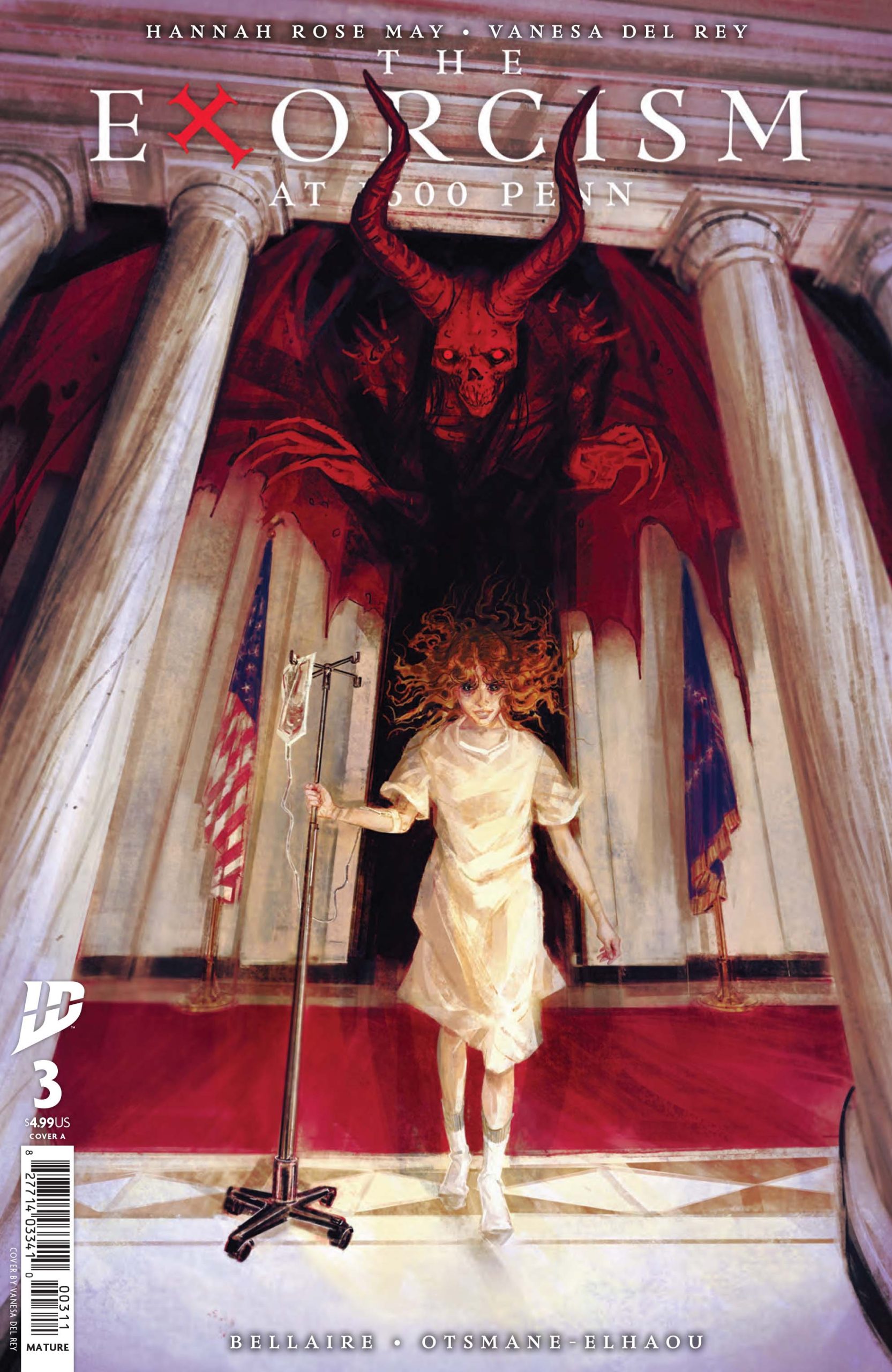

William Peter Blatty’s 1973 film The Exorcist is often praised as one of the scariest movies of all time, and it’s largely responsible for the resurrected practice of exorcisms in the Catholic Church after they had, for the most part, been abandoned for centuries. The influence of The Exorcist continues to be felt today; for example, in the IDW comic series Exorcism at 1600 Penn by Hannah Rose May and Vanesa Del Rey. The book essentially tells the same story, except instead of the daughter of an actress becoming possessed, it’s the daughter of the President of the United States.
Exorcism also offers something of a crash course the idea in general, which is largely accurate according to the Catholic tradition. There’s not a test per se to determine whether someone is possessed, but there are certainly criteria.
Exorcism at 1600 Penn focuses on the Doyle family: Kelly, the mother and newly elected President of the United States, her husband, and their two teenage children — Kevin and Mara, the one who’s possessed. Kevin and Mara both attend a Catholic school, and once Mara becomes possessed, Kevin is the one who approaches a priest asking for an exorcism. Kevin is sorely disappointed when Father Daniel Reid tells him, “The church doesn’t practice exorcisms anymore. They’re archaic, a relic of the past.”

Father Reid’s statement in Exorcism at 1600 Penn couldn’t be less true. According to a 2018 BBC article, exorcisms have been on the rise, prompting the Vatican to sanction the training of more people to perform the ritual. That demand is unlikely to go down anytime soon, as religious studies scholar Joseph Laycock asserts, “I believe the church’s changing stance on exorcism has little to do with our culture’s understanding of mental illness or other scientific advances and more to do with competing visions of the church.”
Is this gonna be on the test?
The skepticism with which Father Reid refuses Kevin’s request for an exorcism, and his insistence on empirical evidence, is wholly justified. Common symptoms associated with a variety of mental illnesses (schizophrenia, psychosis, etc.) can present as classic signs of demonic possession. Following the Second Ecumenical Council of the Vatican in 1962, the Rite of Exorcism was revised to explicitly admonish the exorcist to seek out medical experts to rule out mental or physical illness as a potential cause.
In Exorcism at 1600 Penn, Mara is evaluated by experts, even undergoing a similar battery of tests as that of Regan from The Exorcist. Father Reid is not made privy to that information, and no formal diagnosis is made — Mara’s condition remains a mystery. Assuming Father Reid had concluded an investigation into possession was warranted, it wouldn’t be appropriate or responsible for him to suggest Kevin gather evidence. Only an ordained priest or higher prelate is authorized to make a determination of possession, and it would be their responsibility to conduct interviews and a thorough investigation.
Looking for evidence to persuade Father Reid, in Exorcism at 1600 Penn #3, Kevin mentions there being:
“three major tests to determine whether someone is possessed. First, does the victim have intimate knowledge of information that would normally be unknowable to them? Second, does the victim display aversion to sacred or religious objects and practices? Third, does the victim have mastery of a foreign language they’ve never studied?”
These are indeed measures by which a Catholic exorcist determines whether or not someone is possessed, but they’re not exactly tests, and they’re also not the only criteria the exorcist will look for.
Common signs of demonic possession
For the first thousand years of Christianity and up until the 15th century, there was no consensus on how exorcisms should be performed, or even who could perform them. Early church fathers such as Origen, writing in the 3rd century in his Contra Celsum, tell us that even the simplest and rudest of the faithful were able to cast out demons by prayer and the mere mention of Christ’s name. Similarly, Cyril of Jerusalem compared the name of God to a “fierce flame” that scorched and drove out the evil spirits.
By the 3rd century, exorcism had become an official function within the church. However, it wouldn’t be until 1614 that the Catholic rite of exorcism would be formally laid down by Pope Paul V in the 1614 Rituale Romanum. The rite remained unchanged for the next 350 years, until Vatican II and the eventual publication of De Exorcismis et Supplicationibus Quibusdam, or, “Of Exorcisms and Certain Supplications,” in 1999.

IDW
The exorcist of the 21st century does indeed evaluate the demoniac (a person believed to be possessed by a demon) according to the criteria Kevin mentions in Exorcism at 1600 Penn, but many more prosaic symptoms are also believed to be demonic in origin: cutting, scratching or biting of skin, loss of appetite, unnatural bodily or facial contortions, increased aggression, hostility, or violent behavior associated with a dramatic change in personality, levitation of self or objects, clairvoyance, and supernatural strength.
Most of these, outside the context of demonic possession, are behaviors associated with mental illness, so it’s unsurprising the Catholic Church looks to medical evaluation first. While exorcists have claimed to have personally witnessed levitation and feats of supernatural strength, to my knowledge no physical evidence of these events has ever been produced.
While the scientific research on so-called “hysterical strength” is lacking, there are centuries worth of anecdotal evidence suggesting that under extreme stress situations or altered states of consciousness, people can sometimes display seemingly unnatural strength simply due to the release of adrenaline or the maximizing of motor neural capacity. Which is still a more plausible hypothesis than demonic possession.
AIPT Science is co-presented by AIPT and the New York City Skeptics.



You must be logged in to post a comment.