

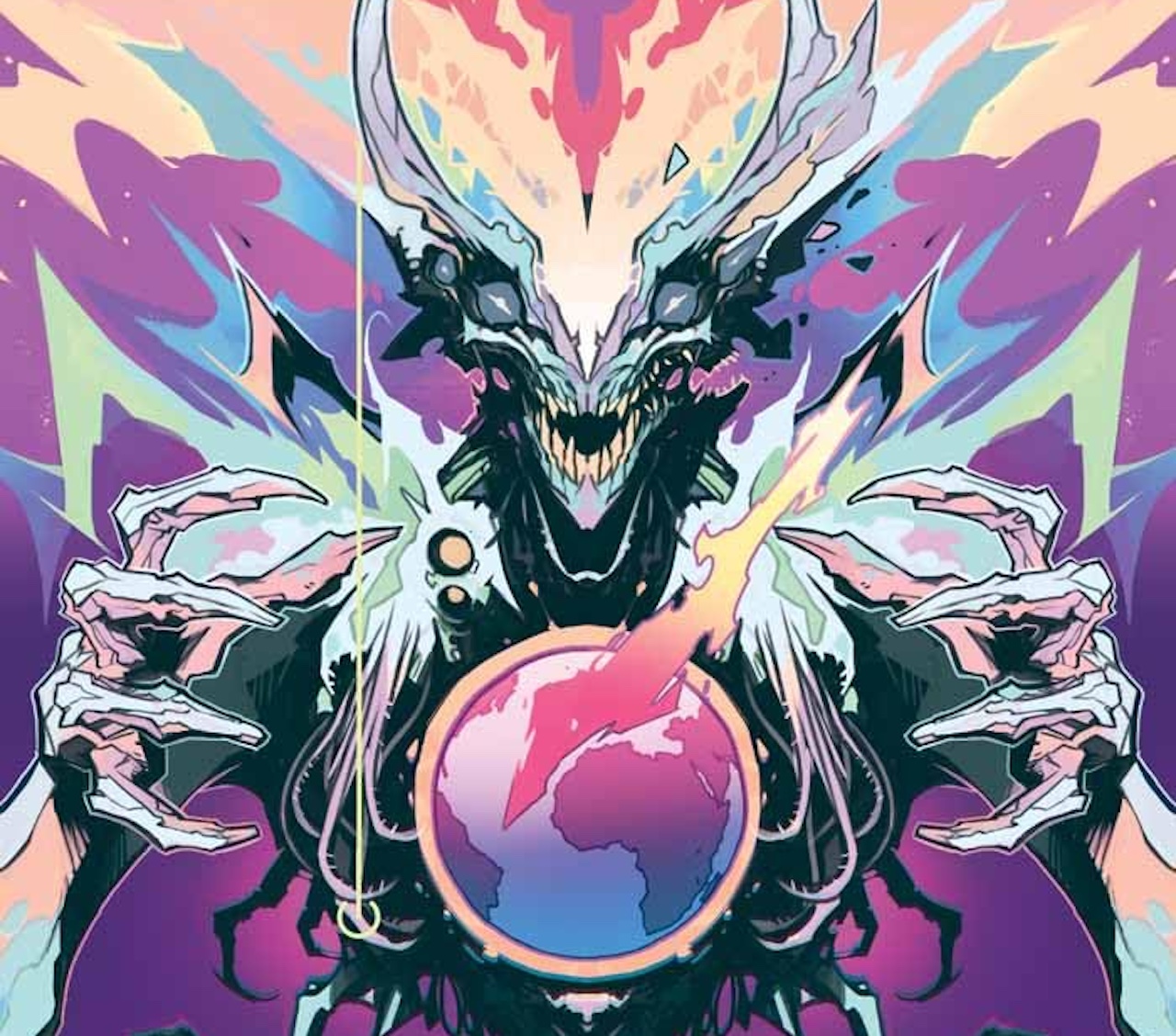

After the revelation last issue that could send the world closer to doomsday, this week’s The Power Fantasy #7 takes a step back. Before war really kicks into gear, issue #7 aims to show us what the supers are capable of after they wiped most of Europe off the map. Or, maybe it wasn’t them at all. It seems, even with the best intentions, the worst things can happen.
The Power Fantasy #7 opens in Manchester in 1989. The sky is lit up in rainbow colors, and soon, we see Valentina confronting a similarly colored being who wants to bring heaven to Earth. We then cut to Manchester, 1999, and the skies are flat red. Valentina is visiting Eliza, who lives in a dark looking cathedral with statues of people praying to it. It’s a reminder Valentina and Eliza are truly juxtaposed, one angelic, the other demonic.
So begins an issue that delves into the Second Summer of Love. It seems this creature wants to make everyone happy through powers that allow folks to be on drugs, have sex, and just live to be happy. This sets off alarm bells for the supers, and writer Kieron Gillen further reveals who these people are, particularly when they are somewhat friendly and together. That includes Etienne, who immediately thinks they should kill this pro-love creature.

A strange super who wants to bring heaven to Earth.
Credit: Image
I use the word creature, as Gillen and artist Caspar Wijngaard never quite explain who she is nor where she’s from. It’s a big mystery that will likely be explored later. It’s also a sign of what could happen again, which helps raise the stakes on the ongoing tensions between the supers.
This issue helps set the stage for Eliza, who has largely been absent in the series. She’s demanding of Valentina in this issue, and largely, she talks around what has happened to Manchester. Frankly, the obtuse approach and dancing around solid details is a growing frustration. Did I read this issue twice to make sure I didn’t miss anything? I did, which is definitely a plus, but the impatient critic in me wonders if many readers will be confused or lose some interest since Gillen can’t come out and say things. Dancing around the story with flashbacks, for instance, adds a distance to what it all means. I’m still invested, but I’m curious why this story can’t tell it plainly and more directly.
Prior to the flashback, Gillen and Wijngaard progress Magus’ ongoing play to influence the U.S. government. This is a nice inclusion that keeps the plot progressing in the current timeline.
Art by Wijngaard is striking, particularly the reveal of something in the sky at one point. His use of colors adds a lot to the fantastical nature of the creature, while his rendering of the supers in the past adds to their character work. Most of this cast continues to be a bit distant, and the art continues to add to their characters.
While The Power Fantasy #7 continues to build an engaging and mysterious world, it also demands patience from its readers. The issue explores a fascinating concept of a love-fueled utopia clashing with pragmatic supers, but its tendency to dance around clarity may frustrate some. Still, Gillen and Wijngaard’s collaboration delivers stunning visuals and compelling ideas, making this a solid, if sometimes elusive, chapter in the series.




You must be logged in to post a comment.