

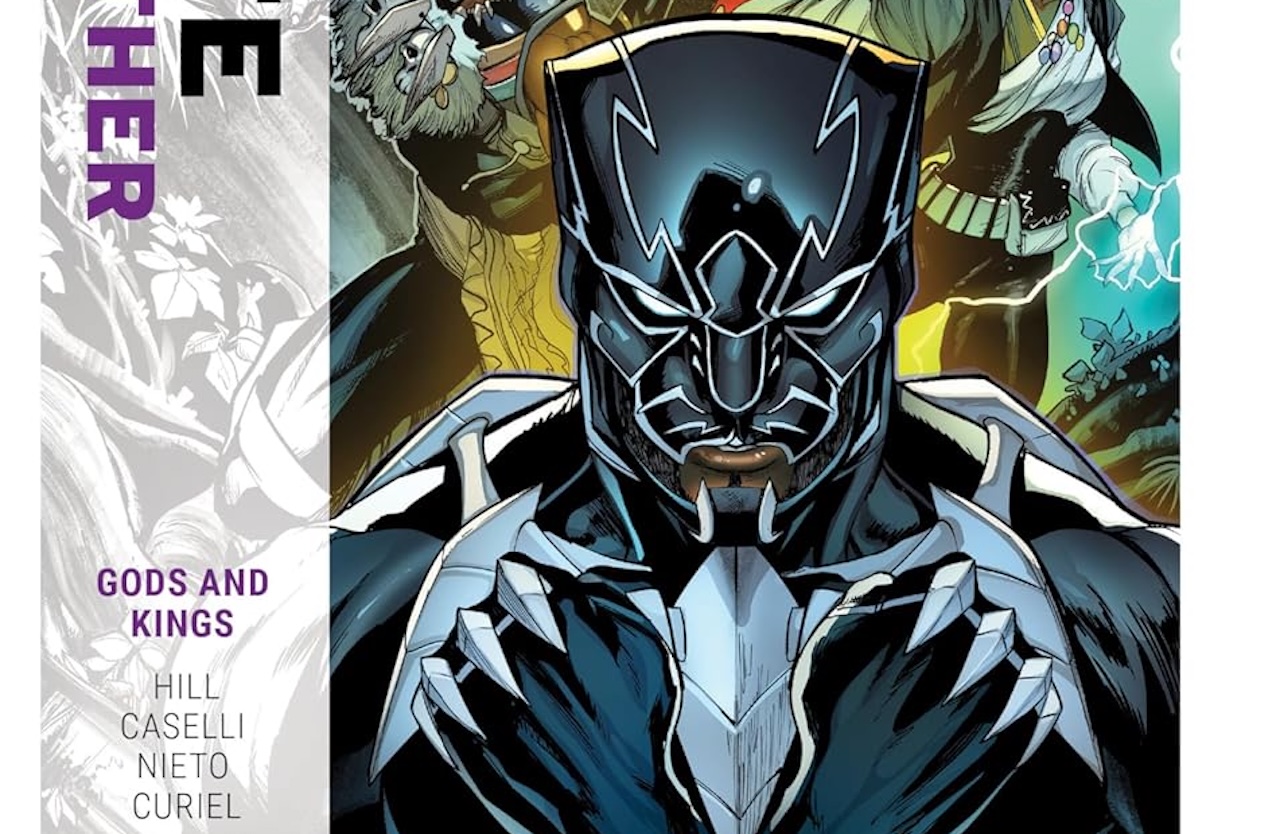

The Ultimate Universe isn’t just a launching pad for new stories about characters we already know and love; it’s also a fresh canvas for the interconnected storytelling that longtime readers of Marvel comics have come to crave. We won’t spend any time comparing and contrasting this Ultimate Universe with the last one — there really isn’t a point. The goals, intentions, and stories in this Universe are new and should be unhindered by the past. In Ultimate Black Panther By Bryan Hill Vol. 2: Gods and Kings, collecting issues #7-#12, Ultimate Black Panther continues its reign as a flagship series of this reimagined Marvel universe.
At this point in the timeline, the Maker is still locked in his city hiding out, perhaps, or gaining new strengths from the machinations of his reality-altering technologies that he amassed in Ultimate Invasion. That leaves his most loyal followers (in this case, Khonshu and Ra) to play at being gods themselves in the sick playground the Maker has left behind.
T’Challa is still the mighty king of Wakanda, though internal and external troubles alike are challenging the way he (and the readers) perceives that power. The kingdom of Wakanda is built upon vibranium, but in this universe the metal has potentially sinister attributes. Unknown to previous generations of Wakandans (but somehow known by the mysterious Vodu-Khan) vibranium not only has magical properties that T’Challa will have to search outside his kingdom to get answers for, but it has an even stranger twin: a terrifying green element that is yet unnamed as it is wielded by Moon Knight to prove his godhood.
One of the grandest themes of this book is about contrasting different ways of thinking and living in the world. T’Challa, in his own words, is bound by “logic and reason”, and this second volume of Ultimate Black Panther highlights his work to break out of this mental cage as he is shown things both magnificent and terrifying by the Vodu-Khan, the other nations of Africa, and by Wakanda itself. The philosophical implications set up by this division of thinking are grand, and Hill handles that weight with a sense of wonder and duty beyond the immeasurable skill it takes to juggle these high concepts.
Hill blends classic dichotomies into tapestries of difficult questions: faith vs. science, good vs. evil, family vs. duty, freedom vs. safety and security. Any of one of these battles alone would make for a simpler discussion, but they are mixed like colors in a painting, creating new colors that it seems T’Challa was not ready to consider.

Marvel
The art in the Ultimate Universe has been great across the board, but this line in particular sticks out as the one most loyal to established styles of comic art. Where Peach Momoko takes our visual brains in a sort of different direction (at least from what one might be used to from the most recent Krakoa-era mutant comics), Caselli and Nieto work with a more classic style, though nothing about this book is run-of-the-mill or common. The new designs for beloved characters like Ororo Munroe and Erik Killmonger are fantastic additions to the visual canon of Black Panther’s world.
There is a wonderful sense of tension and release in this book. Some other books have a hard time balancing dramatic scenes full of dialogue with worthwhile action sequences, leaving the action to feel out of place and tacked on to the necessary plot work being done. There is none of that here: the action grows perfectly from the drama as the script and art work symbiotically to draw the reader in.
Seeing the Black Panther powered up by Storm is just incredible. This kind of action is the reason we read comics. And without the weight of their mainline-universe past to inhibit them, Storm and T’Challa find whole new ways of existing together in this line. Seeing Storm as a platonic ally and Killmonger as a loyal friend (despite both of their slight withholdings about T’Challa’s orders) sets up a garden of possibility for characters you thought you knew everything about. Whether or not this working relationship will last through the entire story of this universe is yet to been seen, and cracks are beginning to show. But there really is something so satisfying about watching them work together, each so powerful in their own right, against a demi-god antagonist.
As the Ultimate Universe unfolds, readers have been getting hints and inklings of the Maker’s true plans. In his absence, his inner circle is running wild around the world, taking some actions that are selfish and others that might just serve evil Reed’s ultimate intention. Within that framework, Moon Knight (Khonshu and Ra) is a perfect antagonist for this series. Forget everything you know about Marc Spector: this Moon Knight is a different beast. What makes this character so interesting is how he dresses his campaign of domination as both a religious deliverance and a promise of democracy and freedom. Moon Knight sort of has a point when he accuses Wakanda of being to cloistered, too set in their ways, too isolated. As T’Challa plainly says, they’ve created a vacuum that Khonshu and Ra have been trying to fill. Readers know they have evil plans, and that they serve an evil god, but having some of their arguments makes sense is a great way to maintain interest.
This creative team does an incredible job of exemplifying the horrors and damage of war. While T’Challa monologues about the desire to destroy his enemies, you’ll be looking at the distraught faces of women and children who have been left behind in Moon Knight and Black Panther’s war of faith versus science, of gods versus kings. The war itself becomes a character, and the reader is left wondering whether all of this fighting is worth it if it leaves so many innocent people in the throes of grief.

Marvel
Besides the Vodu-Khan whispering in his ear (by the way, what god do they serve?) about the facets of faith and magic, our Black Panther is consistently lectured by Moon Knight on the invalidity of his throne and the inherent rights of gods, and by his own family on his duty as king and husband above his duty as protector of all of Africa. T’Challa has long wrangled with the pitfalls of his throne, but in Ultimate Black Panther this pressure feels doubled, maybe even tripled, by this time-twisted universe—and our king hasn’t yet come face-to-face with the Maker, or even the knowledge of his meddling. We can only hope that this team of creatives are the ones who will get the assignment of writing and drawing that first encounter.
All in all, this is one of the best lines in the Ultimate Universe. Exciting and beautifully drawn action with a balanced dramatic flow, even with the large cast of characters and perspectives. Pick this book up if you’re a fan of any kind of comic and you’re sure to find something you like about it, something that will keep you reading until the many mysterious are solved.




You must be logged in to post a comment.