

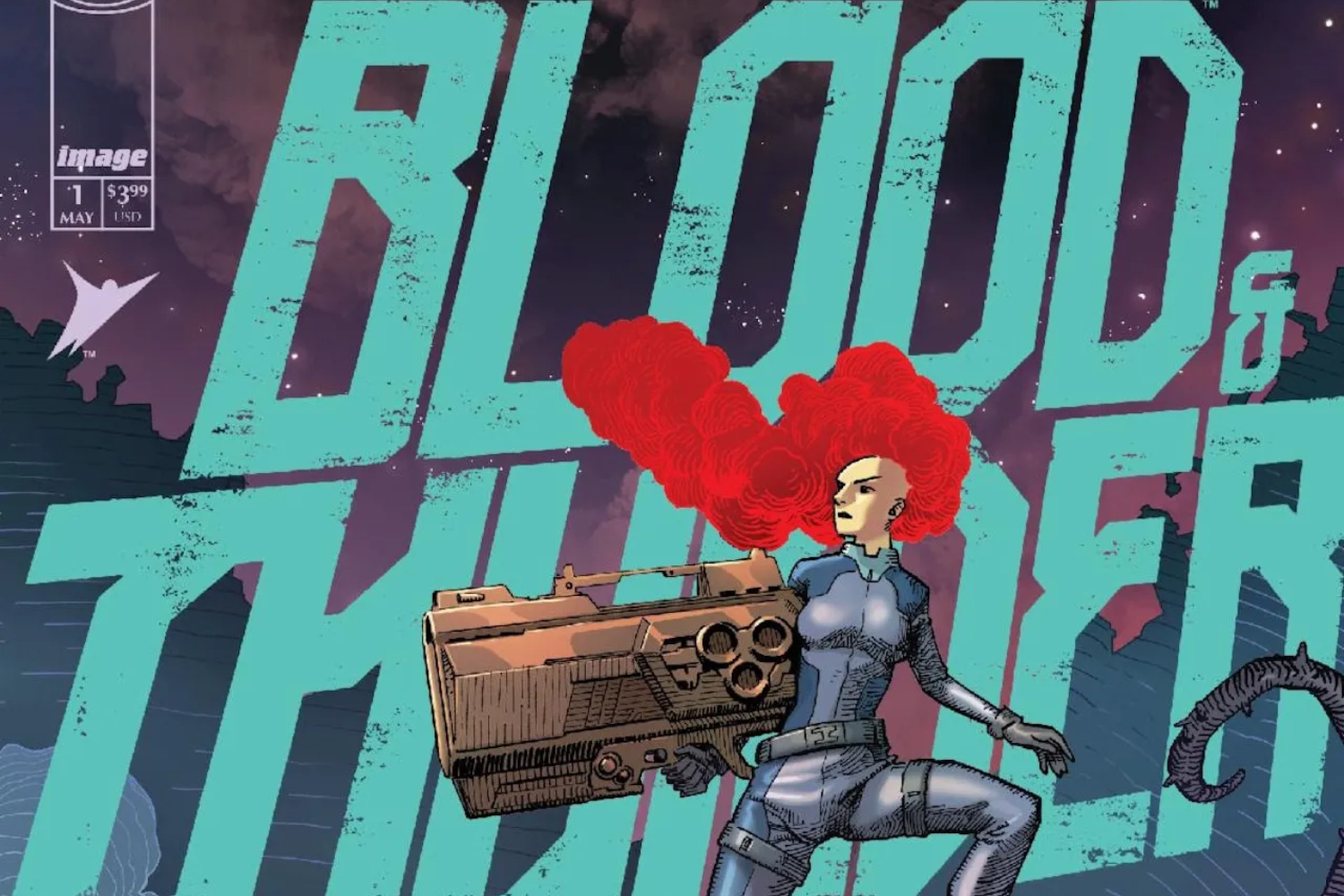

Friendship is a double-edged gun sword.
More specifically, Blood & Thunder only exists because the creative team (writer Benito Cereno, artist E.J. Su, and colorist Michele “msassyk” Assarasakorn) were “gifted” the idea from pal/collaborator Robert Kirkman. The mostly interesting backstory is laid out by Kirkman himself in issue #1’s back pages, but what matters is that the famous scribe’s handprints are all over this book — for better and worse.

Courtesy of Image Comics.
Admittedly, the premise alone isn’t entirely Trademark Kirkman. (Even as Kirkman and Cereno share some authorial energies — the former previously tapped the latter for the Invincible Presents: Atom Eve and Rex Splode miniseries.) Here, bounty hunter Akeldama “Blood” Bledsoe teams up with her sentient gun, Thunder (who is firmly anti-murder). Having spent years capturing some of the worst scum on Metro 1, Blood is now forced to track down an extra nasty escaped convict who will “unlock secrets about her past, present, and future…”
From there, though, we truly begin engaging with Kirkman’s mighty presence.
Seemingly the art of Su and msassyk would be the more obvious connection back to Kirkman considering the Kirkman-Su collabo on the 2002-2003 Tech Jacket series. But Metro 1 also does a lot to stand on its own — the city on a giant asteroid is filled with interesting aliens (called Exos) that I’d describe as “The Fifth Element on mescaline,” and that kind of visual intensity grounds the world in a grander sci-fi tradition even as it feels novel.
At the same time, the city itself is stratified in layers (from the elites on top to the disenfranchised at the very bottom), and while that’s a tad cliche, the visual device works well as we understand the world of Blood & Thunder and its specific aims/themes. It certainly feels like a more robust, slightly silly Judge Dredd, and while that’s hella reductive, it’s a perfect identity-centered niche for this book. But more on that oh-so shortly.

Courtesy of Image Comics.
Where the biggest Kirkman connection comes is with Thunder the gun. I’m all for talking weapons (especially if they’ve got a bleeding heart), but there’s no denying that the gimmick has been done before. (See Barbaric.) Add in that the gun’s look and feel — bulky and also vaguely phallic — is once a gain both aesthetically similar to Tech Jacket and also the kind of deliberately Kirkman-esque visual device (that is, the stuff of overwrought comics goodness). What happens, then, is this very obvious association really gets stuck in readers’ teeth.
There’s a sense that, as much visual power this book has — again, the world leans into certain genre tropes with a joy and intensity that makes it feel new-ish — it’s innately tied to Kirkman. Sure, Thunder isn’t the proper star of Blood & Thunder, but everything about the world has to pivot around that familiar enough gimmick, and it inherently colors your perceptions of this book. There’s no getting around it to a certain degree: This is a Kirkman book before anything else, and any failure or success begins right there. There’s positives and negatives to that sentiment, but it does absolutely frame our relationship.
But that’s not to say the team are entirely beholden to Kirkman/his ideas and preferences. As much room as they had to develop the look of Blood & Thunder (i.e., leaning into Heavy Metal and European comics to lend a more satirical visual sheen), you see even more of that in the book’s narrative. Namely, Blood’s new case involves books, to which she’s dumbfounded about but obviously interested in anyways. That very notion — of storytelling and knowledge seen as these kind of relics — informs a narrative current that feels extra relevant, and could be the thing to really make this book feel utterly different.

Courtesy of Image Comics.
It’s a decision that takes some other Kirkman trademarks in the story — humor and hijinks galore, like when Thunder won’t let Blood use lethal rounds, and even some wordplay (!) — and gives them decidedly sturdier legs. Which is to say, the mystery growing in this title (what are those books, and why do they really matter?) is allowed to be interesting on its own and still feel like it connects to Kirkman-ian tropes in a way that’s exciting and wholly reasonable.
And the books and what they represent — seemingly the true secret of this world and the relationship between humans and Exos — also help address other “issues” in this debut. Again, as mentioned, the literal and figurative stratification of this world is a device that’s been done before, but that’s not a bad thing per se. As much as it could be a metaphor that bashes us in the face, it already feels like a potential metaphor for how information and history can unite the classes. If nothing else, the world here is trying to do things to outgrow its confines and connective threads.
There’s also other elements that just make this narrative skeleton feel downright new. For instance, Blood herself may not fit so neatly in this world, and as we see how she moves in this overarching structure, we can glean better insights into how this place works and how it might change. Similarly, the criminal potentially having some value, and not just being an obvious fiend, is rather nice. Kirkman’s tried the same over the years — see Invincible, mostly — but Cereno and company begin Blood & Thunder having leaned into certain tropes and still given people and ideas some room to grow. It’s that light-ish touch, I reckon, that will help this story avoid pitfalls and use its messaging and story concepts to give us something invigorating to chew on.

Courtesy of Image Comics.
I’d bet my last Schmeckle that most of you will come into Blood & Thunder because of the Kirkman connection. And that’s a good thing, truly. Not only do I always like the idea of creators developing their own “team” of collaborators (James Tynion IV and Scott Snyder are great at this), but comics could use whatever star power does exist in this industry. The creative team of Blood & Thunder are smart enough (but not always) to lean into and away from this association as needed, and to tell a story that’s familiar but maybe still new enough.
This book needs more issues for things to fully develop, but if Blood & Thunder can refine this balancing act — give us sci-fi gimmicks to chew on, but push the boundaries a little further — we could have something really interesting here. For now, it’s an exciting new pal if not exactly your shiny BFF.




You must be logged in to post a comment.