

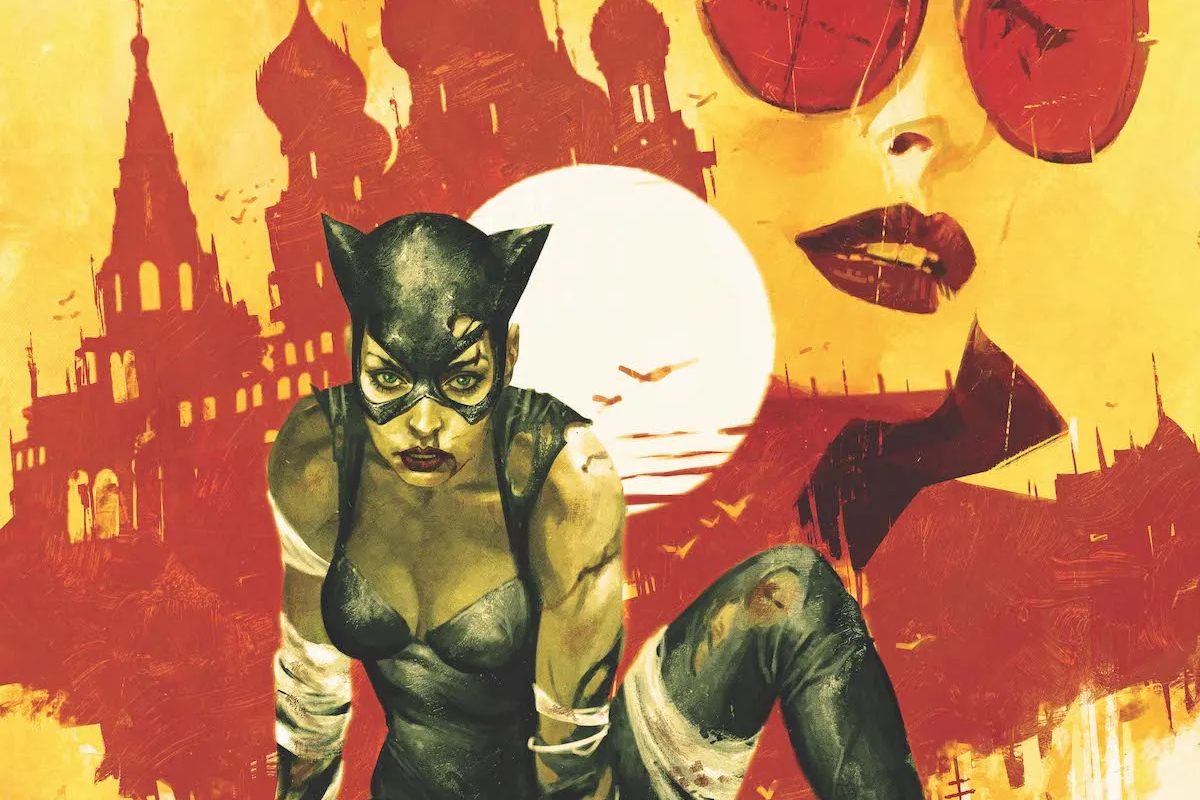

In DC’s ever-evolving continuity, Selina Kyle has lived many lives before taking on her famous identity of Catwoman. Torunn Grønbekk and Patricio Delpeche explore one of these identities – Evie Hall – along with the botched heist that put a target on Selina’s back. Catwoman #75 was a flashback issue that detailed how that particular heist panned out, and what went wrong to warrant a mob hit on Selina years later.
Catwoman #76 details some of the aftermath of that botched heist, but with a twist: a partner Selina trusted may have been playing both sides of the field. After appearing in the flashback issue, Catwoman #76 marks the first appearance of Shota in the present. He continues to be the partner Selina has the fondest memories of, despite learning his deadly secret surrounding that earlier heist. But the reunion does more than catch the old partners up – it reveals how much Selina cares about her former team.
Like in the issues that preceded this one, Grønbekk continues to expand Selina’s world beyond Gotham and her network of allies. As mentioned previously, this is a much-needed change for the character after being defined by her romance with Batman for a good part of a decade. Seeing Selina written as her own character with a raison d’être outside of being Bruce Wayne’s iconic love interest continues to be the major selling point of Grønbekk’s run.

DC Comics
For the first time in a long while, Selina feels like the hero of her own story, and not in a way that comes off as an attempt to emancipate her from Batman like in previous runs. Grønbekk primarily achieves this by exploring Selina’s past and present relationships with the characters of Suzy and Shota. In the earlier issues, Grønbekk explored the friendship between Selina and Suzy in a way that felt organic to the character’s well-established history.
Since the early post-Crisis on Infinite Earths continuity, Selina was known to form friendships with abused women and members of other marginalized communities. This idea was most notably explored with Holly Robinson, a former sex worker who later became Selina’s most important confidante in the Catwoman series of the 2000s. Grønbekk continues to build on this concept with Suzy and the other thieves she partook in the doomed heist with.
Though Suzy is not herself a sex worker and is a computer hacker, she’s still someone Selina sees as vulnerable and in need of protection. This especially plays out in Catwoman #76 when Suzy’s life is immediately threatened by an unseen assailant. This even prompts Selina to take quick action, which is where Shota begins to play a more important role in the present storyline. Their interaction even shows Shota remains fond of Selina. Though their relationship is not presented as romantic, Grønbekk and Delpeche still show that there is a spark between them.

DC Comics
What’s refreshing about Grønbekk and Delpeche’s depiction of Selina’s relationship with Shota is that they’re not depicted as immediately hooking up. Without rushing into a romance, this allows the relationship to be explored with more depth, and in a way that stands out from the other men in Selina’s life. It even presents an opportunity for Grønbekk and Delpeche to do something radically different with Selina: depict a close friendship with a male character that doesn’t automatically end with her getting romantically involved with him.
Though Selina getting together with other men who aren’t Bruce isn’t necessarily a bad thing, the tendency to pair Selina up with every man she forms a bond with is often the default for her character. This, in turn, has robbed Selina of establishing any long-term close friendships with men the way she has with other women like Holly Robinson. If Grønbekk and Delpeche avoid romance all together with Selina and Shota, and instead present them as close friends, this could open up different story opportunities for the antiheroine. It could especially examine the challenges that come with two friends having a shared criminal history, which could easily result in a more rewarding character arc.
While Grønbekk’s character work on Selina Kyle continues to be the most engaging aspect of her writing, one of the drawbacks of the current arc is that the story is taking a tad too long to progress. While neo-noir stories often thrive in gradual revelation of facts, preserving the mystery for too long can also cause the reader to lose patience. This is especially true with monthly comics, where it’s easy to forget what happened in the previous issue, just a few weeks prior. Still, even with this minor drawback, Catwoman #76 continues to be an engaging read, even if it could benefit to raise the stakes a bit more.




You must be logged in to post a comment.