

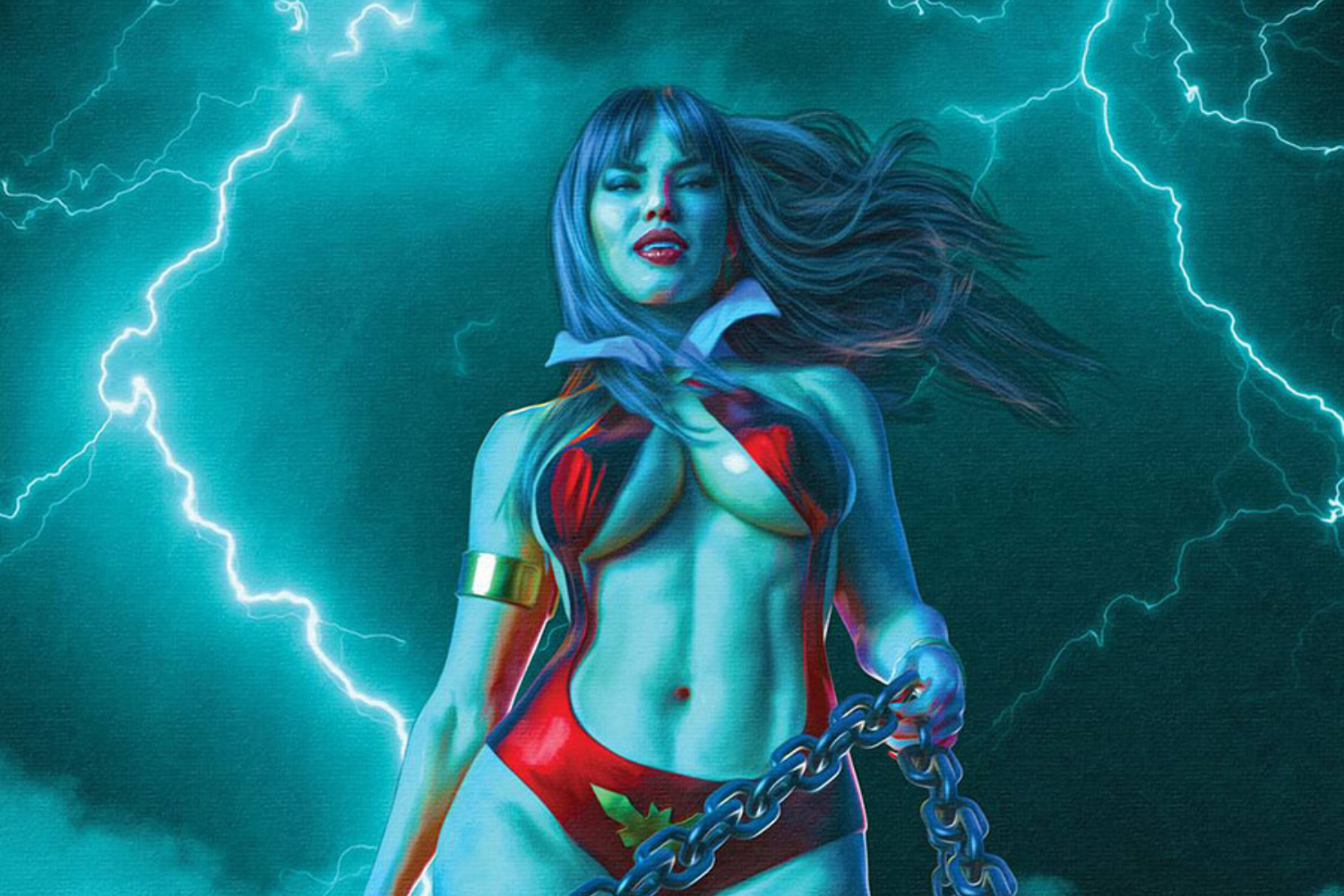

In the late ’90s/early 2000s, Christopher Priest redefined Black Panther for the new millennium. Now, in an exclusive interview with AIPT, Priest revealed he’s hoping for the same resurgence for the sultry Vampirella.
Need to catch up on Vampirella? Read the Vampler for free.
Ever since her inception, people’s general opinion of Vampirella hasn’t evolved all that much. Instead, it’s easy to dismiss Vampirella because of her costume and her throwback appeal to a dated, bygone era. But that’s where Priest comes in. Unlike Vampira, who’s just there to intro horror movies, Vampirella is more than mere eye candy. If people can get past the sexy covers, Priest promises that they’ll find depth.
“She’s not that different from us,” Priest said. “She just wants a regular life with friends, love, except she can’t, because she’s a space vampire.”
For Priest, what’s so special about her is that deep humanity — it’s the story of fitting in and living under the pressures of family drama that resonates with all of us near-universally.

Vampirella #15 (2021). Art by Peach Momoko. Courtesy of Dynamite Entertainment.
When asked about the scantily clad vampire’s 56-year history, Priest likened his run on the comic to J.J. Abrams’s Star Trek. Co-captained by artist Ergün Gündüz, they aim to steer Vampirella into a new frontier, welcoming fresh readership. Mostly, they want to deliver a story that carries the canon of the past without all the corresponding baggage.
As such, with the character recently reaching its 676th issue, Vampirella has been renumbered into a new #1, leading up to a big anniversary special at #700. Priest hypes up the future, talking about the possibility of returning writers and artists from all throughout Vampirella’s history.
It’s a long list, which can look like homework for new readers, and a lot of time spent reading back issues. Priest understands how daunting it can be, which is why he hopes, as with Abrams’s Star Trek, people can let go of presumptions, see that Vampirella is more than meets the eye, and just jump in for a wild ride.
Controversy in Comics
At the beginning of this new series, Priest tackles postpartum depression and the hardships of motherhood. When asked about his inspirations for it, Priest recounts a childhood memory when his 13-year-old sister bore a baby, and he (just as young) had to care for it.
“Suddenly, there was this crying stranger in our house. This screaming little ball of life,” Priest said. “What if Vampirella has a baby that she doesn’t want? That’s never been done before.”
That experience was fundamental in Priest’s life, and he put that living, breathing truth into a permanent fixture of Vampirella’s fiction. The conflicting emotions that came of it, of learning to love something unexpected, bleed into Vampirella’s ongoing struggle.

Vampirella #1 (2025). Courtesy of Dynamite Entertainment.
Talking about the baby, Priest adds that the idea came from a conversation with his editor, Matt Idelson, and was given the greenlight by Dynamite CEO Nick Barrucci.
Priest has a history with these kinds of important editorial decisions throughout his tenure in the comic book industry. He recalls his stint as a 20-something editor for Marvel Comics in the 80s, ready to quit outright when Spider-Man was set to marry Mary Jane Watson. It’s a contentious debate that continues today, something that Priest found again in Superman’s marriage to Lois Lane.
“Okay, so you have Superman marry Lois Lane. Now what,” Priest said. “They have a son, Jon Kent. Now what? He gets aged up to go off on his own adventures.”
For Priest, instead of ‘Yes, and…’ sometimes it’s ‘Yes, but…’ There’s always a catch that keeps the status quo intact.
So then, what’s all this got to do with Vampirella? Put simply, Priest wants to take her on a journey, not just a surprise for the sake of it. Or, as he explains further, “These characters can easily get written into a corner, find themselves in cul-de-sacs.”
If there’s a meaningful change in Vampirella’s life, Priest wants to follow through on it. The last thing he wants is a marketing stunt that drives sales for a few issues but soon loses steam, leaving publishers to revert the changes, or worse yet, make it meaningless. And looking at the reversal of Spider-Man’s marriage, history seems to have proven him right.

The Amazing Spider-Man Annual #21 (1987). Art by John Romita, Sr. Courtesy of Marvel Comics.
Putting the Fridging Trope to Rest
In her current arc, which Priest says lasts six issues, Vampirella’s grown-up baby, named Cicero, travels back in time from a dystopian future. In the second issue, which is out now, there is a depiction of sexual assault, which is presented to be perpetrated by Cicero to his girlfriend. Touching upon this, Priest isn’t shy about controversy.
“Whatever I say, I’m canceled either way,” Priest said.
He proceeds to explain that he doesn’t like fridging – the act of killing or harming usually female characters for the sake of a male character’s motivation or development. He coyly acknowledged that he himself was guilty of it back in the day with Green Lantern and what happened with John Stewart’s wife, Katma Tui.
Priest says that this isn’t the case with Cicero, because both characters in issue #2 have agency. It is a lead-up that will be paid off later on in the series.
With Vampirella, characters of all genders have importance, and not simply plot devices. Priest recalls a similar priority during his time writing Superman: Lost for DC, and how he fought for it to be set in mainline continuity.
Because, as he continued, “It isn’t just a Superman story; it’s also a Lois Lane story.”
He underlines the importance of that seemingly random difference. How both characters fight to maintain their love across light years of physical and mental distance. In Priest’s comic, Lois is an active character with her own mission and struggles, not just a prop in the background.

Superman: Lost (2023). Art by Carlo Pagulayan. Courtesy of DC Comics.
Despite that, Priest knows it’s inevitable that there will be certain clashing interpretations.
“It’s like with people siding on Iron Man or Captain America’s side, in Civil War,” Priest said. “Cicero doesn’t know he’s done wrong. But does that make him right?”
If a story is told well enough, there’s always a discussion of right and wrong, and if things can be justified, and that conversation is generally healthy. Priest doesn’t hold his words back for an invisible audience – he stands with his opinions, forever unfiltered.
Even so, he still condemns Cicero’s actions, stating that if Cicero had only accepted responsibility, maybe the dystopian apocalypse he came from wouldn’t have happened. He argues that this acknowledgement of wrongdoing and admittance of mistake is what is lacking from people, especially those in power, who are responsible for more lives than most.
“You look at Obama. He apologized,” Priest said. “He said, ‘I’m sorry.’ You don’t see that anymore in the world. There’s no accountability.”
As an aside, Priest goes back to how, in this day and age, context is so easily stripped from the original intent. He talks about people spreading the headlines of Jon Kent being bisexual without actually reading the story. He nudges readers to read stories to the end before judging, and not to make premature opinions.

Vampirella #2 (2025). Courtesy of Dynamite Entertainment.
Talking even more about Cicero, Priest relates the character to Jericho, whom he wrote in his Deathstroke: Rebirth run back at DC. He compares Jericho’s relationship with his late brother to Vampirella and her darker sister, Draculina.
“Jericho is the good kid,” Priest said. “Ravager, Grant, is the bad one.”
He then delves into the nature of evil and how, without intending it, a parent can break their children. To him, evil easily slips in familial cracks. What happens when Vampirella ignores her child at his crucial moment of development? What does Deathstroke’s generational trauma do to his children? Without anyone realizing, evil follows like a shadow, until it’s too late.
“That’s what evil is,” Priest said.
Colors are the Music of Comics
To convince readers of that journey towards evil, Priest describes how Vampirella’s son, Cicero, starts as an unremarkable FedEx driver in the future. Progressively, readers will get to see his descent and transformation into the trench coat-wearing, hair-dyed, emo Dracula-like figure in issues to come.
Speaking about Dracula, Priest mentions his work on the Vampirella/Dracula: Rage comic and how he could never settle on writing Dracula if not for the designs of artist Christian Rosado.
“People kept drawing Dracula like Bela Lugosi, the slick black hair, you know, the collar,” Priest remarked while mimicking Lugosi’s iconic cackle.
Priest continued by crediting Rosado for manifesting his vision in a singular, forceful manner.
“Christian Rosado was the first guy who got what I was going for,” Priest said. “Which is a modern man that you wouldn’t notice walking down the street, you know. Very reserved guy. Who is, nonetheless, very much in the Black Panther vein with this guy who is always operating at a different level. If you know what you’re looking at, you can see the evil in him. Even when he’s just wearing regular clothes, walking around. And the guy played the cello. I loved that bit.”

Vampirella/Dracula: Rage (2023). Art by Mike Krome. Courtesy of Dynamite Entertainment.
Only after Rosado drew a more subdued Dracula that it all clicked for Priest. And a similar thing happened when he started working with Vampirella’s current artist, Ergün Gündüz. He explained how his take on Vampirella isn’t horror, and that’s why Gündüz is the perfect fit for the book.
“I go back to Ackerman,” Priest said of Vampirella’s original creator, Forrest J. Ackerman. “What was Ackerman’s original intent? He was doing a science fiction spoof.”
Priest added, “Most vampires in comics just kinda come across as cartoonish and over the top and so forth. The main problem with horror in comics these days is that Bernie Wrightson is gone.” Priest laments the artist’s passing, who gained fame for his detailed horror comics such as Swamp Thing and Frankenstein.
Priest offered even more praise for the artists, noting how the right collaborators foster life with their work.
“Movies have things that comics don’t have. Movies have sound,” Priest said. “More accurately, the absence of sound. And we fall for it every time. In comics, I have no sound. I have color. Our colorists are our music. They are our soundtrack. If you have a good colorist, it’s like having a great drummer.”
On that note, Gündüz colors his own art, and Priest sings praises for a splash page in Vampirella’s upcoming issue #3.
“The things that he can do with color are amazing,” Priest said. “But the sheer amount of detail that this man invests in. There’s stuff in here that’s funny, particularly going on in the background, I guarantee you, most of that’s him.”
Priest teases Vampirella running away to Vegas on a whim, and lauds how Gündüz captures the crowded Vegas airport so perfectly. About Gündüz’s one-of-a-kind pop art style, Priest says, “Nobody draws like this. We don’t have anybody that can just match his style.”

Vampirella #3 (2025). Courtesy of Dynamite Comics.
Priest highlights his mutual writer-artist collaboration by saying, “This is maybe the best part about working on this book.”
And that is why Priest jokes he’ll keep writing Vampirella until he’s kicked off, because he’s given free rein to do his subversive take on a long-standing character with an artist who gets him.
In Priest’s own words, “We are really kind of just charting the territory with Vampirella, and having a blast doing it. Nick Barrucci and Dynamite have really given me an enormous amount of autonomy and said, ‘Look, this is your version of Vampirella. It doesn’t deny Tom Sniegoski’s version.’ Cause he’s doing his own thing over here, and he’s doing marvelous work over there. But I’m able to work without interference. And that’s a real blessing.”
Vampirella #1 and #2 are in stores now. Issue #3 drops June 18.



You must be logged in to post a comment.