

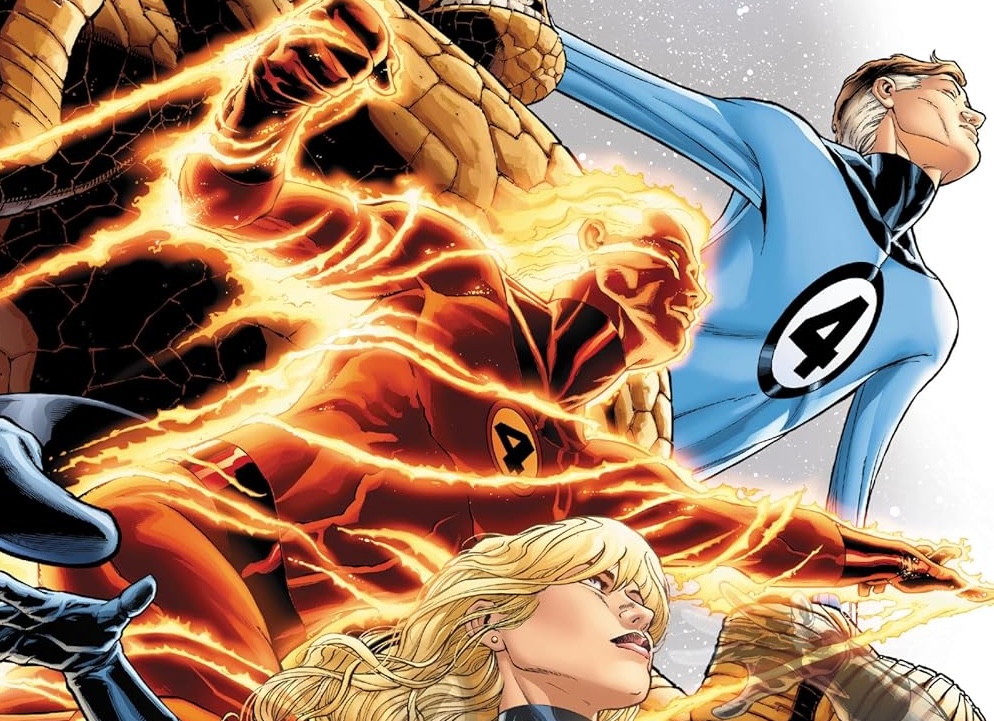

Solve Everything begins with a multiversal council of Reed Richards and ends with a barely stymied Negative Zone invasion and the “death” of a main character. Nearly every single thing in between those events is as big, dramatic, and powerful.
The Jonathan Hickman run of Fantastic Four from 2009 is, like most things Hickman, filled with Big Ideas, large-scale reconsideration of its characters. Hickman works in big, operatic movements: newly discovered but ancient undersea races lead to a power struggle in Atlantis, or High Evolutionary technology leads to conflict with the Mole Man. The Fantastic Four work as mechanisms in these massive conflicts, adventurers coincidentally at the heart of cosmic chaos.

Marvel
The problem with such big ideas and arcs is that they don’t fit into volumes like the new, digest-sized Marvel Premier Collections. This new collection of Hickman’s run isn’t archival: large chunks of issues have been excised in order to streamline the larger story. What isn’t here – Franklin Richards’ birthday party, a Nathaniel Richards cross-time caper – might feel extraneous to the arcs that are presented here, but the trouble is that comics don’t quite work that way. There are fragments of the removed content left behind, pieces that don’t lend themselves to the Mole Man, Atlantis, or Annihilus but which matter to the larger Hickman overture; they matter to the story that continues on after this volume concludes. Slivers of Franklin, Valeria, and Nathaniel’s time-traveling exploits remain, but to what end?
To present the whole of what amounts to 20 issues would make the content too large for the Premier Collection; it’s a sensible decision to condense. But as with all nominally “self-contained” collections of serialized content, what is collected cannot fully divorced from its context. What the editors of this volume have done – though somewhat sloppily – is a commendable attempt at streamlining. Without promising a second volume (and a third, and a fourth), Solve Everything begins where it needs to begin and ends with a brutal, seemingly final tragedy. It reads as complete as it can be.

Marvel
What’s more, each member of the Fantastic Four gets their moment, here. While it is a team book, each member has their independent arcs, spotlight moments which define them against the larger team tapestry. Whether those arcs are large or small depends on the larger events, but they feel earned, true to the characters – if, occasionally, a little distant.
The collection also packs incredibly solid visuals from artists like Steve Epting and Nick Dragotta. The era had a penchant for a bit of gritty realism, a ‘cinematic’ approach that veered away from impressionistic or stylized pencils and simulated thin-lined photo-realism. With Hickman’s massive stories – and the book’s natural inclination for the scifi impossible – that realism works to ground not only the subjects of these stories but the incredible world in which they live.

Marvel
Ultimately, Marvel Premier Collection: Solve Everything does what we know it needs to do: it provides a deeply compelling, dynamic representation of these characters for fresh eyes. This is a book for people unconcerned with complete collections, namely those excited for this summer’s film as yet uninitiated with the comics. It’s a strong collection, no matter how incomplete.




You must be logged in to post a comment.