

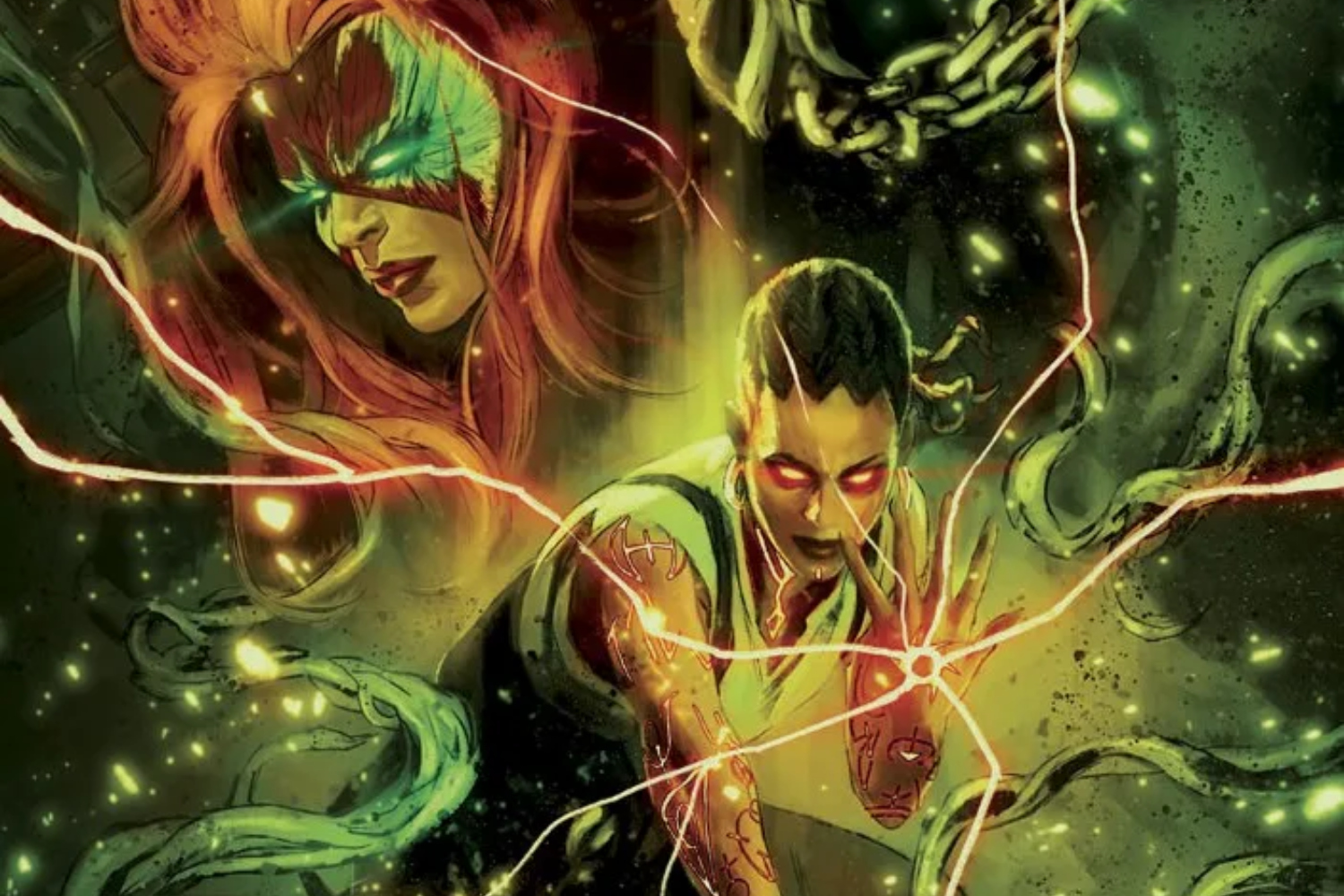

With Bloodletter #2, I was all about the Tasha-She-Spawn dynamic. And rightfully so: In her mission to kill Spawn, Bloodletter’s deep history and comparisons to Jessica Priest were 1) a way to further ground our lead into Spawn lore with record efficiency and 2) make this title much more than a mere revenge story. And in a similar gesture, Bloodletter #3 offers another such “interlude” as we delve into the relationship between Tasha and her “personal Microchip,” Casper.
And boy howdy, are none of you prepared for this supernatural buddy film.
I say interlude knowing damn well that this chapter is an especially vital part of Bloodletter’s overarching mission. The duo set up shop in Jersey to prepare for the coming extra bloody battle, and what we get is a street-level set of errands that quickly turns into conflict with some local vampires. There’s other, celestial elements involved (relating to Casper’s own origins and how the pair hooked up in the first), but for now let’s just say it’s an interlude with real weight.

The Raymond Gay variant cover. Courtesy of Image Comics.
Visually, fighting vamps in the Garden State is another instance for artist Christian Rosado (and colorist DC Alonso) to build up Bloodletter as something novel in the Spawn-verse. The whole dang canon is drenched in blood and gore, but the vamps here are especially prone to carnage as they rip and tear flesh like wild beasts. Casper and Bloodletter get in on the action, too, and their equally deft skills in dispatching the undead is a great shorthand for their friendship and their general odds once it comes time to finally shuffling Spawn loose.
I also just love the design of the city — it feels gross and grounded, which does a lot for the story’s relatability and our own immersion, but it’s tinged with just enough chaotic magic to really stand out.
We’ve gotten a few solid locales already in Bloodletter (including this issue’s visit to Mexico City, where Team Casp-Letter first meets), and it’s intriguing just how much geography matters in this book. Tasha hovers toward the seedier side of most places, and that’s not only fitting from a thematic standpoint, but it shows the scope and stakes of this story. Still, by giving her room to move around, Bloodletter becomes real and robust in other ways, and that’s going to be continually important as she becomes someone we can both care about and actually believe as capable of smashing Spawn.

Courtesy of Image Comics.
Sure, those extra gnarly vamp kills help (they make me strangely hungry for ribs?) but something about the open road — albeit of supernatural shit-holes — that just makes Bloodletter a true boss.
Still, there’s a bigger reason that the writers (Joseph Illidge and Tim Seeley) brought Casper and Bloodletter to Vamp Central USA. I’m trying to be extra careful as to not reveal the issue’s genuinely big moment, but it does directly impact the scope of the Bloodletter-Casper relationship. At the same time, it furthers the mission of this book and also extends our understanding of magic in this world in a way that feels like it’s essential for the Spawn fight and also the universe in general going forward. But mostly it’ll just break your damn heart.
I can say that it will fundamentally alter your perception of Bloodletter. (For the better or worse, I’ll let you decide.) But it’s one of those instances where we’re seeing more and more of the true face of Bloodletter herself, and what she has to do (or what she thinks she has to do) in order to achieve her goals. Illidge and Seeley handle the issue’s finale with grace, emphasizing this deep-seated love of all things Spawn to where it feels as emotionally robust and thematically appropriate to the dramatic, endless politicking of Spawn.

Courtesy of Image Comics.
At the same time, it’s an extra cutting moment all on its own, and it feels like we’re seeing not just a “Spawn clone” but this new character make choices they may either regret or simply learn to live with one day.
Still, it’s not a moment that’s totally out of pocket or is somehow utterly unpredictable. No, because as we saw in Bloodletter #2, Tasha learned something from her dealings with She-Spawn. For instance, how others reconcile their goals and actions in a world that’s increasingly, irrevocably morally gray. Or, what value friendship and affinity actually hold in this world, and how sometimes the best thing you can do is see the world as a series of transactions. Even that making big, ugly decisions doesn’t always make you a bad person — it just makes you someone who is alive.
In that way, this “interlude” feels like a massively vital part of the larger story, and perhaps even a turning point to see not only how Bloodletter will battle Spawn, but just who she has to become and what’s really at stake beyond her bloodlust.

Courtesy of Image Comics.
With just two issues left, Bloodletter doesn’t have much left before we’ll (most likely) see the big battle royale go down. But as issue #3 demonstrated, this book can do some truly big things with just 30-ish pages. Like tell a novel story about two friends in the big city. Or, grow and extend magic in an otherwise rich, complicated world. It can also give us ample body horror to snack on. And its even set up a huge character-building moment like slipping in a blade between your third and fourth ribs.
Whatever you’re all about with Bloodletter #3, I guarantee you it’ll kick you in the teeth and turn your blood into pure magma.




You must be logged in to post a comment.