


Dark Honor certainly is an apt title — mostly if you’re the only one to have reviewed all five issues.
The overt cheese (and occasional ineptitude) of this “COVID crime caper” hasn’t always made it so easy to keep on reading. But the book’s more subtle commentary on social change spurred on by the pandemic has evidently been enough to maintain my interest. Generally, it hasn’t always been a great time, but it’s been an important and relevant story, and maybe that’s what we need more of in comics nowadays.
But whether this series was an honor, or just an exercise in self torture, all comes down to the grand finale. Did Dark Honor #5 stick the landing for something indulgent and cheesy but nonetheless thoughtful and compelling? Or, has this all been a bad fever dream and I should get my head checked for devoting this much time/energy?
And, yeah, it’s generally both.

Courtesy of Image Comics.
Leading into this conclusion, bad guy Grigor was one key short of having access to the Families’ vast wealth, with only Rain potentially standing in his way. With her father Josef dead, Rain would have to decide if she’d continue the work of The Hundred or go and make her own life instead.
And when I mean she’d have to choose, she was literally given two boxes representing her respective “paths.” You can likely guess which one she chooses, but gimmickry aside, I’m mostly glad that the writers (including Brian DeCubellis, K.S. Bruce, and Ethan Sacks) finally put more of an emphasis on our lead. Because after having Rain feel like an afterthought across the first four issues, Dark Honor #5 is when she gets a chance to be a real person, and she even leans into her one established character trait (a nasty gambling habit) to help make a decision in what’s a solid full circle moment. It’s also a little hokey, and maybe harmful to those in actual recovery, but I’ll take it for finally making Rain feel unique and special. Sure, she’s still a little one note, but at least now she’s in the driver’s seat.
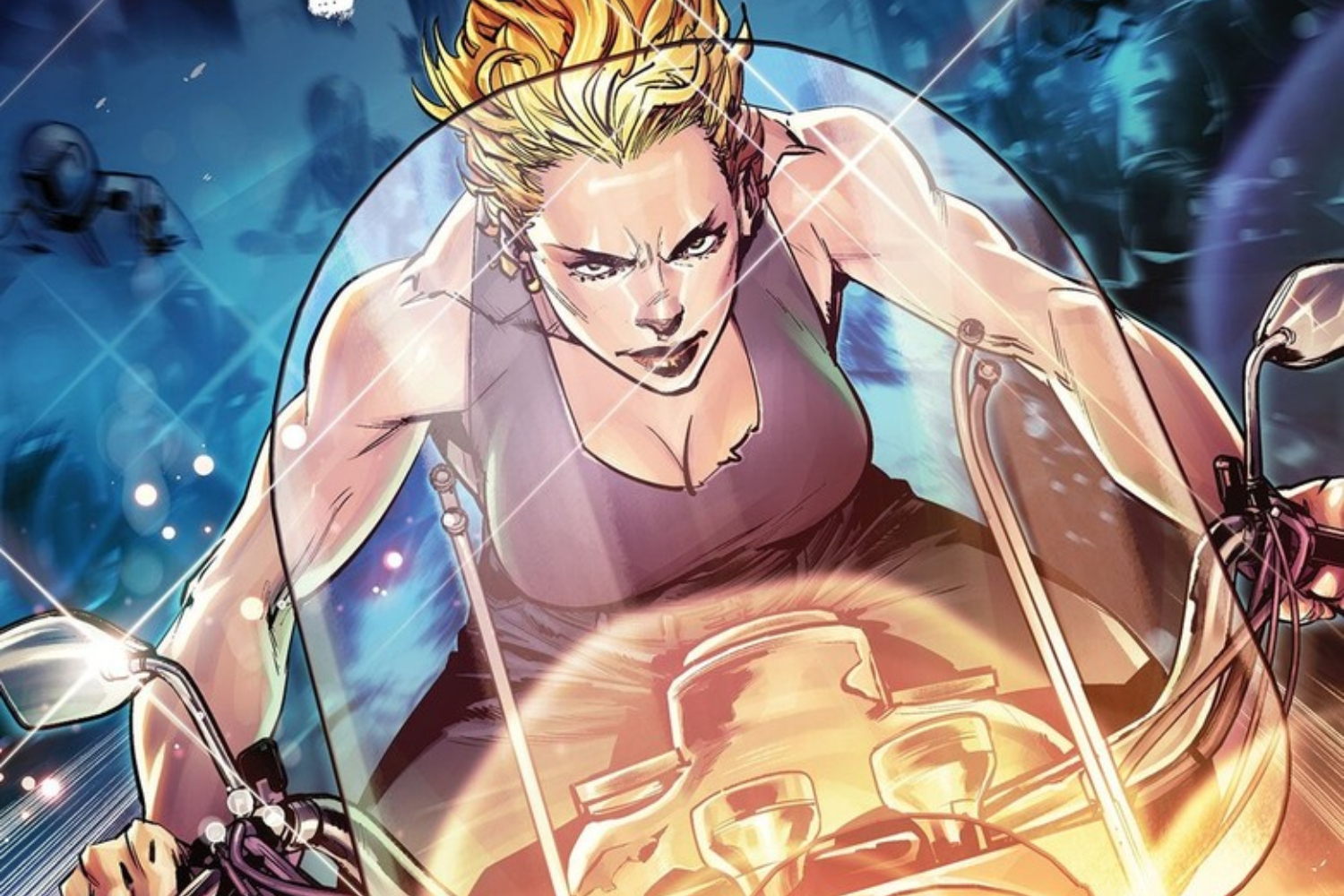
Only, don’t expect anything too emotionally resonant. (Or, something’s that perhaps resonant but also wonderfully robust/complicated.) Rather, Rain spends most of this issue riding a motorcycle and battling Grigor. And as was the case with Fico Ossio and David Messina, issue artist Jamal Igle brings a sense of force and grace when it comes to these fight scenes. (It’s worth noting again that, despite the changes in artist across each issue, there’s a consistency in the look and feel of this book that really helped my continued immersion.) That includes some well-developed fight choreography, a scene where I’m pretty sure some dude wields a motorcycle like a club, and a thrilling enough helicopter clash between Rain and Grigor.
In some ways, a lot of this issue felt like eating fast food — we can see it’s real value (or the lack thereof), but it’s wonderfully filling all the same, and we want to gorge ourselves regardless. Dark Honor has always nailed this aspect of its story, and even as the COVID-centric thematic dissection wavered to an extent, we could always rely on the action to keep us locked in while hoping that the rest might fall into place.
So, then, did it? Did Dark Honor ultimately have something vital to say about COVID? The story has certainly said some things before this issue, like hinting at the equality exacerbated by the pandemic, and how it was an opportunity for once-in-a-lifetime reform. But what was the final message, and did it capture this unique, multifaceted issue with intent and efficiency?
Meh.

Courtesy of Image Comics.
To better understand what Dark Honor had to say, it’s important to know that it basically turned the interesting and organically-crafted Grigor into nothing more than a cheap James Bond villain. (The finale also left Aja feeling like a Bond love interest, but maybe that character was just doomed from the start?)
To an extent, the change with Grigor at least fits the action movie obsession of this book, and it’s a small but mighty gesture of how this issue finally found a way to align its many threads and use those over-the-top energies to actually say something important. (Sort of like with Rain and the gambling stuff.) The issue is that the final message doesn’t exactly have a ton of weight, and it basically boils down to throwing out the old world and making a new version of The Hundred.
Sure, a vital vein of that very message is about exploring shifting power dynamics, and cementing how the working class is waking up like never before. But it was ultimately a kind of “superliminal” wish fulfillment, with the final splash page being uber cheesy in a book that has more cheese than 1 million versions of Plymouth, Wisconsin. So, sure, it’s a little bit disappointing from an intellectual standpoint, but perhaps that’s OK — quite good, even. Maybe that’s what we needed as opposed to some kind of motivational “guide” for actually addressing wealth inequality and social stagnation. Even if said process does figure a sweet death scene involving a giant radio tower.
Because Dark Honor has been, if absolutely nothing else, unafraid to connect with all things COVID. It didn’t always manage those ideas and concepts so effectively, but it was able to work through them nonetheless. And when we’re thinking about all the madness and existential terror of the last five-ish years, to give form to a veritable planet of grief and anger, maybe what we needed most was something obviously and unwaveringly cheerful/uplifting. Because we clearly didn’t get any of that in real life, so maybe Dark Honor, through its many imperfections, was still able to say, “The world can change, and you can live to enjoy that new world.” Or, “All your struggles and pain are worth it for having forged something different.”
Either way, Dark Honor was the best kind of wish fulfillment: The kind that (like many great action films of yesteryear) told us what we needed when we needed to hear it most. Maybe that resulting message ain’t exactly groundbreaking, but it’s more about the impact over the actual content. And in that way, this book was deeply human (read: enthusiastic but imperfect) in its goal to make us feel alive when that’s still so hard to do even right now.

Courtesy of Image Comics.
I’m reminded of a Simon Pegg quote from his recent visit to the Criterion Closet. In talking about showing his daughter David Lynch’s Blue Velvet, Pegg explained, “I was delighted Tilly hated it. Because she talked about it nonstop that night and then the next day. And I said, ‘Sometimes entertainment is an overrated function of art. Sometimes being made uncomfortable is the point.’” Would I dare to compare Dark Honor with Lynch? God no. Would I also say any of this was intentional? Also no.
What I can say, though, is Dark Honor was exactly what it was, for better and worse. And while it thrilled me (albeit in a mostly surface manner) with its exaggerated action, it mostly kept me thinking and engaged, trying mightily (perhaps too much so?) to work through it all. Maybe I would’ve been better off reading and dissecting another book. But I didn’t, and I spent my time with Dark Honor because I think it was worth it to come to the end, feel the many things I still feel, and decide what value that holds as both a reader and a critic.
I can’t say it’d be worth it for anyone else to do, but sometimes a story only has to matter if affects a rather select group. At the end of the day, this book moved me and made me reconsider big events and ideas, and even if that effort was often half-cocked or ultimately just half-fruitful, that’s got to matter for something.
The honor, it seems, really was mine all along.




You must be logged in to post a comment.