


It’s quite fitting that I’ve written this from an airport (shout out to O’Hare), listening to the ocean-like sounds of pink noise.
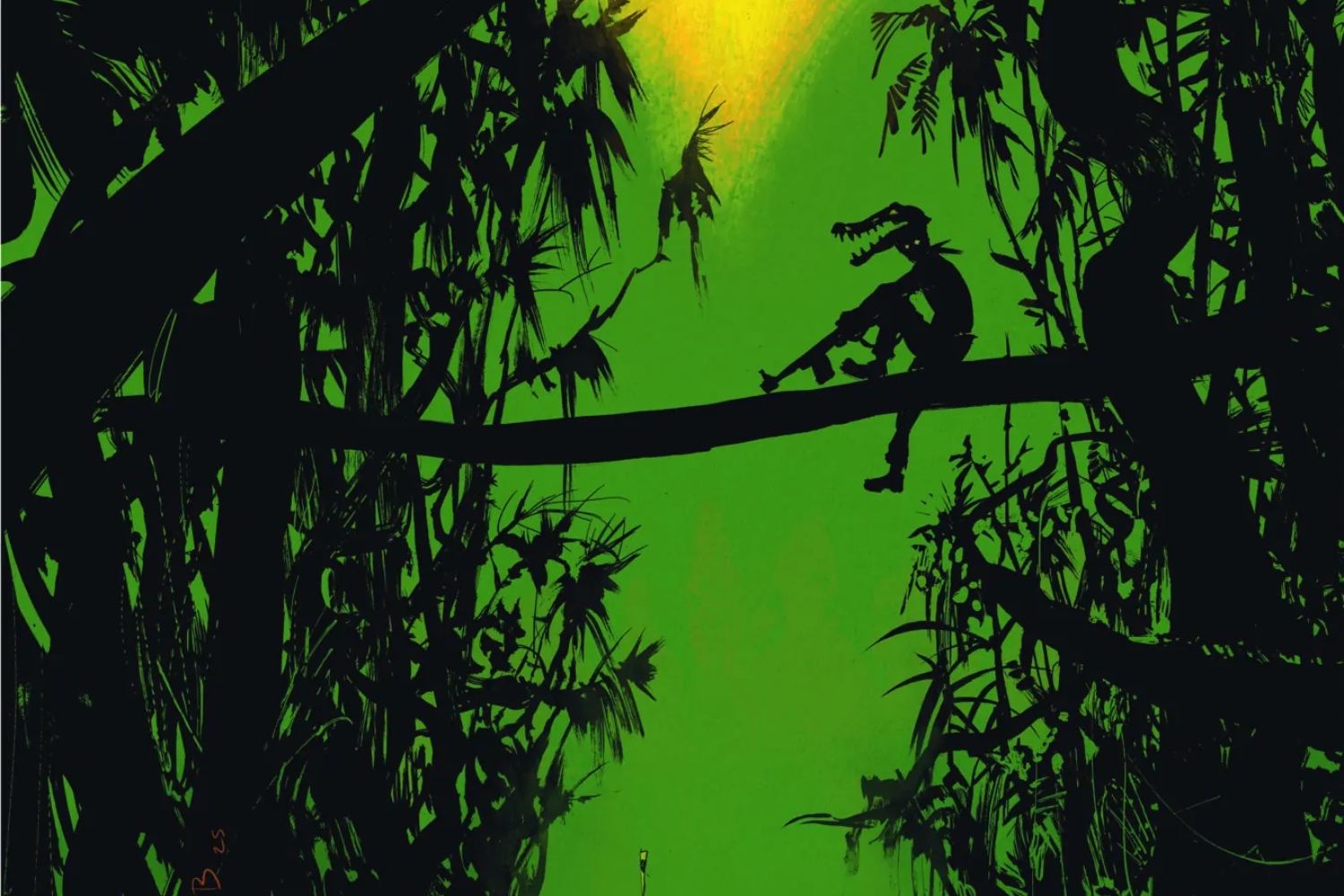
Because The Voice Said Kill #2 ended with a transportation-centric twist as the drug runners that nabbed Marie were going to take off in a damn submarine. And, sure, it’s a gimmicky choice from the creators (Si Spurrier and Vanessa R. Del Rey), but it fits with the whole vibe of this “Cajun crime thriller.” Which is to say, left-of-center, hugely refreshing, singular in its scope and nature, and a little bit weird and joyous.
But this ride ain’t over yet, and The Voice Said Kill #3 furthers this book’s deeply interesting ways with a few big moves/ideas.

Courtesy of Image Comics.
Here’s what you should know before going in to #3: There’s no submarine ride. (Not yet at least…) Instead, there’s a change in leadership among our criminal friends, and that puts Marie into even hotter water. Beyond that, I don’t want to spoil too much, and speaking in broad strokes will hopefully maintain the “mysterious essence” of this book. Because if you give it that kind of room, The Voice Said Kill moves like a mighty crane through the Louisiana swamps.
What I can say, though, is there’s big-time character swings that really define this issue. The first is the “rise” of Cindy, who begins to lead the criminals as they opt for a new path forward in their many schemes. Emotionally, Cindy is a great counter to Marie: she’s harsh and decisive, and when she moves through the world, you feel that fear and tension that Marie has battled since this ordeal started. Physically, Del Rey (alongside colorist John Starr) perfectly mirror that sentiment, and Cindy’s lithe, snake-like vibes make her seem like the most vicious predator in the swamp. (Even as, quite ironically, she’s in need of Marie to maneuver this space — it’s another solid exploration of how women as mothers are innately connected to the natural world.)

Courtesy of Image Comics.
Speaking of such thematic gold, there’s a small but mighty moment with another predator that speaks even louder to this core theme. It’s a moment that directly connects with that idea of women as their own profound ecosystems of life, and the things they’ll do (both impressive but also maybe a little tragic in this instance) to keep their babies alive and push life ever forward. It’s not just this instance of profound reverence — a moment to let the art team really bring us into this gorgeous, chaotic world with maximum depth and force — but a sturdy push forward for Marie. It’s a burst of inspiration that reminds her what she must do to truly protect herself and her unborn baby.
It feels like a turning point for our lead, and the plan Marie launches is not only semi-brazen, but it brings in another strong female lead back into the mix. And through that process, The Voice Said Kill further elevates women not just as these facilitators of our very existence, but these multifaceted beings who grapple with fear and doubt as much as they maintain power and purpose. In that way, they’re connected to the natural world even further still, with everything aligning to speak about our species’ shared role in the world, the mysteries waiting to be discovered in the wilderness, and even that you can be strong while still very much remaining vulnerable. It’s all in line with this book’s effort to dissect and ground parenthood as this multifaceted experience.

Courtesy of Image Comics.
It’s a point furthered by other vital moments throughout this issue. Namely, as much as The Voice Said Kill #3 empowers Marie, it also calls her strength and adaptability into question. Again, without revealing too much, we learn that Marie’s maybe not as with it as she’s thought, and the book pokes a few strategic holes in her capabilities to manage these criminals and make it out alive. Visually, it offers some moments of raw tenderness and uncertainty, with Marie stripped of her usual stoicism to truly feel the weight of what might be happening to her very faculties.
But this never makes her look weak for a second, and visually and emotionally, we can appreciate the toll she’s had to pay and how she struggles to fight on. In that way, there’s a surge of added sympathy that takes hold — Marie is more real than ever, and we see her not as some unstoppable hero in just another crime story but someone with weakness and layers that only endear her further and make us experience the many layers of life. It’s a valuable component of our sustained immersion, and more ways the creators are engaging us head on.

Courtesy of Image Comics.
Mostly, though, it’s a chance for the underlying magic of this book to really come to the surface. I’ve been feeling that very weight this entire time — a real sense that the world may crack open and reveal something far beyond our understanding. Don’t expect, say, a magic swamp troll or something, but perhaps an understated admission by the creators that there is something else here. Something that may be the swamp itself, pregnancy brain, or maybe a voice from elsewhere. Either way, it’s quite there, and it’s trying to help Marie. (Or is it Marie helping herself…)
Even visually it plays out like a bad drug trip — or the worst case of food poisoning ever — and the intense psychedelic colors, disrupted landscapes, and twisted human faces play with our sensibilities in a deliberate manner. (The art team manages to make this “surrealist hell” still align with the feeling and tones of nature, and that’s just another layer to use the true magic of this environment.) In that way, The Voice Said Kill makes good on its “promises,” but in its own way and according to its own schedule, which is just more proof that this book is marching to its own pace and bringing us right along.

Courtesy of Image Comics.
There’s even more vital developments in this issue, including who may or may not be the father of Marie’s baby. (Once again, though, the book isn’t going to make that guessing game easy at all.) But as this book has also proven, not being easy — or predictable, boring, or even actually a crime story in practice — is just vital fuel for a genuinely enriching journey.
The Voice Said Kill has done so much in just three issues; it’s explored the human-nature connection, delved into the nuance of motherhood, and made us appreciate the magic of even the “ordinary.” I have no idea what The Voice Said Kill #4 has in store for us, but I’m certain it’ll move us better than any submarine. (And certainly United Airlines for that matter.)




You must be logged in to post a comment.