

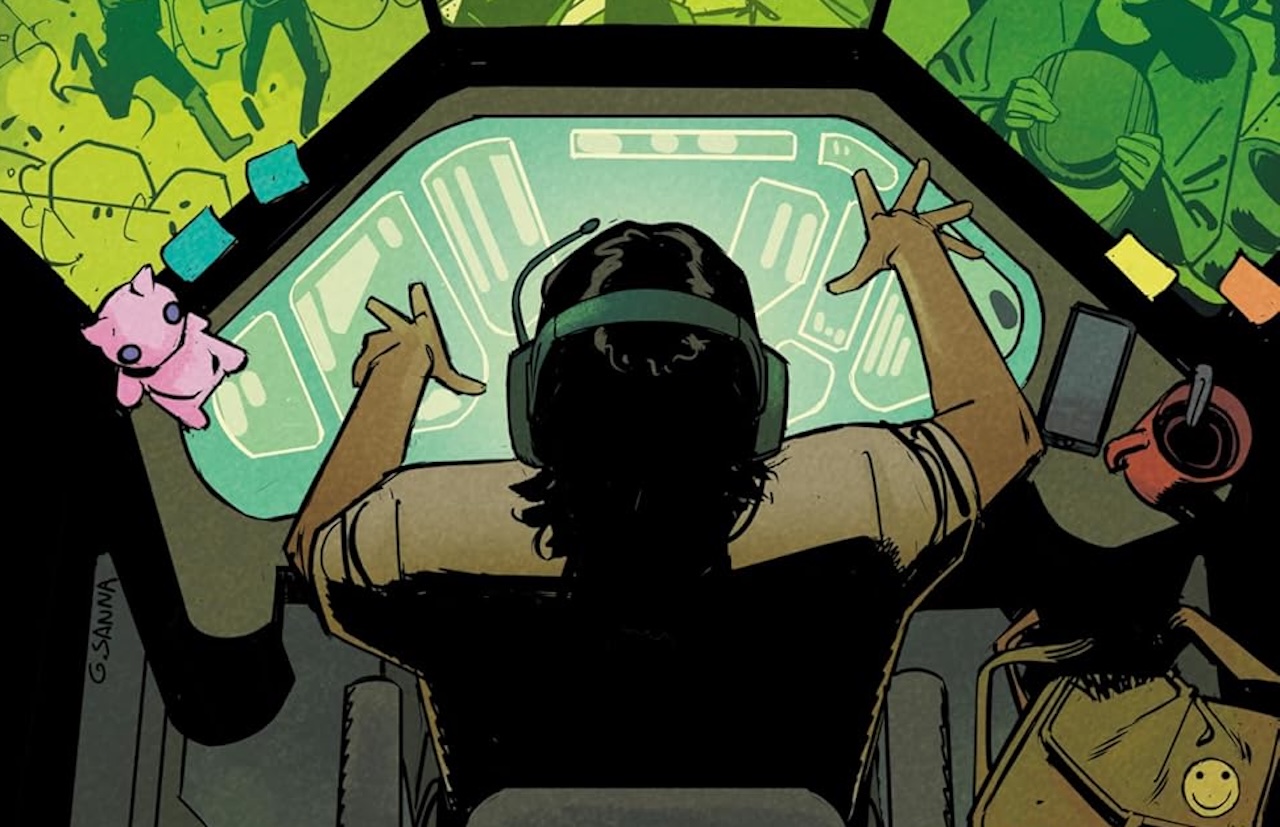

Dark Horse Comics once again presents a book of international intrigue and spy craft, this time focusing on a Tactical Analyst and the Field Agent he supports (and secretly loves).
The Guy in the Chair #1, written by Hannah Rose May and Utkarsh Ambudkar with art by Guillermo Sanna and colors by Dearbhla Kelly, has a couple of positive aspects to it but ultimately reads like a generic “you can’t trust anyone” narrative that’s been done in countless books, films and TV series in the past (most notably Alias and La Femme Nikita).
One of the main issues I found with the book was the dialogue. It felt like a bad mimicry of Quentin Tarantino’s discourse. But where Tarantino’s dialogue is jazzy and organic to the characters, spiced a bit with pop culture references, the dialogue here is loaded with lots of name drops and “witty” asides that just didn’t feel natural.
Abhi, the lovestruck Tactical Analyst, is equally generic. We get to see his life both on and off the job, living a mostly hermit-like existence when not at work and constantly having the women in his family relentlessly matchmaking for him. He’s a nerd through and through, which apparently makes him awkward and undatable. It’s an overplayed scenario that seems like something out of a book from the ’80s or ’90s and not in the more nerd-friendly environment we live in these days. I mean, have the writers ever seen The Big Bang Theory? It would have been a more interesting twist to make Abhi a womanizer, a man with confidence and charm who has no trouble finding a date, yet longs for Field Agent Merlin, the one woman he truly loves but who doesn’t care about him.
Field Agent Merlin is another generic-type character, a female agent who’s one of the best in the field and has an endless stream of good-natured jibes and ribbing for Abhi. On the plus side, I like that the book is told from Abhi’s perspective rather than Field Agent Merlin’s viewpoint. Normally, Merlin would be the star of the series and Abhi just the “wacky and lovable” supporting character. It’s nice to see the story from his point of view. That doesn’t mean the book’s all about Abhi sitting behind a computer screen sipping coffee, however. Nope, we still get to see Merlin in action in the field and it offers brief moments that are exhilarating and fun.
Also, I liked seeing the interplay between Abhi and the other Technical Analysts, who compete against each other while also supporting each other. It’s a fascinating dynamic, watching this clique of operatives, who spend most of their time invisible and unnoticed, having lunch together, talking about their days and occasionally bickering as they prepare for their next missions. Hopefully, as the intrigue grows throughout the next few issues, Abhi and Merlin will develop into more unique three-dimensional characters, taking the series to the next level.




