


It wasn’t the action, it was the audacity.
Because in a story all about building to a big blow-off with Spawn, Bloodletter #4 went really big by having the coup de grace come decidedly early. But that chutzpah played off, and it was yet another way Bloodletter was building an interesting new corner of this universe with dynamic characters, genuine excitement and tension, and some proper stakes.
But here we are at Bloodletter #5, the true finale of this run, with nary a big goal or objective to achieve. (Right?) So, how did the creative time (writers Tim Seeley and Joseph Illidge, artist Christian Rosado, and colorist DC Alonso) run out the clock in a fun and meaningful manner, and what’s it spell for the future of Bloodletter as a whole?
Well, it was awkward but admirable.

Variant cover by Mirko Colak. Courtesy of Image Comics.
Because, in a lot of ways, this issue felt like it could have come at the very beginning (at least in certain parts). In the intro, where Bloodletter deals with some Wall Street jerk with a penchant for “helljumping,” that could have just as easily been a cold open for the series. (It was also a chance to show how Rosado and Alonso approach Hell, and the sheer layers and ornate detail atop the endless terror further proves that this team just get all things Spawn in a really organic and intrinsic manner.)
And, yes, there’s nothing especially wrong with this approach. For one, we’re still very much getting to know Bloodletter and this segment of the Spawn-verse, and building it out — like having her play magic-spy at the Watergate Hotel with these wonderful toys and magical abilities — is a way to show the greater layers and versatility of our hero. In turn, the “bolstering” lends credibility for more Bloodletter down the road, and this character 100% deserves a long-term future to grow out her narrative. (Like what’s the deal with her father that’s “introduced” here…)

Courtesy of Image Comics.
At the same time, it feels rather odd for things to feel so decidedly out of sorts at this point — it’s like a familiar song broken up and replayed in a different, slightly weird order. I can at least give that approach an affirming nod of understanding and appreciation — it demonstrates bravery and intent from a creative standpoint — but it just didn’t feel like it worked as well as it might have otherwise.
We spent the first four issues building up, and even if we’re denied some of that great release from a more definitive Spawn-Bloodletter battle, this issue didn’t do enough to engage with that beyond a surface-level, “Well, Al Simmons is still alive. Now what?” I mean, the whole dang book was about Spawn get snubbed out and Bloodletter getting her just desserts. If the team were going to fake left this whole time, or push that out further, I would’ve preferred they just told a different story in the first place. Bloodletter #5 clearly showed the character’s range and potential, but coming when it did, it just felt a touch underwhelming, a smidgen confusing, and generally just good enough when this book is so much more than that.
It’s also worth pointing out that there were some design choices, like a very green motorcycle alongside a general sheen of action movie heavy-handedness, that left me feeling irked in a couple parts. Maybe it’s more on brand for other parts of Spawn, but I guess a turn toward such overtness was the cheap icing on a cake that was only just yummy enough.

Courtesy of Image Comics.
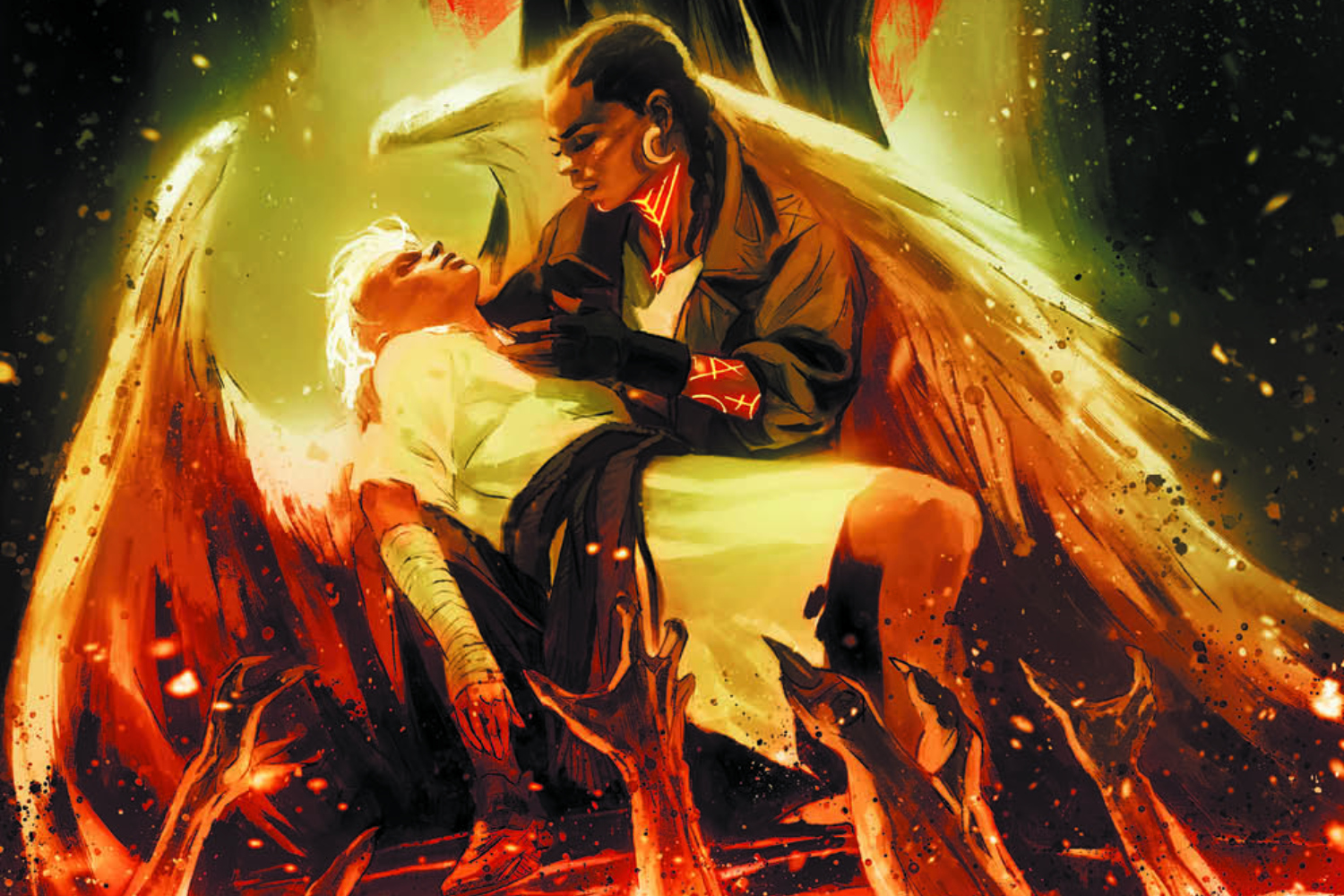
Still, there was at least one area where Bloodletter #5 did fully excel, and that was in further exploring the relationship with Casper. If you remember around issue #3, Bloodletter basically betrayed her angel friend in order to work toward her Spawn-killing goal. Without spoiling too much, a lot of this issue is then getting Casper back into the fold, and exploring what their friendship/partnership might look like going forward. And friends, it ain’t gravy at all!
It’s at least emotionally resolute, and Casper could have easily just run back to Bloodletter like some celestial puppy. But the fact that they don’t acquiesce isn’t just interesting from a story perspective, but gives Casper some teeth moving forward and lets that character be real and not just a prop. (Even visually, a broken, disheveled Casper feels like such a proper force in a book that regularly features Hell.) In that way, this “turn” feels like the real point of the book — it’s such an interesting and exciting dynamic (ripe with emotional and narrative might), and I almost wonder if this was the team’s end goal all along. I still have my doubts — maybe that sense is serendipity or simply my own heavy lifting — but it’s this brief but effective interaction that saved so much of what could have been simply an OK enough issue.

Courtesy of Image Comics.
It doesn’t take away any of the faults of this issue, but this “reunion” does give us a real focus moving forward and not just the hope and promise for a new miniseries/full series. It forces Bloodletter to have to move in a new way, which may explain the order of operations for this issue. But mostly, it means Bloodletter has an arc of redemption on her hands, and is caught between different sides/ideologies. And that positioning is really going to make the character feel dedicated, energized, and with lots of work to do in further securing her place in this great universe. Luckily, she’s got more than enough tools, tricks, and general tonal magic to make that a compelling journey — she’s basically like a magic espionage Ronin, and I’m here for it.
Still, if this somehow The End for Bloodletter, I’m also cool with that decision. Because even with a less-than-perfect finale, this story gave us bloody action, endless dark magic, great character work, even more layers for Spawn himself, some huge stakes, added story potential for the entire line, and even a little heart and humor. It was exactly how all creators should approach both a miniseries and introducing new characters — with passion, dedication, and creativity to make it feel like the universe is growing (and not just rolling over to open up its bank account for feeding time). Not being perfect at the end isn’t necessarily the worst thing; it just proves how inventive this book was as it really stretched its legs to do something truly worthwhile.
In short, Bloodletter was absolutely awesome.




You must be logged in to post a comment.