


Not to get all Millennial Yakov Smirnoff on ya, but the best video games play you right back.
As you’re maneuvering and exploring their worlds, they’re testing you mentally and emotionally (with enemies, puzzles, traps, mind games, etc.) The end result is this undeniably personal and affective experience, a feedback loop between the real and the digital that doesn’t just entertain, but gets us thinking about what really makes us human and how those notions continue to evolve.
It’s an experience that’s expertly facilitated/recreated by Cemetery Kids Run Rabid.
Starting with the first series, Cemetery Kids has maintained this back-and-forth: Four friends entered a game world, and must deal with the increasingly blurred line between reality and a virtual nightmare. But beginning with Cemetery Kids Run Rabid #2, it feels as if creators Zac Thompson and Daniel Irizarri are doing as all great “programmers” do, and peeling back some of the book’s “gimmickry” to tell something even more direct and lethal about living (and not merely growing up) online. As such, issue #3 doesn’t just further reconfigure their approach — it re-balances gameplay in a way that’s decidedly more effective.
It’s not only increasingly difficult for our heroes to discern the game versus rel life, but there’s even more of that wondrous struggle/confusion targeting us readers. Perhaps the most obvious form of that is the continually-developing design of the game world. More and more, it feels like Irizarri is developing levels that combine memory, gaming tropes, and real-world locales to mess with everyone involved.
In issue #3, the “haunted freeway” is even more effective than issue #2’s “spooky old neighborhood” in that it merges bits of memory from Birdie (her accident on the King’s Highway) and Maddie (her life on the prairie). The end result is a setting that’s not only deeply effective (and featuring wonderfully kitschy, car-themed ghouls), but a clear sense of everyone not knowing which memories belong to whom, what’s actually real versus memory, and how much the game is just torturing the lot of us.
It’s an approach that not only gives us the perpetual, unavoidable creeps, but it disarms us for these deeply shocking moments that get at fundamental questions of life right now. (Like, how does memory actually exist if we live fully online, and is reality what we see or what we think it to be?) Mostly, though, it just feels like the art existing on a plane that’s wholly elemental, showing us something we may have seen before but warping and twisting it until we can’t decide what’s up from down, what’s real versus fake — and why do we have to sort it all out in the first place?

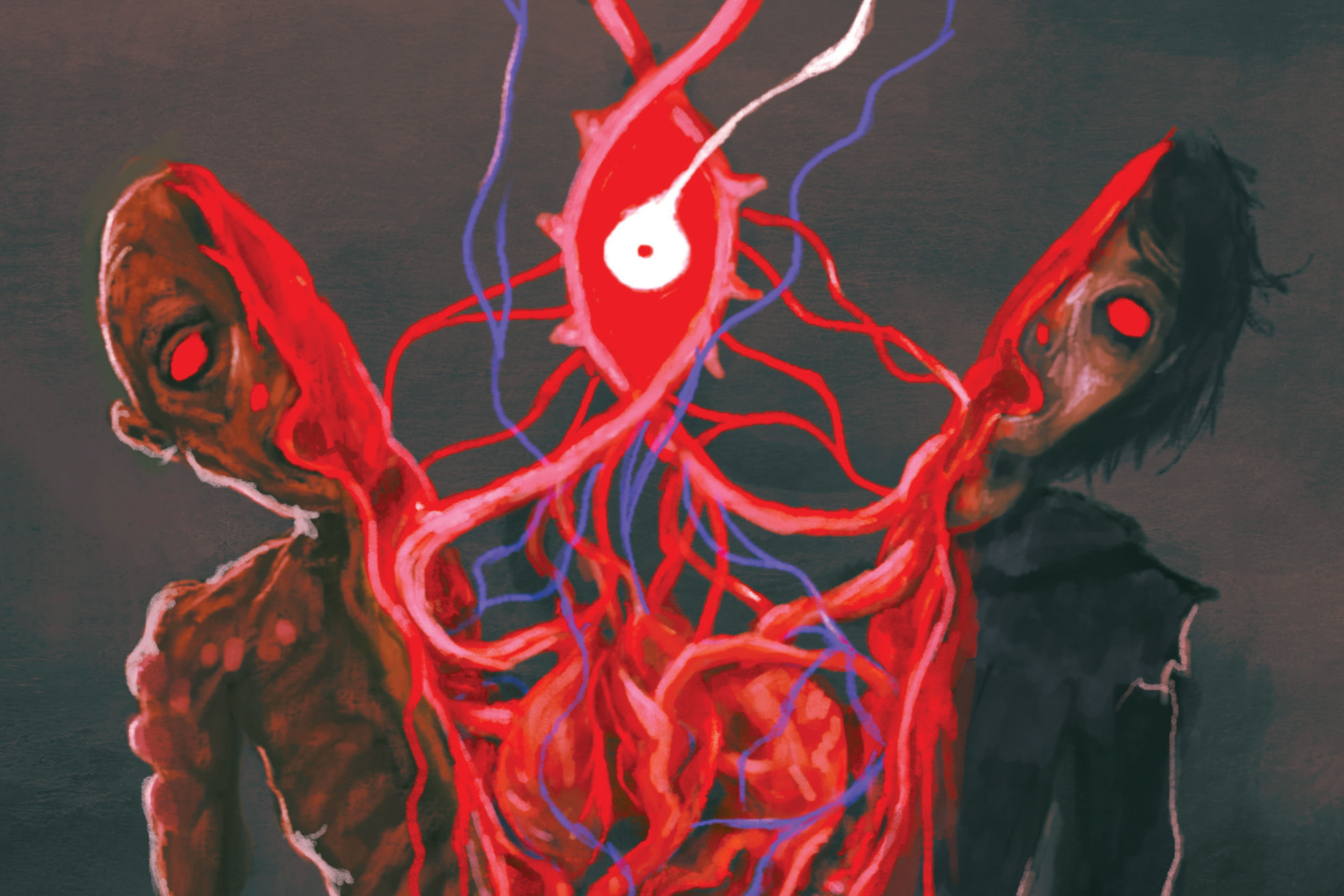
Main cover by Daniel Irizarri. Courtesy of Oni Press.
This issue feels very much like the moment when this book’s two worlds have fully, unavoidably coalesced. Past issues have maintained some distinction, but as they move through this horrific highway realm, the teens are faced with the possibility that nothing is real or fake and yet all of it is consuming and shaping us regardless. Yet it’s more than just the art, and this energy moves deeper into the cast to extend this “perpetual blurring” in a way that brings us ever deeper into this singular world.
Perhaps my favorite such aspect is Wilson’s “performance.” As the POV character for Cemetery Kids Run Rabid, he’s gotten a chance to really show himself off, and Wilson is this charming, deeply sensitive lad whose own struggles are very much central to this entire run. (Remember, he can no longer play the game, and is forced to basically “run comms”/do research.) In #3, though, his struggle has broken open, and he speaks almost entirely in gaming ideas/lingo, drawing out not only his increasing inability to track it all, but his acceptance of this “new” existence and the nightmare it presents. As an extension of this, the Wilson “segments” feel visually robust and vivid, and that feels important in connecting us to his journey in this coalescence.
Not that Wilson’s storyline is somehow a condemnation of “living online” (not anymore than the rest of the book), but this is a reality faced by young people everyday, and Thompson and Irizarri have the heart and courage to speak honestly to these kids without pandering or preaching. In that way, Cemetery Kids continues to feel like a great social and existential experiment that maintains its fictional confines — there’s just enough sweet monsters slayings alongside, say, the teens having to kill fake avatars of their childhood selves to lend important texture and nuance. And that’s hugely important if we’re going to not just relate to the Cemetery Kids, but feel their pain and experience their hope with the same potent head rush.
Wilson, though, is just the start. Other characters experience a similar “breakdown” of their understandings and sensibilities across #3. There is, of course, Pik, who this whole time been possessed (effectively) by the digital demon Yggs. The fact that he/they are working with the Kids as of issue #3 is then interesting for a couple reasons.
One, it feels like another solid commentary on young people’s relationships with media/the digital space, and how that’s unhealthy but also oddly quaint given the way socialization works. (That’s another aspect of the creators never critiquing but asking pointed questions.) Secondly, there’s an event toward the issue’s end with some huge real-world ramifications. I won’t spoil it, but it does make you ask some important, deeply uncomfortable questions about digital violence and depersonalization, and what happens when these experiences get very really.
It also shows some larger stakes to the Kids’ experiences, and it reminds us that none of this is theoretical but speaking to the way of the world right now and how we’ll live from here on out. (Again, the starkness of this reveal once again shows how much the art is able to grab hold of us and concuss our sensibilities into feeling things deeply while also scrambling for truth/perspective.)

Variant cover by Trevor Henderson. Courtesy of Oni Press.
Then, last but certainly not least, there’s a moment between Birdie and Maddie that’s another favorite across this rather jam-packed issue. For one, it offers solid background on Maddie; if you were ever unsure of her (as I have been), it does foster a sense of sympathy for her while further blurring the real and digital in some heart-smashing ways. It also complicates our relationship with Birdie: As someone who is playing the game to save her bro, she does come off a little harsh and callous, and in direct confrontation with Maddie in a major way.
Plus, there’s something almost extra playful from a visual aspect, as if the game filter has been sharpened somehow. And that only heightens the real tension here: It’s easy to forget this isn’t just some dramatic game between pals. That, and it’s a breeze to get lost in your own pain in a rather siloed experience, but this issue reminds our teens the problems of this game are so much deeper still, and while their pain is important, kids everywhere are losing themselves (to one degree or another).
That not only makes the stakes of this story world seem infinitely larger (and thus more compelling), but it’s a valuable lesson for the Cemetery Kids. The world itself is changing in front of them, and while hope is a rare commodity, they must take solace in the fact that they’re not being singled out. Instead, it’s time to act and push back, and to figure out what’s real and what matters before it’s too late. And with the issue’s finale setting up a barn-burner of a conclusion, these teens may not have much time to act.
Now, traditional video game logic tells us that they might band together, kick a little demon butt, and walk off into the sunset. But there’s no extra lives or mega power-ups in the lives of the Cemetery Kids, and there’s a darn good chance they’ll fail and learn these lessons in the worst, most bloody way possible. But maybe that’s a good thing — not just because they should suffer, but because the creators have committed to a story with real teeth that wants us to feel these events and ideas with the absolute carnage intended.
Still, the fact that we don’t know how this game will go (and what’s actually a game and what’s not?) just proves that Cemetery Kids Run Rabid is doing its job. We should all be locked in until the very last quarter.




You must be logged in to post a comment.