

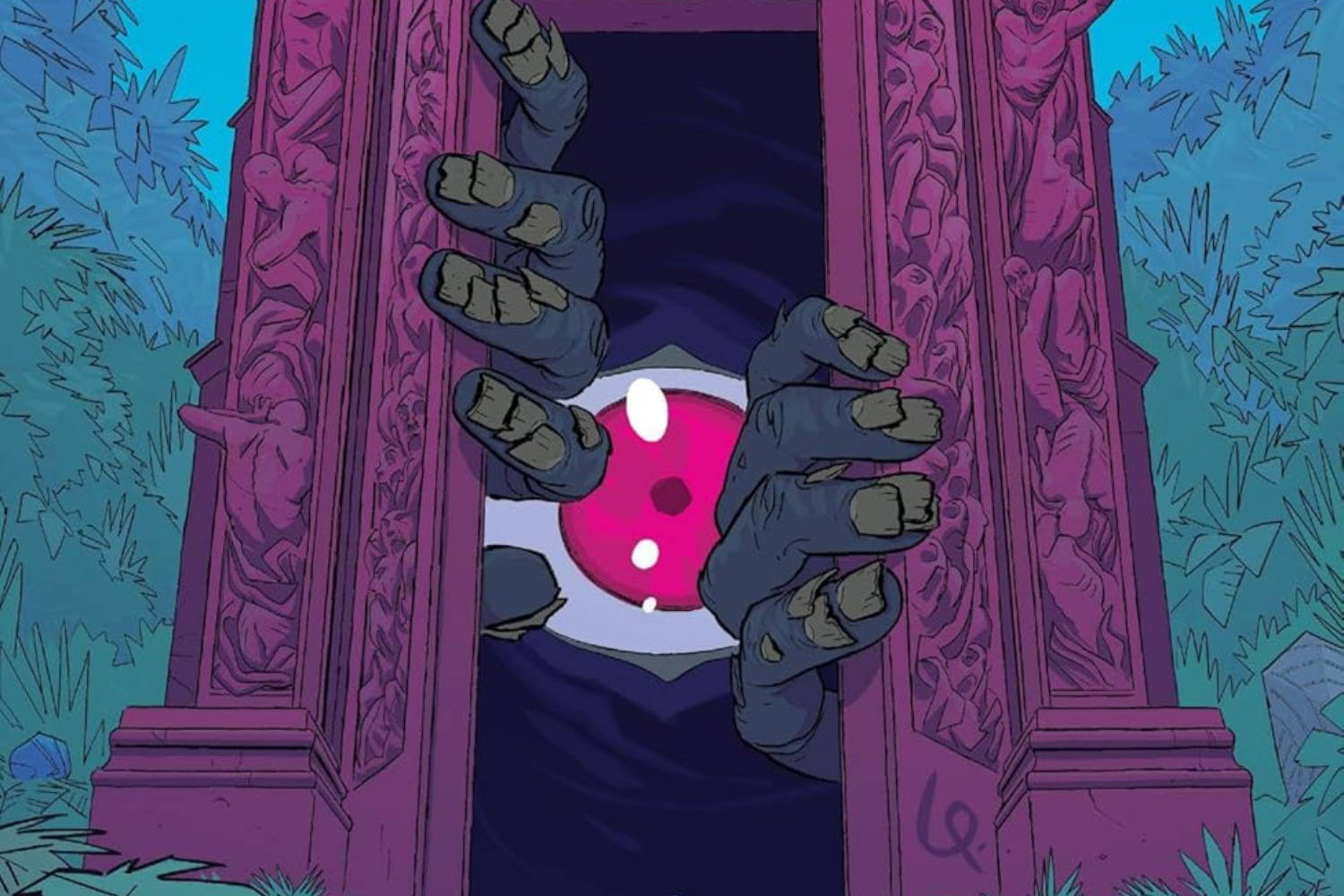

If it wasn’t clear by now, I adore Nights like a dear friend.
And like any such friendship, sometimes that means spending a little time apart. When Nights and I last connected back in April, creators Wyatt Kennedy and Luigi Formisano were in the midst of telling a prequel involving the early days of Agent Tsukumari and our favorite vampire in the world, Gray. Sure, Nights #15 wasn’t exactly my fave issue ever, but I could mostly see the layers it was trying to build as it extended out the larger life and power of this singular universe.
Even still, six months is a long time away, and leaving on a solid but inspired not sure must’ve mitigated even the last shred of momentum and thrown this entire series into disarray, right?
You clearly don’t know my pal Nights.

Courtesy of Image Comics.
Certainly the fact that this arc is a prequel does help quite a bit with the “time delay.” That’s not to say that this is just a mere dalliance or something (more on that later…), but rather this arc was clearly meant to be something new-ish or different-adjacent to give people a breather before Vince and the gang inevitably return. And so the story so far has been doled out in a way to make this feel like a destination of sorts, and to some extent you’re not really missing out on too much. (Except, of course, for a genuinely poignant story.)
But if you are confused, here’s what you need to know. At some point in the past, Tsukumari captured Gray and her then-BF, Erik, who is effectively a “lizard wizard.” (That’s not a wizard who is a lizard but a wizard who uses lizards as a kind of conduit.) After washing up on the magical, moving island of Thule, the trio spend the bulk of Nights #16 immersing themselves in this tight-knit community. Gray works as a night guard (who’s clearly working through some personal issues); Tsukumari tends to a magical garden (and makes some important personal connections); and Erik furthers his education as a witch (in a move that may spell gloom and doom for the world — TBD).

Courtesy of Image Comics.
It’s basically like the most charming, fantasy-laden version of Animal Crossing I’ve ever seen. As such, Formisano (alongside colorists Francesco Segala and Gloria Martinelli) really slow things down from the endless pop culture references, oversized action/combat, and generally reality-smashing inventiveness that ordinarily defines Nights.
It’s genuinely alluring to watch, for instance, Tsukumari pick a bunch of plants and talk about his own life/romance with Chimera’s then-current director. (Talk about a budding young man, amirite?!) Or, for Erik to find both human connection and the fantastical energies powering this world — it’s a profound bit of character development made visually delightful. And even if Gray is just emoting a lot near the beach, seeing this version of her (different but also not) does a lot for our continued understanding of this ever-dynamic figure.
It’s a really “steady as she goes” issue, and I frankly enjoyed a little island time with the gang. As mentioned, Nights tends to operate at the speed of “Gen Z rollerblader huffs mid-grade stimulants,” which is mostly charming and why this book feels like it expertly gets at what it’s like to grow up. Something a little more even-keeled isn’t just visually engaging (really, it feels like they’re playing with the idea of this prequel as a “vacation” with true heart and intellectual heft), but it means something for the continued world-building of Nights.

Courtesy of Image Comics.
This whole dang universe is so much wider and robust than we’d ever imagined, and as we peel back the layers inch by inch on this island, we’re thrilled to see how deep the hole goes without feeling overwhelmed. It is, in many ways, a new friend opening up even further, and through that increasing understanding, Nights becomes all the more real.
But don’t you forget for one second that this book can still cut you fast and deep as well as remain your good, good buddy. Because Nights #16 delivers some important revelations and furthers key moments of tension and relationships with brutal efficiency. As I’d mentioned, Erik continues to become increasingly vivid — he’s no longer just Gray’s old BF, but this character who loves this creature dearly and is also learning things about himself that could push him in either direction. And that, my friends, is a recipe for a wonderfully combustible character.
Similarly, Tsukumari has become a little softer in our eyes, but by the end of that issue, that openness/vulnerability just might land him in a terrible situation. And through that, we’re learning about the struggle that defines him and the road he took to become the masked badass in arc No. 1; he’s so much more alive and textured, with sympathy and painful, complicated associations already taking root.

Courtesy of Image Comics.
And Gray doesn’t leave this issue unchanged, either. I had this sense going into this arc that we’d get to know her, but that maybe it would be a nice bonus regarding just how robust and hyper-developed she is through Nights #12. And, sure, we know lots about her, but in this issue, there’s something different here: Gray is scared. Of what I can’t say just yet, but whoever we think she is — this eternal wild-child headed toward a giant reckoning in the present day — she’s so much more surprising still.
And that’s the key to this whole issue: Surprising readers. Because if you’ve been reading along so far, Nights may feel like a childhood pal who you generally have a solid grasp on (more or less). And while there’s nothing super-duper jaw-dropping in this issue — the finale is yet another instance of this series expertly dropkicking us with a mystery/cliffhanger — it’s not about superficial plot points to razzle and dazzle us readers. No, it’s reminding us that, where some books might “take it easy” with these prequel-before-the-sequel stories, Nights is much different.
This is the first issue of this arc where I really feel like it’s more than a little fun in the good ol’ days. (Even as remains that “construct” like never before.) Or, that characters are going to do Cool Stuff but ultimately end up where they need to be for the present day. Instead, I mostly don’t know what’s going to happen next, and that’s exciting in the grand scheme of these stories.

Courtesy of Image Comics.
Because what could have just been a vacay is not only even more character development and world-building, but even more of that organic, unruly variety that Nights has relied on since issue #1. That it continues to not only achieve its most basic goals, but does so with a freshness and intensity, is only further proof of why this book works. Maybe you can see these characters’ trajectories a little better, but I’d bet my remaining 2025 vacation days that no other book makes you feel as excited and uncertain.
And the team does so by operating as they always have: Telling these characters’ stories with grace, courage, and pure emotion, putting them through their paces not only to tell a good story but because the best characters must flourish and fumble for it to mean a damn. And across this issue, we are brought forward and pushed back (and so forth and so forth) in a way that we have these real connections with our leads that feels comfortable but confrontational, engaging but a little upsetting. In short, they’re raw and real and we must find ways to move through their world and come to terms with it all without the promise that it’ll ever be any easier.

Courtesy of Image Comics.
And maybe I’m alone, but that’s the kind of friendship I want more of: loving, unruly, a little dramatic, and with “folks” who don’t demand our affection but earn it with their truth and unwavering humanity. Nights #16 did all that even after half a year away, and it was only capable of such a break because it’s very much our friend. It knows that it can’t be the only story you read, and that sometimes breaks are inevitable. But when we do eventually come back together, it’ll mean something because this book never once meanders or phones it in.
Ain’t nobody got the time for such wastefulness, and so Nights instead gets us up to speed, uses its many creative tools (and sense of timing and pacing to boot) to push the story forward, and rewards us with something important and exciting to remind us why no break could ever be too long. There’s lots more mysteries left to solve, character arcs to flesh out, and worldly elements to develop before this arc ends. And even if I don’t know how that might play out, I just know my good amigo won’t let me down.




You must be logged in to post a comment.